 Language
 简体中文
简体中文
- On the 2018 National Day holiday, Lifet completed six 100 ton large tonnage lifting belts as a gift
- The role of suspension net in the transportation of goods turnover
- Cargo soft lifting net, lifting net, lifting net, lifting net, bag, climbing net
- Precautions for using Lifutiden elevator
- How to make circular lifting straps
Contact: Wang Lili
E-mail:18066002268
Phone:702461526@qq.com
Address: Lifute Industrial Park, Taizhou City, Jiangsu Province
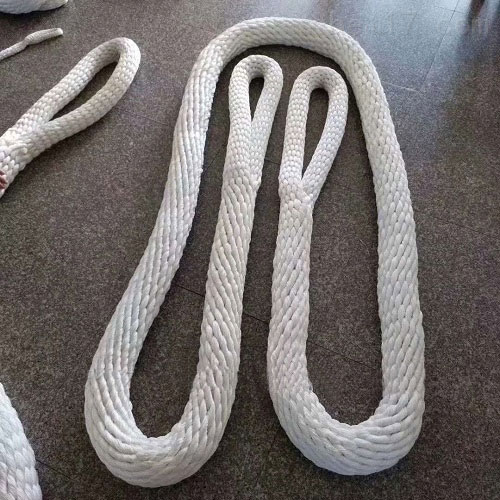
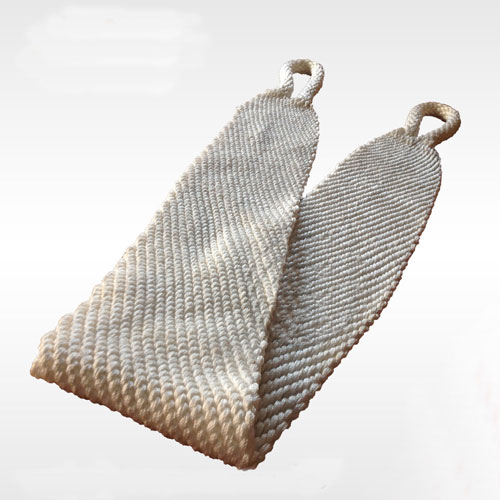
Lifute Hoisting Co., Ltd. 18066002268 produces lifting belts, lifting nets, nylon ropes, soft ladders, steel wire rope rigging, paper ropes, safety belts, safety nets, lifting chains, steel coil hoists, crossbeam hoists, flat lifting belts, circular lifting belts, electric traction ropes, high-altitude safety belts, and anti fall safety nets Large tonnage hoisting ropes, large tonnage lifting ropes, large tonnage hoisting ropes. Read the words one at a time and the name gives a size and an article form, nothing else. Large tonnage is a size; hoisting rope is a kind of thing, cordage rather than a woven band; and the two things that actually decide whether the article can do the job are absent from the name: how the rope is constructed, and how each eye is formed.
Hits: ℃
Release time:2026-09-28 13:34
Lift Sling Rigging Co., Ltd manufactures Large tonnage lifting rope, large tonnage hoisting rope, large tonnage hoisting rope. Large Tonnage Hoisting Ropes and Large Tonnage Lifting Ropes — The Thr ee Words, and the Two Things They Leave Out
Large Tonnage Hoisting Ropes, Large Tonnage Lifting Ropes — The Three Words, and the Two Things They Leave Out
The short answer. Read the words one at a time and the name tells you a size, an article form, and nothing else. Large tonnage is a size. Hoisting rope is what kind of thing it is — a length of cordage, not a woven band. And the two things that actually decide whether the article can do the job are absent from the name entirely: how the rope is constructed, an d how each eye is formed.
That matters more at large tonnage than anywhere else in this catalogue, because a rope sling is not a webbing sling made longer and thicker. Capacity on a woven article comes from plies and band w idth, both of which are chosen from a table. Capacity on a rope comes from the number and arrangement of strands and from the splice that closes each end, and neither of those is visible in the words large tonnage hoisting ropes. Two ropes of the same diameter and the same fibre can differ in construction, and two ropes of the same construction can differ in the s plice that was specified.
So this page does not start with tonnage, and it does not repeat what the site's other large-article pages already argue. It does four things. It separates the words in the name and says which part of them is a specification. It identifies the standard this article actually falls under, which is specific to lifting slings made from fibre ropes and which this site names nowhere else. It sets out the construction families that exist at large tonnage and what the choice between them means. And it takes the rope's own two structural decisions — the splice and the end form — as its main subject, because those are where the article is made or wasted.
Where a subject belongs to a neighbouring page it is linked rather than restated: the arithmetic of factors and proof testing, the storage and issue of a very large article, curvature and fabricati on efficiency, and what a colour cannot tell you at size are all argued properly elsewhere on this site, and the closing section says where.

The page's own photograph, and a good place to start because it already shows one of the two things the name leaves out. The rop e is braided — the outer structure is a continuous woven sheath, not a set of strands twisted around each other — and that single fact belongs in the specification and not in the appe arance. Through the sheath run red tracer yarns, woven in rather than printed on. Around the coils are yellow bands. Now the honest part: nothing in this picture show s the tonnage, the strand count, the splice at either end, or any test. A photograph can establish that an article is braided and that it carries tracers. It cannot establish that it is the constructi on you ordered, and it certainly cannot establish that its eyes were closed the way they should be.
1. The Three Words, and the One Thing They Leave Out
Take the name apart and only one of its three components constrains the article. Everything that decides whether it works sits outside the name.
| Part of the name | What it fixes | What it does not fix |
|---|---|---|
| Large tonnage | A size band, and by implication the scale of the whole arrangement: the diameter, the hardware at each end, the mass, and who is able to handle it. | Nothing about construction, and nothing about the eyes. Two 100 tonne articles can be built two different ways and be two diff erent purchases. |
| Hoisting, or lifting | That the article is intended to take a load in tension and to be part of a lifting arrangement. In this trade the two words ar e used for the same thing, and the choice between them is habit rather than engineering. | Nothing at all beyond intent. Neither word distinguishes a rope sling from a strop, a grommet, or a length of rope sold by the metre. |
| Rope | The article form: cordage, load-bearing along its length, with the ends closed by forming or joining rather than by weaving a flat band and sewing it. | The construction, the strand count, the lay, the splice type, the end form, and the finish. This is the word that narrows the article most, and it still leaves the whole specification open. |
| Absent from the name | Nothing, because it is not there. The construction of the rope and the splice at each end are both requirements, and both are missing. | These are the two decisions that Sections 3 and 4 are about, and they are the two a buyer most often leaves to the supplier wi thout saying so. |
One practical note about the phrase itself, since it turns up in enquiries in a form that costs a round trip to resolve. The three phrases used to name this article are commonly written with ho isting in two of them and lifting in the third, and they mean the same article. Large tonnage hoisting ropes and large tonnage lifting ropes are not two products. If a d ocument lists them as separate line items, they are one line item typed twice, and the useful thing to do with the repetition is to spend it on the construction and the splice instead.
2. This Article Has Its Own Standard, and the Site Has Never Named It
Here is a fact worth stating plainly, because it explains why so many enquiries arrive under-specified. Across this site's hundred product pages, the phrase EN 1492 appears several hundred times. The part number that governs a lifting sling made from fibre rope appears nowhere on it.
The standard in question is EN 1492-4, Textile slings — Safety — Part 4: Lifting slings for general service made from natural and man-made fibre ropes, published with an amendment as EN 1492-4:2004+A1:2008. It is the part of that family written for exactly the article this page is about: not flat woven webbing, not roundslings, but a sling whose load-bearing element is a rope.
Why that distinction earns a section rather than a footnote: the family of textile sling standards is divided by article form, and the division is not cosmetic. A flat woven sling and a rope sling differ in how capacity is built up, in how the ends are formed, in what the article's own mass does to the arrangement at size, and in what an inspector can reasonably see. Quoting the family name tel ls a supplier which world you are in. Quoting the part tells them which article.
So the working rule for this page's subject is short. Say the article form, then the part of the standard that covers it, then the construction. A request that says only that a rop e is wanted at large tonnage has named a size and left the standard, the construction and the splice to somebody else — and the supplier will fill all three gaps with whatever is most convenient to th em. That is not a criticism of suppliers; it is what happens when a requirement is not written down.
Where the family's other parts and the site's other articles are concerned, the arguments already made elsewhere are not repeated here. What a colour can and cannot identify once the tonnage climbs past the tabulated range is set out on the 300 ton lifting belt page. What can and cannot be proven at the very top of the range, and what a proof test does and does not establish, is on the high tonnage circular sling page. And what happens to a very large article when it is no t lifting — goods-in, storage, issue, transport, retirement — is on the large tonnage circular lifting belt page.
3. The Construction Families That Exist at Large Tonnage
The missing half of the name is construction, and at this scale it is not an academic choice. The families below are the ones that exist; they behave differently, they are spliced differently, and they are inspected differently. A rope order that does not choose among them has not been written yet.
| Family | How it is built | What it means at large tonnage |
|---|---|---|
| Three-strand laid | Three groups of yarns twisted into strands, and the strands twisted together in the opposite direction. The classic constructi on, and the easiest to inspect because the strands are on the outside where they can be seen. | Simple and inspectable, and it twists under load. At the tonnages this page is about, the tendency to rotate under tension bec omes an arrangement problem rather than a rope problem — the load turns, or the line kinks when the tension comes off. |
| Eight-strand plaited, or eight-strand laid | Eight strands arranged in pairs so that the twist of one pair is balanced by another. The construction that made large ropes m anageable, and the reason it is used for heavy mooring and heavy lifting alike. | Very much less rotation under load, which at this scale is often the property that decides the order. The trade-off is that th e load-bearing strands sit inside, so the outside is not what carries the load and an inspector is looking at a surface rather than at the strength. |
| Twelve-strand braided | Twelve strands interwoven into a single continuous structure with no separate sheath. Usually spliced back into itself, so the join is a continuation of the rope rather than a fitting on the end. | Rotation is largely balanced by the weave, the rope stays flexible at large diameter, and the splice can be made as strong as the rope itself allows. It is also the construction where a splice is least visible from outside, which puts the whole burden on the paperwork. |
| Double braid | A braided core inside a braided sheath, both load-bearing or the sheath sacrificial, depending on how the maker builds it. The sheath takes the abrasion; the core takes the load. | Abrasion is dealt with by a layer that is meant to be sacrificed, which matters where a rope is dragged over hardware. It also means the part that carries the load cannot be seen without opening the rope, and that is a fact an inspector has to be told rather than shown. |
| Cable-laid | Smaller complete ropes laid up together into one larger rope. A rope built out of ropes rather than out of strands. | The route to the very large sizes, and the construction behind the traditional heavy sling forms. It is also the construction whose vocabulary a buyer is least likely to have met, which is why the two forms it produces are described in Section 6. |
Two points about reading that table, because it is easy to read it as a quality ladder and it is not one.
There is no best construction here, only a best construction for the arrangement. A three-strand laid rope is not a lesser article than a twelve-strand braid; it is an article with a different answer to rotation and a different answer to inspection. Where an arrangement tolerates a rope that twists under load and where an inspector needs to see the strands, laid construction is th e informed choice rather than the cheap one.
And the construction changes the splice, not just the rope. Every family in that table is closed by a splice, and the splice that suits one construction does not suit another. That is Section 4, and it is the reason a rope order written without a construction cannot be answered properly even by a supplier who wants to help.
4. Where a Large Rope's Capacity Actually Sits: the Splice
A rope arrives as a length. It becomes a sling when its ends are closed, and the closing is a fabrication — a made thing, made by a person, to a method. That is the single most important structural fact about this article and the least visible one from the outside.
The general principle is easy to state and worth stating precisely: the eye of a rope sling is not the rope. Capacity at the eye depends on how the end was formed, and a rope sling is therefore only as strong as its terms of fabrication, not as strong as its rope. This is not an argument made from first principles here; the site argues the general case for fabrication efficienc y and curvature on the heavy duty lifting sling page, and this page does not repeat it. What belongs to the rope half of the subject is narrower and more specific: which splice, on which construction, and what has to be documented about it.
Which splice follows from which construction. The families in Section 3 are not closed the same way. A laid rope is normally spliced by tucking strands back into the body of the rope in an established pattern; a braided rope is normally closed by burying the end inside the braid, so the join is a continuation of the structure; and a double braid involves both the core and the shea th. Each of these is a recognised method with its own procedure, and a supplier who is asked to close an unusual construction has to either know that method or decline the job.
And what has to be documented. Because the eye is made rather than manufactured, the useful question is not whether the eye looks well made — a splice that will hold can be plain to t he eye and a splice that will not can look tidy. The useful question is whether the fabrication is written down: which splice method was used, to what document, by what competence, and what the articl e's rated capacity is stated to be on the basis of it. That is what Section 8 asks an order to carry, and it is why a rope sling without a fabrication statement is an article without a specification e ven if the rope itself has one.
A caution that belongs with the honest boundaries on this page. This page does not quote a splice efficiency figure. The percentage of a rope's breaking strength that survives the eye depends on the construction, the splice method, the competence of the person who made it and the standard the article is being made to, and a number lifted out of a general table and applied to your rope would be a claim rather than a measurement. The figure that matters is the one on the documentation of the article you are buying, and if it is not there, that is the finding.
5. The Ends: Soft Eye, Hard Eye, Thimble, Ferrule
The second half of the specification the name leaves out is the end form, and it is where the rope meets the hardware. At large tonnage this is not a detail of finish; it is the interface through w hich the whole load passes, and there are four words for four different answers.
| End form | What it is | Why it is chosen, and what it costs |
|---|---|---|
| Soft eye | The rope's own structure turned back on itself to form a loop, with no metal anywhere in the eye. The rope is the eye. | Light in the hand, no harder component to damage the load, and the eye conforms to whatever it is placed over. Costs: the eye is the part most exposed to abrasion, and the contact it makes with a small-diameter pin is a bend the rope may not enjoy. |
| Hard eye | A loop with a metal fitting set into it so that the load is borne by the fitting rather than by rope pressing on rope. | Chosen where the eye will be loaded against a pin or a hook repeatedly, and where the shape of the eye has to stay put. Costs: a harder component, more mass at the end, and a fitting that has to be inspected as a fitting rather than as rope. |
| Thimble | The lined form of a hard eye: a grooved metal liner that sits inside the loop and takes the pin, so the rope bears on a curved surface of the right radius rather than on the pin directly. | The usual answer where a rope sling meets a shackle at size, because the whole point is to control the radius the rope bends a round. Costs: it must match the pin it will sit on, so the shackle and the thimble are one decision rather than two. |
| Ferrule-secured eye | An end closed by a metal sleeve pressed onto the rope, rather than by tucking or burying the rope into itself. A mechanical te rmination instead of a splice. | Even and reproducible, and it does not depend on the hand of a splicer. Costs: it is a completely different fabrication from a splice, with its own method and its own inspection, and a ferrule end and a spliced end are not interchangeable on one article without saying so. |
Three practical consequences follow, and they are the reason this section exists rather than a footnote.
The end form is a decision, not a default. An order that names the rope and the tonnage and stops has left the ends to whoever builds it, and the ends are where the article meets the load. Two suppliers given that order can return two articles that are not alternatives to each other.
A hard eye is only as good as the radius it offers. Its purpose is to control the bend, so a thimble sized for a different pin defeats the reason it was specified. At large tonnage th e rope is stiff and the pin is big, and mismatching the two concentrates load exactly where the eye is weakest.
And the end form changes what an inspector is looking at. A soft eye is rope and is judged as rope. A hard eye is rope plus a fitting, and the fitting has its own failure list — defor mation, corrosion, cracks, wear at the bearing surface. A ferrule end is judged by a method again, because the evidence of a failing pressed termination is not necessarily on the outside. A site that inspects every sling the same way will misjudge two of these four.
6. Two Rope-Sling Forms: the Grommet and the Cable-Laid Sling
Cable-laid construction, the last family in Section 3, produces two classic sling forms whose names a buyer meets in specifications and rarely in a catalogue. Both are worth knowing precisely, beca use both are ways of making a very large endless or near-endless article out of rope, and because each has a construction consequence rather than only a shape.
A grommet is an endless rope loop whose ends have been laid back into the rope's own body so that there is no join in the usual sense — the rope closes on itself. In steel wire rope t he form is formalised in a standard of its own, EN 13414-3, which covers grommets and cable-laid slings; for the fibre ropes on this page the article form is the same idea made in a different material , and the applicable standard is the fibre-rope part named in Section 2. The engineering value of the form is that the loop is continuous: there is no termination to fail separately from the rope, and the load path runs around a closed circuit.
A cable-laid sling is built from cable-laid rope — a rope made by laying up complete smaller ropes — and is the traditional route to very large capacity in a single article. Its struc ture is why it appears on this page at all: because the building block is a finished rope rather than an individual strand, the construction is inherently a large one, and it is spliced according to i ts own practice rather than by treating it as a scaled-up three-strand rope.
Two honest notes belong with these forms, because they are the ones most often blurred in a quotation.
Do not transfer a steel-wire-rope standard onto a fibre article. The form names are shared across materials, and the standards are not. A grommet in fibre rope and a grommet in steel wire rope are the same shape and different articles, made by different methods to different documents. The useful discipline is to name the material and the standard in the same breath, and to treat a quotation that names only the shape as incomplete.
And the form does not remove the splice question. A grommet is not an article without a splice; it is an article whose splice is turned back into the rope's own body, which is a more demanding fabrication than an eye rather than a lesser one. Where a buyer is attracted to the form because it sounds like there is nothing to join, the correct reading is the opposite: the joining is the whole of the work.
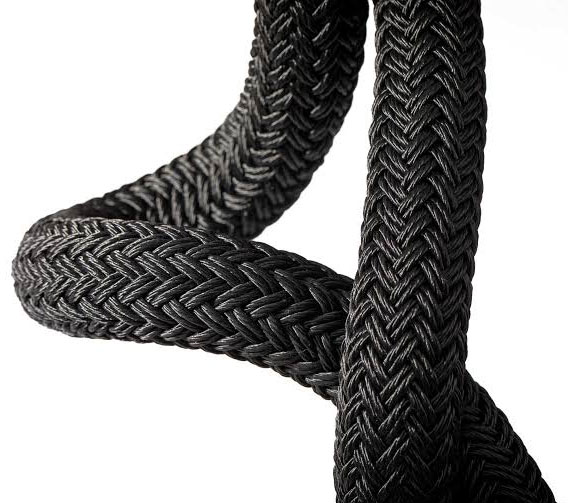
The construction question, seen close up. The outer structure here is continuous along the whole length — there is no seam, no s titching and no wrapped covering, which is the difference between a braided rope and a flat article joined together. Two consequences for this page. First, the layer that meets the hardware and takes the abrasion is the same structure that carries the load, which is not true of a rope with a sacrificial sheath. Second, in a construction like this the splice is made by burying the end inside the st ructure, so once it is closed there is nothing to see from outside. That is why Section 4 puts the burden on documentation rather than on appearance, and why an inspection of a rope a rticle is a search for what has changed rather than a reading of a certificate.
7. "Hoisting" and "Lifting" Are the Same Word Twice
The terminology around this article is loose in a way that costs money, and the looseness is worth mapping once so that an enquiry can be read against it.
| Word a buyer may meet | What it means in practice | The risk if it is used carelessly |
|---|---|---|
| Hoisting rope, lifting rope | The same article. The two words describe intent, and the choice between them is regional habit. | An order that lists both as separate lines, which invites a quotation for the same thing twice or a comparison between two thi ngs that are identical. |
| Rope sling | The same article described by what it is used as: a rope with at least one end formed, ready to be part of a lifting arrangeme nt. | This is the useful term, because it distinguishes the finished article from rope sold by the metre. Use it in a specification and the end forms become discussable. |
| Rope sold by length | Cordage without formed ends and without a rated capacity as a sling. A material, not an article. | The most common confusion on this page's subject. Rope is not a sling until somebody closes it, and the closing is what create s the capacity. An order for rope is not an order for a sling. |
| Grommet, cable-laid sling | Specific built forms, described in Section 6. Named after their construction rather than their use. | The forms are shared between steel wire rope and fibre rope, so the name alone does not tell a maker what to build. Name the m aterial with the form. |
| Tonnage, capacity, WLL | A tonnage is a size band in conversation; a rated capacity is a figure with a basis. The two are not the same claim. | Buying a size when a figure was needed. What a rated capacity rests on, and what has to be agreed above the tabulated range, i s argued on the large-article pages linked at the end of this one. |
The one substitution worth making in every enquiry is to replace the loose pair hoisting rope and lifting rope with rope sling, and then to say what kind. That single change makes the end forms a subject, which is the point of Sections 4 and 5, and it separates the article from rope sold by length, which is the confusion that produces the most wa sted quotations on this subject.
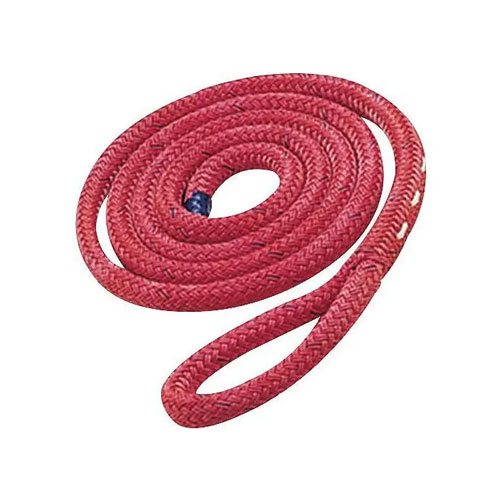
How loosely this vocabulary is used, and how little colour helps. This article is red and braided; the rope at the top of the pa ge is white and braided with a red tracer; the rope in the close-up is black. Colour on a rope does three useful jobs — it makes a line visible against the ground and against other lines, it lets a si te assign colours to its own duties, and it lets a coil be identified from across a store without uncoiling it — and one thing it cannot do. No colour states a construction, a strand count, a splice method or a rated capacity. At the tonnages this page is about, the habit of reading an article by its colour is the single most likely way to end up with the right-looking rope closed the wrong way.
8. What the Order Has to Name That a Sling Order Does Not
The reason this page exists is that a request written as a sling order leaves two requirements unstated for a rope. The table below is the rope order, with the lines that a woven-sling order would not need marked as such.
| Line | What to write | Rope-specific? |
|---|---|---|
| 1. The article, and the standard part | Rope sling, and the part of the textile sling family that covers fibre rope slings. Not the family name alone. | Partly — the family is shared with every other textile article this site builds; which part applies is specific to a rope. |
| 2. Construction, and the strand count | Which family from Section 3, and the number of strands. This is the line most often missing, and the one that changes everythi ng downstream. | Yes. A woven article has plies and a band width; a rope has a construction and a strand count. No equivalent line exists on a sling order. |
| 3. Lay direction and finish | For laid constructions, the direction of lay; and the surface finish or treatment, where the rope will be worked against hardw are. | Yes. Direction of lay and finish are rope properties with no woven equivalent. |
| 4. The splice, by method | How each eye is to be closed — the splice method, or a ferrule termination — and the document it is to be made to. | Yes. A woven sling's end is a sewn fabrication to a pattern; a rope's end is a splice or a ferrule, and the two are not alternatives to each other. |
| 5. End form | Soft eye, hard eye, thimble or ferrule, and if a thimble, the pin it will sit on. | Yes. The whole point of the hard-eye family is the radius it offers, so the end form and the hardware are one decision. |
| 6. Rated capacity, and its basis | The figure required, the configuration it applies to, and the basis it is to be stated against. | No — but on a rope the figure depends on items 2 and 4 above, so it cannot be fixed before they are. |
| 7. Length, with the definition stated | Finished length, and whether it is measured over the body, between bearing points, or around the whole article. | No — but the options are wider on a rope, because an endless form and a two-eye form are measured differently. |
| 8. Marking, packing and documentation | Any site colour and tracer, what the band must state, how the article is coiled, and the fabrication and test documentation th at must travel with it. | Partly — the marking argument is shared, but on a rope the documentation is what carries the splice, because the splice cannot be read off the article. |
Two closing notes on writing the order, both of which save a round trip.
Lines 2 and 4 are the ones that make the other six answerable. Capacity cannot be quoted, length cannot be fixed, and the end form cannot be checked until the construction and the spl ice method are stated. An enquiry that leads with tonnage and leaves those two out will produce a quotation that is a guess dressed as a figure.
And ask for the fabrication statement, not only the test. A test result describes an article that was tested. The fabrication statement describes how yours was made. On a rope sling t he second is the one that tells you whether the article in your store is the article in the certificate.
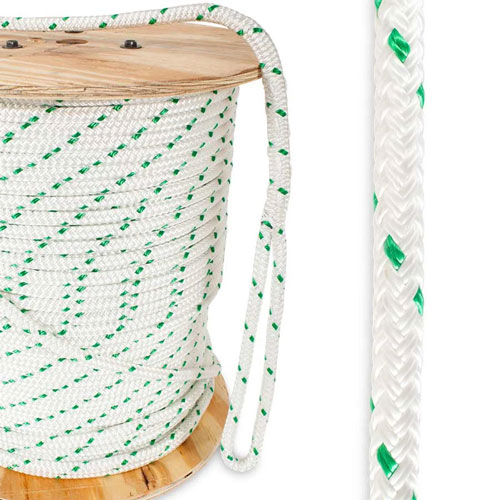
What marking can and cannot carry on an article of this kind. The tracers here are green; on the rope at the top of the page the y are red. Both are woven in, so they cannot be rubbed off by dragging or cut away with a worn band — which is exactly what makes them useful for identifying a rope by construction an d type from across a store. What they cannot do is carry a value. A tracer can tell a handler that this is the braided article rather than the laid one, and nothing more. The rated capacity, the splice method and the test reference all live on the band and in the paperwork, which is the point of line 8 in the table above — and the reason a rope order needs its documentation line filled in rather than left to the invoice.
9. Inspection and Retirement of a Rope Article
A woven article is inspected by looking at a surface. A rope is inspected by looking at a structure, and the structure behaves differently depending on the construction, which is why this section f ollows the families in Section 3 rather than treating all rope alike.
| What you are looking at | What it means on a rope | Where it cannot be seen |
|---|---|---|
| Broken or cut strands | On a laid rope the strands are outside and a break is visible where it happens. On a braided rope the load-bearing structure m ay be under a sheath, so an external mark is not the same as a strand break. | Inside a braided or double-braided structure. This is the single most important limitation in this table. |
| Abrasion | Rope abrades where it runs over hardware, and the damage is concentrated at the same few places every time. On a three-strand rope a flattened or glazed strand is material lost. | Under the contact points of a sheath, and along the internal length of a cable-laid construction. |
| The splice | A splice that has moved, drawn in, or opened at its entry point is the finding that matters, and it is confined to the region where the end enters the body of the rope. | The buried portion. What can be judged from outside is the entry and the general shape, not the tuck itself. |
| Heat damage | Synthetic rope that has been overheated does not blister; it stiffens and becomes brittle. Stiffness in a rope that used to be supple is evidence, wherever the heat came from. | Throughout, because the change is in the material rather than on the surface. |
| Contamination | Grit worked into a rope abrades it from the inside, and a rope that has been in contact with a chemical it was not specified f or has lost something that no amount of cleaning returns. | Between strands, and inside a braided structure. Some of it will show as discolouration; some will not show at all. |
| Fittings, where the end is hard | A hard eye or thimble is a second article with its own defect list: deformation, cracks, corrosion, and wear at the bearing su rface where the pin runs. | Not hidden, but often not looked at, because the inspector's attention is on the rope. |
| A pressed termination | A ferrule is judged by its method and its own inspection criteria rather than by appearance, because the mode of failure is no t necessarily visible at the surface. | Inside the sleeve. This is the case where a documented method matters most. |
Three conclusions, and they are the practical output of this section.
Inspection on a rope is a comparison, not an inspection in the abstract. Almost everything in the table above is a change rather than a state: a strand that has gone, a rope that has stiffened, a splice that has drawn in, a surface that has flattened. That means the only inspection that works is one done often enough to know what the article looked like last week. A rope examined for the first time on the day it is needed cannot be judged at all.
And what cannot be seen has to be documented, or it does not exist. This is the same conclusion as Section 4's, arrived at from the other direction. A braided rope hides its strands; a double braid hides its core; a buried splice hides its tuck; a ferrule hides its termination. In each case the visible evidence is second-hand, so the article's history is not a management nicety. I t is the other half of the inspection.
Retirement, finally, is a decision somebody has to be competent to make. Removing a rope from service because it is visibly damaged is easy and does not need this page. The difficult case is the article that looks sound and has been through something — a hard pull, an overload, a wetting, a contaminant, a heat event. Those are the cases where the decision rests on a record and on a method, and where the wrong answer is not a wasted rope but an article still in use. What this site's large-article pages say about proof testing, about recording, and about deciding the retirement route before it is needed applies directly here and is not repeated; the routes to those arguments are given in the next section.
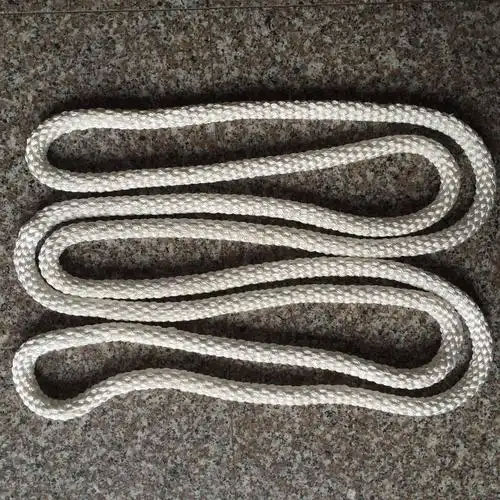
The comparison this section depends on, and the reason a rope has to be inspected while it is still sound. This rope is new, cle an, straight and uniform: no flattened strand, no glazing, no stiff patch, no drawn-in splice, no contaminant worked into the structure. That is what the baseline looks like, and because the whole met hod above is a test against this baseline, an article has to be recorded when it is new in order to be judged when it is not. A rope photographed for the first time on the day it is needed can only be described, not assessed.
10. Which Part of This Subject Is Argued Where
This page deliberately takes only the half of the subject that concerns the rope as an article: its standard, its construction, its splice, its ends and its vocabulary. The other half is argued pro perly elsewhere on this site and is linked here rather than restated, so that a reader can find it and so that the two pages do not drift into saying the same thing.
| Subject | Where it is argued | Why it is not repeated here |
|---|---|---|
| What can be proven at the top of the range, and the proof test | the high tonnage circular sling page | It is a complete treatment already, written on the same question, and a second version here would only be longer. |
| The factor arithmetic, and what a tonnage means above the tabulated range | the 300 ton lifting belt page | The arithmetic is the same for every article form, so it belongs where it is, not in two places. |
| Goods-in, storage, issue, transport and the retirement route for a very large article | the large tonnage circular lifting belt page | It is about the logistics of size, which is article-independent, and it is already written as a whole. |
| Curvature and fabrication efficiency as general principles | the heavy duty lifting sling page | This page takes the rope-specific half — which splice, on which construction — and leaves the general principle where it is pr operly made. |
| Colour as an unreliable identifier at size | the 300 ton lifting belt page | Section 7 of this page states the rope-specific version; the general argument is already made and is not rebuilt here. |
| Non-conductive compared with insulating, for an article used near live parts | the cable sling page | A different qualification entirely, which a rope does not acquire by being a rope. |
The purpose of that table is worth one sentence, because a page that lists what it does not cover can look like an apology and is not one. A rope sling at large tonnage is bought for its co nstruction and its ends. Everything else about a very large article — what can be proven, what it costs to own, how it is stored, how the factor works — is the same problem whatever the artic le is made of, and it is better solved once, in one place, than repeated on every page that touches a tonnage.
Frequently Asked Questions
Are large tonnage hoisting ropes and large tonnage lifting ropes two different products?
No, they are one article described twice. In this trade the two words are used for the same thing, and the choice between them is habit rather than engineering. If a specification lists them as sep arate line items, treat the repetition as a mistake and spend the space on the two things the name actually leaves out: the construction of the rope and the way each eye is formed.
What standard covers a lifting sling made from fibre rope?
The part of the textile sling family written for slings made from natural and man-made fibre ropes: EN 1492-4, published with its amendment as EN 1492-4:2004+A1:2008. That is the point of Section 2 . The family name is used widely on this site and the part number that applies to a rope is the one to quote, because a rope sling and a flat woven sling are covered by different parts of the same fam ily.
Why is the construction not part of the name?
Because the words large tonnage hoisting rope describe a size and an article form, and construction is a third thing that the trade leaves to conversation. It is the requirement that decides rotati on under load, flexibility at diameter, how the rope is closed at the ends, and what an inspector can see. An order that does not state it has left the most consequential decision to whoever builds th e article.
What is the difference between a rope and a rope sling?
A rope is cordage. A rope sling is a rope that has had at least one end formed, so that it has a rated capacity as an article. The forming is what creates the capacity, which is why an order for ro pe by the metre and an order for a sling are different orders, and why the ends have to be specified rather than assumed. This is the confusion that produces the most wasted quotations on this subject .
How much of the rope's strength survives the splice?
That figure is not quoted on this page, and the reason is not evasion. What survives the eye depends on the construction, the splice method, the competence of the person who made it and the standar d the article is made to. A number taken from a general table and applied to your rope would be a claim rather than a measurement. The figure that matters is the one on your article's fabrication docu mentation, and if it is not there, that absence is itself the finding.
Which splice suits which construction?
They are not interchangeable, and each recognised method belongs to a family of constructions. A laid rope is normally closed by tucking strands back into the body; a braided rope is normally close d by burying the end within the braid so the join continues the structure; a double braid involves both the core and the sheath; and a ferrule termination is a mechanical fixing rather than a splice a t all. A supplier asked to close an unusual construction either knows the method for it or should decline the work.
Soft eye, hard eye or thimble — how do I choose?
By what the eye will bear on. A soft eye is light, conforms to the load and is judged as rope. A hard eye is chosen where the eye sits on a pin or hook repeatedly and has to keep its shape, and it is judged as rope plus a fitting. A thimble is the lined form of the hard eye, and its whole purpose is to control the radius the rope bends around, so it has to match the pin it will sit on. At large tonnage the rope is stiff and the pin is big, and that pairing is one decision rather than two.
Can a grommet or a cable-laid sling be specified without saying what it is made of?
It should not be. Those two form names are shared between steel wire rope and fibre rope, while the articles and the standards behind them are not. Naming the form without the material leaves a sup plier to guess, and the two guesses produce different articles made by different methods to different documents. Name the material and the applicable standard together with the form.
What is different about inspecting a rope rather than a woven sling?
On a woven article you are reading a surface; on a rope you are reading a structure, and much of that structure may not be on the outside. A braided rope hides its strands, a double braid hides its core, a buried splice hides its tuck and a ferrule hides its termination. Almost everything you are looking for is a change rather than a state — a strand gone, a rope stiffened, a splice drawn in, a surface flattened — so the inspection only works against a recorded baseline, which means the useful information is what the article looked like when it was sound.
Is colour any help at this size?
For visibility, for a site's own duty coding, and for identifying a coil without uncoiling it — yes. As a statement of construction, strand count, splice method or rated capacity — no. At the tonna ges this page is about, reading an article by its colour is the surest way to end up with a rope that looks right and was closed the wrong way, which is why the mark that survives a handover is a wove n tracer plus a band plus the paperwork, and not the shade of the rope.
What should I send with an enquiry?
The eight lines in Section 8, in that order, because lines 2 and 4 make the rest answerable: the article and the standard part; the construction and strand count; lay direction and finish; the spli ce method, with the document it is to be made to; the end form and, for a thimble, the pin it will sit on; the rated capacity and the basis it is to be stated against; the length with the way it is me asured stated; and the marking, packing and documentation that must travel with the article. If a photograph helps, send one of the hardware the eyes will sit on rather than of the rope.
Contact Lift Sling Rigging Co., Ltd
Large tonnage hoisting ropes are made to order at this works in the construction, strand count and end form the arrangement calls for, and the large tonnage lifting ropes built alongside them are t he same article under the other of the two names this trade uses. Neither name is a specification on its own, so what we ask for is the construction and the splice: which family the rope is to be buil t in, how many strands, and how each eye is to be closed and to what document.
Tell us the article form first, then the standard part that applies to it, then the construction. After that the rated capacity, the length and the end form all become answerable, and the quotation becomes a statement about an article rather than a figure attached to a word. Where the arrangement is one we cannot build honestly — because the construction is not one this works splices, or becaus e the capacity being asked for is beyond what the documentation would support — we will say so, and that is usually more useful than a quotation.
Three parts of this subject are argued properly elsewhere on this site and are not repeated here: what can be proven at the top of the range and what a proof test establishes, on the high tonnage circular sling page; the factor arithmetic and what a tonnage means above the tabulated range, on the 300 ton lifting belt page; and goods-in, storage, issue and the retirement route for a very large article, on the large tonnage circular lifting belt page. The general principle of curvature and fabrication efficiency is made on the heavy duty lifting sling page.
Telephone and WeChat: 18066002268
E-mail: 702461526@qq.com
Address: Lifute Industrial Park, Taizhou City, Jiangsu Province, China
HS code: 630790
- Previous:High strength circular high-voltage traction rope with lifting ring type high-voltage traction rope
- Next:DuPont wire power construction insulation rope, power guide
-
Drone Anti-collision Net
-
Extra Large Capacity Cargo Net
-
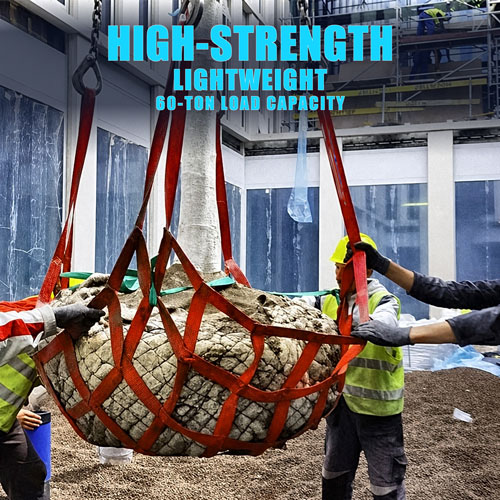
Cargo Webbing Net
-

Color changing nylon double buckle loop nylon braided rope
-

Two end buckle lifting rope, double buckle round lifting rope, double fork nylon lifting rope, non jointed nylon lifting rope
-

Emergency escape lifeline, fire escape rope, fire safety escape emergency rope, steel wire core fire rope

