 Language
 简体中文
简体中文
- On the 2018 National Day holiday, Lifet completed six 100 ton large tonnage lifting belts as a gift
- The role of suspension net in the transportation of goods turnover
- Cargo soft lifting net, lifting net, lifting net, lifting net, bag, climbing net
- Precautions for using Lifutiden elevator
- How to make circular lifting straps
Contact: Wang Lili
E-mail:18066002268
Phone:702461526@qq.com
Address: Lifute Industrial Park, Taizhou City, Jiangsu Province

Lifute Hoisting Co., Ltd. 18066002268 produces lifting belts, lifting nets, nylon ropes, soft ladders, steel wire rope rigging, paper ropes, safety belts, safety nets, lifting chains, steel coil hoists, crossbeam hoists, flat lifting belts, circular lifting belts, electric traction ropes, high-altitude safety belts, and anti fall safety nets High strength circular high-voltage traction rope with lifting ring type high-voltage traction rope Read the name as a description of one rope and it says almost nothing about the rope.
Hits: ℃
Release time:2026-09-28 13:57
Lift Sling Rigging Co., Ltd manufactures High strength circular high-voltage traction rope with lifting ring type high-voltage traction rope. High Strength Circular High-Voltage Traction Rope with Lifting Ring, and Lifting Ring Type High-Voltage Traction Rope — Five Words About the Line, and Almost Nothing About the Rope
High Strength Circular High-Voltage Traction Rope with Lifting Ring, and Lifting Ring Type High-Voltage Traction Rope — Five Words About the Line, and Almost Nothing About the Rope
The short answer. Read the name as a description of one rope and it says almost nothing about the rope. High strength is a claim with no figure in it. Circular describes a form. < em>High-voltage describes the line the work is being done near, not the article. Traction describes what the rope does. And with lifting ring describes one end. Five specificati ons stacked into one phrase, and the only one that is a statement about the material is the one with no number attached to it.
That is not a complaint about the name. It is the reason this page is organised the way it is. There is a whole world of work behind the phrase that this site has never described, and it is not a w orld of material properties — it is a world of machines, sheaves, running lines and approach distances. The vocabulary that goes with it, the terms a buyer will meet in a method state ment or a stringing plan, appears nowhere on this site: not the winch, not the sheave, not the running line, not the terms for the line itself.
So this page does four things, in this order. It takes the name apart and says which of its five parts is a requirement the buyer can write down. It explains what high voltage actually con strains, which is approach and method rather than the rope. It puts the word traction back into the job it comes from — pulling conductors on a line, over hardware, from a machine — and gives the vocabulary that job uses. Then it returns to the two parts of the name that are genuinely about the article: the circular form and the ring end, which are the two places where this rope is actual ly specified rather than merely described.
Where a subject belongs to a neighbouring page it is linked rather than restated. What an insulating rope is, and how it differs from a rope that merely happens not to conduct, is argued on two oth er pages of this site and the closing section says which. Nothing about insulation, tonnage or size classes is repeated here.

The page's own photograph, and it shows two of the five words in the name at once. The rope is braided, white, with fine blue tracer yarns woven through the outer structure. At the lower left is the end: a yellow protective sleeve over a formed eye, with a metal fitting inside it. That single detail is the phrase with lifting ring made visible, and it is also the part of this article that is most often specified badly, because the ring and the radius it offers are one decision (Section 6). What the photograph cannot show is the other three words. There is no figure for the strength, nothing that says what voltage the work was near, and nothing that shows wheth er this rope has ever run over a sheave.
1. The Name Is Five Specifications, and Only One of Them Is Written Down
Take the phrase apart and it becomes clear why enquiries for this article arrive under-specified. Four of the five parts are statements about the job, and only one is a statement about the article — and that one is the vaguest of them all.
| Part of the name | What it is actually about | What you have to write down instead |
|---|---|---|
| High strength | A claim about the article with no figure in it. Every rope in this catalogue is sold as strong; the two words distinguish noth ing between one rope and the next. | A tensile figure and the configuration it applies to, with an allowance for the pull you actually expect. A name is not a numb er, and this is the only part of the phrase that has to become one. |
| Circular | The form of the article: a closed loop rather than a length with two ends. This is a real specification, and Section 5 is abou t why it is chosen for this work. | The finished circumference or length, how it is measured, the construction, and the diameter. A loop has a size and the size i s not the strength. |
| High-voltage | The line the work is being carried out near. It is a statement about the environment and the method, not a property of the rop e — a rope does not have a voltage. | What the method requires of the article: whether it must hold an electrical qualification or merely stay outside the approach distance. Section 2 is about that distinction. |
| Traction | The duty: this rope pulls. It is not a lifting article in the sense the rest of this catalogue uses, and it is not a rope that carries a person. | What it pulls, how far, over what, and from what machine. The vocabulary for those questions is the subject of Sections 3 and 4. |
| With lifting ring | One end of the article, and the reason the page's name reads as one product with a variant rather than two products. A ring is a bearing surface, not decoration. | The ring's inside diameter, the hardware it will sit on, and the material. A ring sized for a different fitting is a ring that concentrates the load in the wrong place (Section 6). |
One practical consequence of reading the name that way, and it is worth stating before anything else on the page.
The name describes a job, not an article. That is why a supplier cannot quote from it. A buyer who writes the name and nothing else has described a working environment, a duty and one end form; the four things that decide whether the article survives the job — the pull it must take, the hardware it runs over, the length it must be, and which of the ends has to meet a machine — are all still missing. The rest of this page is those four things.
2. "High Voltage" Describes the Line, Not the Rope
This is the part of the name most often misread, in both directions, and the misreading is expensive whichever way it goes.
A rope does not have a voltage rating. There is no such thing as a rope that is rated for 110 kV or 220 kV, in the way a glove or an instrument has a class. What a voltage does is set the rules of the work: the approach distance that has to be maintained, whether the line is worked as live or as isolated, what the method permits, and whether the article being used has to hold an e lectrical qualification of its own. Those are decisions about a job and a method. They are not properties that a rope carries in its construction.
So the phrase high-voltage traction rope should be read as a traction rope for work near high-voltage lines, and it leaves one question genuinely open:
| What the method says | What that means for this rope | Where that subject is argued |
|---|---|---|
| The line is isolated and earthed, and the rope only has to stay outside the approach distance | The rope is a working line. Its requirements are tensile, abrasion and handling. No electrical qualification is needed and buy ing one would be money spent on the wrong property. | This page — the traction duty is the subject of Sections 3 to 5. |
| The work is done live, and the rope may come near or touch energised parts | The article needs an electrical qualification of its own, and with it the handling and storage regime that keeps the qualifica tion alive. A working line is not a substitute, however new it looks. | Argued in full elsewhere: see the power construction insulation rope page for the standards and the condition the qualification rests on, and the cable sling page for why being non-conductive is not the same t hing as being insulating. |
| Not stated at all | The most common case, and the one this page exists to catch. Without that sentence nobody can tell whether the rope needs a qu alification, and the safest-looking option is the wrong one half the time. | Put the sentence in the enquiry. One line settles it, and Section 8 asks for it by name. |
A second point belongs here, because it follows from the first and is the reason this section is not just a definition.
Where a working line and a qualified article sit next to each other on the same job, the risk is not the rope — it is the handover. Two ropes of similar appearance, one carrying a qua lification and one not, in the same store and on the same vehicle, is a control problem rather than an engineering one. The pages linked above deal with it at length, and this page does not repeat the argument; what it adds is that on a traction job the two are unusually likely to be on site together, because the pulling work and the live work happen on the same day.

The environment these words describe, shown honestly: a site photograph rather than a product photograph. It is a silhouette of lattice booms at dusk, and it is here because the section above is about a working environment rather than an article. Two things should be said plainly about it. It is not a power line— no conductor, tower or insulator appears in it, so it illustrates the setting and not the work that gives this rope its name. And it shows why the vocabulary matters: a photograph of the environm ent tells a reader where a rope is used and tells a buyer nothing at all about which rope to order. That distinction between a setting and a specification is the whole subject of Section 1.
3. What "Traction" Means as a Job
The word in the name that does the most work is the one that looks simplest. Traction places this rope in a sequence of operations, and the sequence is what determines what the rope has to survive.
The job is this. A line is to be run between structures. Something light goes across first, so that a heavier line can be pulled behind it. The heavier line is then pulled from a machine at one end , and it is that line which brings the conductor into position behind it. In this trade the light line is the pilot or guide rope, and the heavier one is the traction rope — the article this page is a bout. Every part of that description has an engineering consequence.
| Feature of the job | What it asks of the traction rope | Why it is different from a lift |
|---|---|---|
| The rope runs for a long distance, not a short one | Length with an allowance, a manageable mass per metre, and a length that can be paid out and recovered without becoming unmana geable on the ground. | A lifting sling is measured in metres of span. A traction rope is measured in hundreds of metres of travel, and its own mass b ecomes a handling question before the load does. |
| It runs over hardware, repeatedly, in the same few places | A surface that accepts being drawn over sheaves and rollers, and a construction in which the load-bearing part is not sacrific ed by surface abrasion. | A sling touches the load at a few contact points. A running line touches hardware continuously along its working length, and t he wear is distributed rather than local. |
| The pull is applied by a machine, continuously | A steady tensile capacity against a measured pull, and low enough elongation that the tension on the instrument is the tension in the rope. | A lift is brief and its peak is the event. A pull is sustained, and the rope spends a long period working near its duty rather than passing through it. |
| The rope is paid out, worked, and rewound, over and over | A rope that does not twist itself into a state it cannot be worked out of, and a form that can be wound and unwound without ca tching. | This is where the circular form earns its place (Section 5) and where a rope's handling history, not its load history, decides its working life. |
| The load is a conductor, and it is not hung from the rope | A rope that pulls rather than carries: the conductor follows the rope in its own hardware, and the rope is not the thing suppo rting it. | A lifting article holds a load against gravity. A traction rope overcomes friction, and the difference matters to which proper ties are governing. |
The single most useful consequence of that table is about which property governs. On a lift, the governing question is how much the article can hold. On a traction job it is usually s omething else: how much friction the run imposes, what the rope does as it passes over hardware, and whether the operation can be kept under control. A buyer who specifies this rope from a load table alone has specified the one quantity that is rarely the binding constraint. That is not an argument against knowing the tensile figure — Section 1 asks for it — but it is the reason Section 4 exists.< /p>
A note on the boundary with a neighbouring subject: the pilot line that goes across before the traction rope, and the whole arrangement of a guide rope on a construction job, is argued on the power construction insulation rope page and its guide-rope stages are not rebuilt here. This page takes the heavy line and what happens when it is put to work.
4. The Vocabulary of a Traction Job That This Site Has Never Used
Here is a fact about this site that explains a great deal about how these enquiries arrive. Across a hundred product pages, the terms that describe the machinery and the practice of a pulling job a ppear nowhere: not the winch, not the sheave, not the running line, not the terms for the structures and the conductor. The vocabulary a person meets on their first day of a stringing job is absent fr om the catalogue they are ordering from.
That is worth a table rather than a complaint, because a buyer who cannot use these words cannot ask for this rope accurately, and a supplier who is not given them has to guess.
| Term a buyer will meet | What it is in the job | Why it decides something about the rope |
|---|---|---|
| Winch | The machine at the pulling end that supplies the pull and holds the rope while it is under tension. It is where the load comes from and where the rope ends up stored. | Its drum diameter sets a minimum bending requirement, and its capacity sets the working pull the rope has to be sized against. A rope ordered without knowing the machine is sized against nothing. |
| Sheave | A grooved wheel, mounted so that a line can run over it. On a stringing job the rope passes over many of them along the route. | Every sheave is a bend and a contact. The groove radius and the number of passes determine how much the rope is worked, and a sheave that is too small for the rope is the classic way to shorten its life. |
| Running line | A rope that travels through the route repeatedly rather than being attached and loaded. It is a role, and a rope is a running line because of how it is used rather than what it is made of. | It is the phrase that explains the circular form. Something that travels has to be continuous, and anything that can catch on hardware will eventually catch on hardware. |
| Pay out and rewind | The two halves of the cycle: the rope leaves the drum under tension, and later comes back onto it, usually under less. | Winding is where twist accumulates and where a rope that has taken a set becomes difficult. The handling quality of a running line matters as much as its strength and is rarely written into an order. |
| Conductor and structure | The thing being installed and the thing it will hang from. The rope never becomes part of either, and it must not damage eithe r. | A conductor is a soft-looking article that is unforgiving about being scratched, and a structure is a set of edges. A rope tha t is abrasive to the conductor, or that fails against an edge, has failed at the interface rather than under load. |
| A kink or a twist the rope will not come out of | A permanent deformation left by handling: the rope has taken a set at a point, and that point behaves differently from the res t for the remainder of its life. | This is the failure that has nothing to do with load and everything to do with use. It is also, in practice, one of the most c ommon reasons a running line comes out of service early. |
Two conclusions follow, and both change what an enquiry should contain.
The machine belongs in the enquiry. A pull is produced by a winch, and a rope's working life on a pulling job is decided by what that winch and the sheaves along the route do to it. N one of that is captured by a tensile figure, and all of it is captured by naming the hardware.
And the terms in that table are the ones a supplier needs in order to answer properly. Where an enquiry says only that a high-voltage traction rope is wanted, the honest reply is a re quest for the route and the machine. That is not a delay; it is the difference between quoting a rope and quoting the right rope.
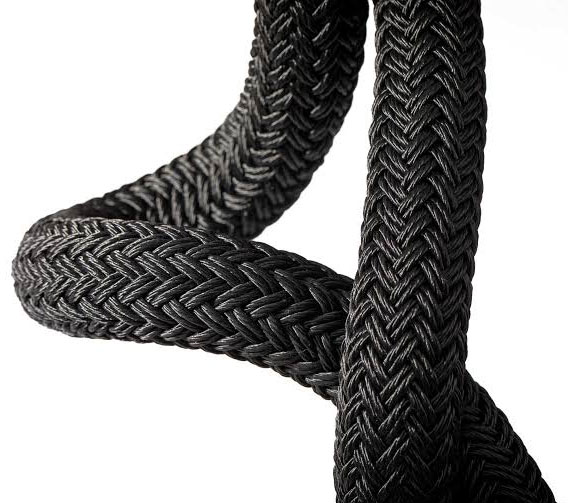
What runs over the sheaves, seen close up. The outer structure here is continuous along the whole length — no seam, no covering, no stitching — and that is the layer that meets every sheave, roller and edge along the route. Two points follow from the picture. First, on a construction like this the structure that takes the abra sion is also part of what carries the load, which is precisely why a running line's surface condition is a strength question and not a cosmetic one. Second, the picture is of a new rope: uniform, unde formed, with no flat spot and no taken set. On a traction job the change from this state to a used one happens along the working length rather than at a single point, so the comparison in Section 9 ha s to be made against a record rather than against memory.
5. Why the Circular Form Is Chosen for a Running Line
The first of the two words in the name that is genuinely about the article is circular, and it is worth more attention than it usually gets, because it is not a shape preference. It follow s from what a running line does.
A rope that travels through a route has to be continuous. Anything on it that can catch will catch: a termination, a spliced eye, a joint, a thickening where two pieces meet. The circular form remo ves the whole class of problem by removing the ends — the article is a closed loop, and the load path runs around a circuit with no termination to fail separately from the rope and nothing protruding to foul a sheave.
| What the closed form gives | Why it matters on a traction job | What it costs |
|---|---|---|
| No protruding end to catch | The rope can be dragged over sheaves and rollers and through the route without a termination being the thing that jams. On a l ong run that is not a detail; it is the difference between a working line and a rope that stops. | The article must be made as a loop, which is a more demanding fabrication than putting an eye in each end of a length. |
| A closed load path | Tension runs around the circuit rather than terminating in a fitting. There is no single end where the whole pull has to be tr ansferred from rope to hardware. | Where the loop closes, that region is a fabrication and is inspected as one. A closed loop does not mean an article with nothi ng to join; it means an article whose joining is turned back into the rope itself. |
| Both of the rope's faces are working faces | The loop can be turned, so a length that has been worked at one place can be presented differently on the next job. On a runni ng line the wear is distributed along the working length, and turning it is a genuine way to use the whole article. | Turning a loop only helps if somebody records that it was done. A rotated rope and a rope in its first week look the same, and an inspector without the history is guessing. |
| A predictable, even mass along the length | A uniform article behaves predictably when wound and unwound, which is what keeps a long pull controllable at the machine end. | A loop of a given circumference is a fixed size. Sizing it wrongly cannot be corrected by trimming, as it can be on a length w ith two ends. |
And a note about the word in the name that is not circular. The circular form is not a round sling in the sense of the covered, sleeved articles elsewhere in this catalogue, and the t wo should not be confused when ordering. A covered round sling is an article whose load-bearing core is protected by a sleeve and used for lifting; a circular traction rope is a running line, used to pull, and its working life is decided by travel rather than by a load held at rest. They can look similar in a photograph, and the demands placed on them are different enough that a page about one is not a page about the other. The covered lifting form is argued on the circular lifting straps page.
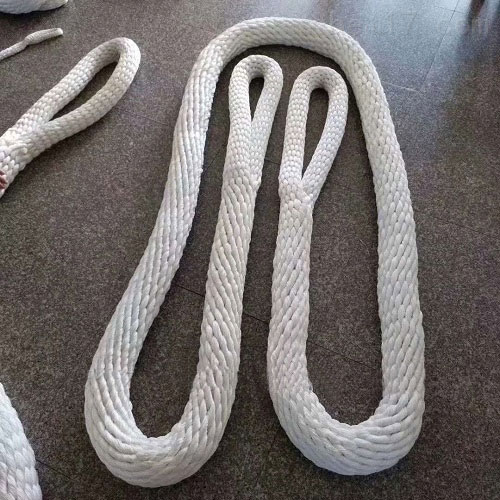
The circular form itself, and what the phrase closed load path actually looks like. There is no fitting in either artic le: the rope turns back into its own body and the loop is complete, which is why the ends cannot catch on a sheave. Two honest observations belong with the picture. First, this is the form the name ca lls circular, and it is a rope rather than a sleeved or covered article — nothing here is wrapped, and the surface that will run over hardware is the surface carrying the load. Second, the photograph shows the shape and nothing about its strength or its history: two loops of the same circumference can differ in construction and in what they have already been through, and neither fact is visible fr om above.
6. The Lifting Ring End: What a Ring Changes
The last word in the name is the one that makes the phrase read as one article with a variant, and it is the part of this rope that most often gets specified from a picture rather than from a numbe r. A ring is not a decoration on the end of a rope. It is the component that decides where the pull enters the article and how the rope bends as the load comes on.
| The end form | What it does at the connection | What has to be written down |
|---|---|---|
| A formed eye in the rope | The connection is made by rope against hardware. Light, and it conforms to whatever it sits on, so it is forgiving of slight m isalignment. | Nothing beyond the eye's own size. It is judged as rope, because it is rope. |
| An eye reinforced with a sleeve | Adds a sacrificial layer exactly where a running line is worked hardest. It protects the rope from the hardware, not the load from the rope. | Whether the sleeve is a permanent part of the article or a replaceable one, because the two have different lives and only one can be renewed on site. |
| A ring fitted to the end | The pull is taken through a metal component rather than through rope pressed on rope. The connection becomes a bearing, and th e shape of the connection stops changing under load. | The ring's inside diameter, its material, and — the line most often left out — the fitting it will sit on. A ring is chosen fo r the hardware it meets, and a ring that is wrong for the pin puts the load in the wrong place. |
| A ring combined with a sleeve, as in the photograph at the top of this page | Two jobs in one end: the ring provides a stable bearing for the hardware, and the sleeve protects the rope where it is bent ha rdest and worked most. It is the form the page's own photograph shows. | Both of the above, and one more: which part is expected to wear first, because that is what decides whether the article is rep airable or comes out of service when the sleeve is done. |
Two engineering points, and then the honest boundary that belongs with them.
The ring's value is the radius it offers, and that radius has to match the hardware. A ring exists so that the rope bends around a known, curved, hard surface instead of around whatev er is on the end of the winch line. If the ring is sized for a different pin, the bend it produces is not the bend it was chosen for, and the place where the rope leaves the ring is where the pull con centrates. This is why the ring and the hardware are one decision on an order, and why a diameter quoted without a pin mentioned is only half a specification.
And a ring is a component with its own inspection. A rope end with a metal ring is not one article but two, and the ring's failure list is not the rope's: deformation, cracks, corrosi on, and wear at the bearing surface where the hardware runs. An inspection that looks only at the rope will pass a ring that should not be used, which is why Section 9 separates the two.
The honest boundary. This page does not quote a ring's working load, a bend radius requirement or a minimum diameter for a given rope, because those follow from the specific ring, the specific construction and the standard the article is being made to — and a general figure applied to a particular end would be a claim rather than a measurement. What should be on the order is the r ing's rated figure on its own documentation, alongside the rope's, and the two should be checked against each other rather than assumed to agree.
7. High Strength: What Two Words Can and Cannot Mean
High strength is the first phrase in the name and the least informative, which is worth demonstrating rather than asserting. On this site the words appear on fifteen separate product pages, a ttached to articles made of several different fibres and built in several different ways. They are a shared description rather than a distinction, and any page that treated them as a specification wou ld be selling a category that does not exist.
What the words can legitimately do is mark that an article is built for a demanding duty rather than a general one. What they cannot do is tell a buyer anything that could be checked. Three substit utions turn the phrase into something a supplier can answer:
| Instead of high strength | Write | Why that is the useful form |
|---|---|---|
| A figure with a basis | The tensile requirement, the configuration it applies to, and the standard or document it is to be stated against. | A number can be met or missed. A claim cannot, and the difference is the whole reason a quotation is worth anything. |
| The construction it implies | Which family the rope is to be built in and how many strands, because that is where strength actually comes from on a rope. | Two ropes of the same diameter and the same fibre can differ in construction and therefore in capacity. The construction is th e mechanism; the adjective is the impression. |
| The property the strength has to survive | What the rope has to keep doing while it is strong: abrasion at the sheaves, flexibility at the drum, low elongation under a s ustained pull, or resistance to taking a set. | On a traction job the strength is rarely the binding constraint (Section 3). A rope can meet its figure and still fail the job by handling badly, and only this line captures that. |
One practical consequence, and it is the theme of this whole page. Of the five parts of the name, four describe the job and one describes the article — and that one is the part with n o number in it. The way to read a name like high strength circular high-voltage traction rope with lifting ring is not as a specification but as a question: what pull, what route, what machin e, what length, and what hardware at the ring. Everything this page has said so far is an attempt to make those five questions easy to answer, and Section 8 asks for the answers in one place.
8. What the Order Has to Name
The four missing items identified in Section 1 become eight lines here, in the order that makes them answerable. The first two are the ones a name cannot supply; the rest follow from them.
| Line | What to write | What it settles |
|---|---|---|
| 1. The duty, and what the method says about the line | That this is a traction rope; whether the work is done with the line isolated or live; and whether the method therefore requir es an article with an electrical qualification. | Whether the article being bought is this one or an insulating article. One line, and Section 2 is entirely about it. |
| 2. The pull, and how it will be measured | The expected pulling tension with an allowance for friction over the whole run, and the instrument or method that will show it . | The tensile requirement — which is what high strength was standing in for, and cannot. |
| 3. The route, from the plan | Length including every bend, the structures it passes, and the number and position of the sheaves or rollers the rope will run over. | Length, and how much the rope will be worked. Section 4's table is the vocabulary for this line. |
| 4. Length or circumference, and how it is measured | For a circular article, the finished circumference and the way it is measured; for a length, the working length and the allowa nce at each end. | A loop cannot be trimmed to size (Section 5), so this is the line where an error cannot be corrected later. |
| 5. Construction, strand count and diameter | Which family the rope is to be built in, the number of strands, and the diameter. The state of the article the buyer actually wants. | Where the capacity physically comes from, and what the surface that meets the sheaves will be. |
| 6. The machine and the hardware | The winch or puller, its drum or capstan diameter, and the sheaves along the route with their groove sizes. | The minimum bending the rope will accept, and therefore whether the diameter being asked for is workable on this job at all. |
| 7. The end form, and for a ring, the pin | Which end carries the ring, whether a sleeve is part of the article or replaceable, and the inside diameter and material of th e ring along with the fitting it will sit on. | The radius the rope bends around where the pull enters it. Section 6 explains why this is one decision and not two. |
| 8. Marking, packing and documentation | Any site colour and tracer, what the band must state, how the article is to be coiled, and the documentation that must travel with it — including the ring's own rated figure where one is fitted. | Whether the article can be identified at a handover, and whether its two parts can be checked against each other rather than a ssumed to agree. |
Two closing notes about writing it.
Lines 1 and 2 make the other six answerable. Until it is settled whether the article needs an electrical qualification and what pull it must take, the construction, the diameter and t he ends are being chosen against nothing. An enquiry that leads with the name and the strength adjective has, in effect, led with the two parts of the specification that carry no information.
And name the machine. On this page's subject the single most useful thing a buyer can add is what the rope will be pulled by and what it will run over. That is not a formality: it is the difference between a rope sized for a duty and a rope sized for a number.
9. Inspection and Retirement of a Traction Rope
A traction rope is inspected differently from a lifting sling, for a reason that follows from Section 3. A sling meets its load at a few points and is inspected there. A running line is worked alon g its whole length, so what an inspector is looking for is distributed rather than local, and the article's history matters as much as its appearance.
| What you are looking at | What it means on a running line | What a record adds |
|---|---|---|
| Surface condition along the working length | Glazing, flattening or a polished look at the places the sheaves have worked. On a braided running line this is the layer that both carries load and meets the hardware, so it is a strength observation rather than a cosmetic one. | Which length of the rope has been working, and whether it has been turned. A rope that has been rotated looks better than its age suggests. |
| A taken set, or a kink that will not come out | A point where the rope has deformed permanently and now behaves differently from the rest. It is a handling failure, not a loa d failure, and it is one of the most common early retirements on a pulling job. | How it happened. A set from one incident and a set from a repeated pattern call for different answers, and only the record dis tinguishes them. |
| Broken or cut strands | On a laid rope the strands are outside and a break can be seen where it happens. On a braided construction the load-bearing st ructure may sit inside, so a mark on the surface is not the same as a strand break. | Nothing, if the structure hides the damage: it has to be documented or it cannot be assessed (Section 5's note on the closed l oop applies here too). |
| Stiffness where the rope was supple | Synthetic rope that has been overheated does not blister; it stiffens and becomes brittle. The damage is in the material, so i t will not be found by looking at the surface. | Whether the rope has been near a heat source or run under abnormal friction. The change is real either way; the record tells y ou whether to expect more of it. |
| Contamination worked into the structure | Grit inside a rope abrades it from within on every subsequent pass, and a rope that has met a chemical it was not specified fo r has lost something cleaning will not return. | Where it has been. A rope that has been in a duct, in mud or in a wet trench is a different article from one that has only run over sheaves. |
| The sleeve, where the end is sleeved | A sacrificial layer doing its job. It will look worse than the rope beneath it, and that is the design. | Whether the sleeve is renewable. A renewable sleeve turning a worn end into a serviceable one is only an advantage if somebody is allowed to renew it. |
| The ring, where the end is ringed | A second article with its own defect list: deformation, cracks, corrosion, and wear where the hardware bears. Looking only at the rope will pass a ring that should be withdrawn. | Its rated figure and its date. The ring's capacity and the rope's are two claims, and they should be checked against each othe r rather than assumed to agree. |
Three conclusions, which together are the practical output of this page.
Inspection on a running line is a comparison, not a test. Almost everything in that table is a change rather than a state — a surface that has gone polished, a rope that has stiffened , a set that has appeared. The inspection only works against something recorded when the rope was sound, which is why an article examined for the first time on the day it is needed cannot be assessed at all.
And what cannot be seen has to be written down or it does not exist. A braided running line hides its strands, a sleeve hides the rope beneath it, and a ring hides the bend that matte rs. In each case the visible evidence is second-hand, so the documentation is not administration; it is the other half of the inspection.
Retirement is a decision somebody has to be competent to make. Removing a rope that is visibly damaged is easy and needs no page. The hard case is the article that looks sound and has been through something — a hard pull, an overload, a wet trench, a heat event, a kink that was straightened. Those are the decisions that rest on a record and a method, and where the wrong answer is not a wasted rope but an article still in service.
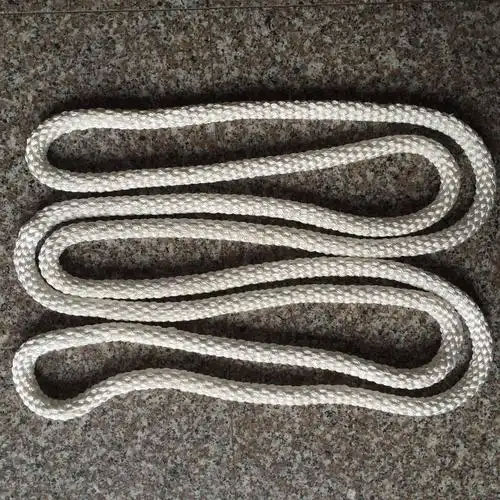
The baseline the whole of Section 9 is measured against. This rope is new, clean, straight and uniform: no polished patch where a sheave would work it, no flat spot, no taken set, no contaminant in the structure. Because every observation above is a comparison against a state like this one, the article has to be record ed while it is still in this condition in order to be judged later. A running line photographed for the first time after a hard pull can be described, and cannot be assessed.
10. Which Part of This Subject Is Argued Where
This page takes the traction half of its own name: the duty, the machinery vocabulary, the circular form and the ring end. The other half — everything about working near energised parts, and everyt hing about the size classes and the covered lifting forms — is argued in full elsewhere on this site and is linked here rather than restated.
| Subject | Where it is argued | Why it is not repeated here |
|---|---|---|
| What an insulating rope is, the standards behind it, and the condition the qualification rests o n | the power construction insulation rope page | A complete treatment already, and a different qualification. Section 2 links to it rather than summarising it. |
| Why non-conductive is not the same as insulating | the cable sling page | The principle is made there in full; repeating it here would weaken both pages. |
| The covered round sling as a lifting article | the circular lifting straps page | A different duty — lifting rather than pulling — and the core-and-cover argument belongs with it. Section 5 states the differe nce and stops. |
| What can be proven at the top of the size range, and what a proof test establishes | the high tonnage circular sling page | Tonnage is not this page's subject, and the argument is already made on the same question. |
| The factor arithmetic, the colour system and the general arithmetic of ratings | the 300 ton lifting belt page | Shared across every article on the site, and better solved once than repeated on each page that touches a figure. |
| Where the strength actually comes from on a rope: construction and the splice | the large tonnage hoisting rope page | The construction families, the splice and the end forms are the whole of that page; here they are referred to and not rebuilt. |
One sentence on why a page lists what it does not cover, since it can read like an apology and is not one. A traction rope is bought for its duty and its ends. Everything else abou t a rope — how a figure is derived, how a colour is assigned, what a standard requires — is the same problem whatever the rope is doing, and it is better answered once in the place where it is answere d properly.
Frequently Asked Questions
Is a rope rated by voltage?
No. There is no rope that is rated for a particular voltage in the way a glove or an instrument is. What a voltage does is set the rules of the work: the approach distance to be maintained, whether the line is worked live or isolated, and whether the article used has to hold an electrical qualification of its own. So high-voltage traction rope should be read as a traction rope for a jo b near a high-voltage line, and the one thing it leaves open is which of those two cases applies.
How does that differ from the insulation rope on your other page?
The insulation rope is an article with an electrical qualification, used where the work brings it near energised parts. This page's article is a working line: its requirements are tensile, abrasion and handling. The same job can need both, which is precisely why the distinction matters, because one is not a substitute for the other and the two are easily confused when they sit on the same vehic le.
Why is the article circular rather than a length with an eye at each end?
Because it travels. A running line passes over sheaves and rollers along the whole route, and anything that can catch will eventually catch: a termination, a splice, a joint. A closed loop removes that class of problem and gives a load path that runs around a circuit with no end fitting where the pull has to be transferred from rope to hardware. The cost is that a loop cannot be trimmed to size , so the circumference is a decision that has to be right.
What does the lifting ring end change?
It turns the connection into a bearing. Instead of rope pressed against hardware, the pull is taken through a ring, so the rope bends around a known curved surface and the shape of the connection s tops changing under load. That makes the ring's inside diameter and the fitting it will sit on one decision rather than two, and it makes the ring a second inspected component with its own defect list .
Why can I not order from the phrase high strength alone?
Because it contains no number and appears on fifteen different product pages of this site attached to several different fibres and constructions. It is a shared description rather than a distinctio n. Replace it with the pulling tension you expect and the configuration it applies to, and the phrase stops being a claim and becomes something a supplier can be held to.
What diameter do I need?
That depends on the pull and on the hardware, and the hardware half is the one usually left out. The rope has to have enough tensile capacity for the pull with an allowance for friction over the wh ole run, and it also has to be able to bend around the drum of the machine and the sheaves along the route without being over-worked. A diameter chosen on strength alone can be unworkable on the machi ne.
What is a running line, and does mine need to be one?
A running line is a rope that travels through the route repeatedly rather than being attached and loaded. It describes a role, not a material. On a traction job the answer is usually yes, because t he rope is paid out, pulled and rewound — and if it is, then the handling properties matter as much as the strength, which is a line most enquiries do not contain.
Does elongation matter on a pull?
Yes, and it is often the property that is left out. A rope with high stretch extends as the load comes on and stores energy that returns when the load releases, so the pull loses precision exactly when the load starts to move and the tension on the instrument is not the tension in the rope. Low elongation is what makes the gauge and the load agree.
How do I know when to retire a traction rope?
Partly by looking, and partly by knowing what it has done. Visible damage — a cut strand, a polished worn patch, a set that will not come out — is a straightforward judgement. The difficult case is a rope that looks sound and has been through a hard pull, a wet trench or a heat event; those decisions rest on a record and a method rather than on appearance, and they are the reason a traction rop e should be logged from new.
Is a circular traction rope the same as a round sling?
No, and they can look alike in a photograph. A covered round sling is a lifting article whose load-bearing core is protected by a sleeve, used to hold a load. A circular traction rope is a running line, used to pull one. Their working lives are decided by different things — a load held at rest, against distance travelled — so a page about one is not a page about the other.
What should I send with an enquiry?
The eight lines in Section 8, in that order, and the two that make the rest answerable first: whether the method requires an insulating article, and the pulling tension you expect. Then the route a nd the sheaves, the length or circumference with the way it is measured, the construction and diameter, the machine and its drum, the end form with the ring's inside diameter and the pin it will sit o n, and the marking and documentation. If a photograph helps, send one of the machine and the hardware rather than one of the rope.
Contact Lift Sling Rigging Co., Ltd
The High strength circular high-voltage traction rope with lifting ring type high-voltage traction rope is made to order at this works, in the construction, diameter and circumference the route cal ls for, and the lifting ring type high-voltage traction rope is the same article specified by its end rather than a different product. Neither phrase is a specification on its own, so what we ask for is the duty and the ends: what the rope must pull, what it will run over, what machine supplies the pull, and what the ring has to sit on.
Tell us first whether the method calls for an insulating article, and then the pulling tension. After those two lines the construction, the diameter, the circumference and the ring all become answe rable, and the quotation becomes a statement about an article rather than a figure attached to an adjective. Where the arrangement is one we cannot build honestly — because the bend the machine impose s is too tight for the diameter being asked for, or because a ring specified for different hardware would concentrate the load where it should not be — we will say so, and that is usually worth more t han a quotation.
Five parts of this subject are argued in full elsewhere on this site and are linked rather than repeated here: what an insulating rope is and what its qualification rests on, on the power construction insulation rope page; why being non-conductive is not the same as being insulating, on the cable sling page; the covered round sling as a lifting article, on the circular lifting straps page; what can be proven at the t op of the size range, on the high tonnage circular sling page; and where a rope's strength actually comes from — its construction and its sp lice — on the large tonnage hoisting rope page.
Telephone and WeChat: 18066002268
E-mail: 702461526@qq.com
Address: Lifute Industrial Park, Taizhou City, Jiangsu Province, China
HS code: 630790
- Previous:Fire safety rope, static safety rope, dynamic safety rope
- Next:Large tonnage hoisting ropes, large tonnage lifting ropes, l
-
Drone Anti-collision Net
-
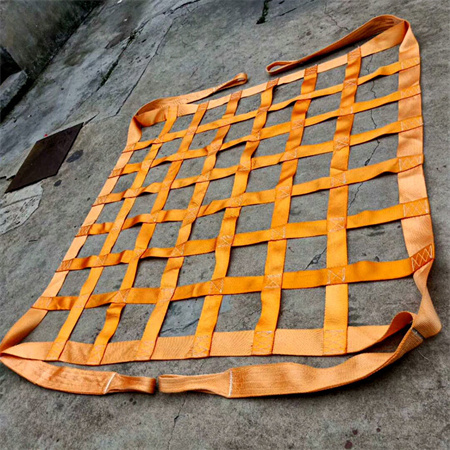
Extra Large Capacity Cargo Net
-
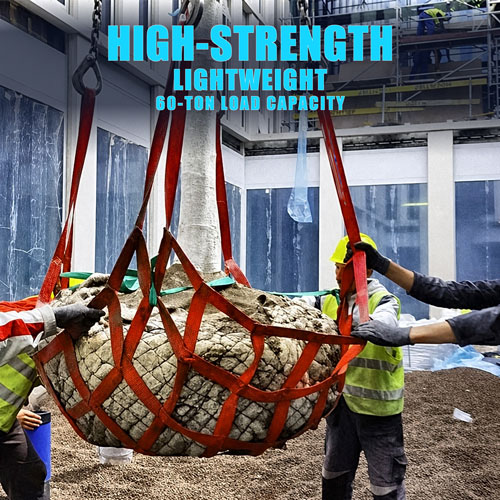
Cargo Webbing Net
-

Color changing nylon double buckle loop nylon braided rope
-

Two end buckle lifting rope, double buckle round lifting rope, double fork nylon lifting rope, non jointed nylon lifting rope
-

Emergency escape lifeline, fire escape rope, fire safety escape emergency rope, steel wire core fire rope

