 Language
 简体中文
简体中文
- On the 2018 National Day holiday, Lifet completed six 100 ton large tonnage lifting belts as a gift
- The role of suspension net in the transportation of goods turnover
- Cargo soft lifting net, lifting net, lifting net, lifting net, bag, climbing net
- Precautions for using Lifutiden elevator
- How to make circular lifting straps
Contact: Wang Lili
E-mail:18066002268
Phone:702461526@qq.com
Address: Lifute Industrial Park, Taizhou City, Jiangsu Province

Lifute Hoisting Co., Ltd. 18066002268 produces DuPont wire power construction insulation rope, power guide rope, cable laying rope. The three phrases in this page‘s name are usually read as three descriptions of one rope. They are three different jobs on the same kind of site, and only one of the three is an electrical job. A power guide rope is a pilot line: pulled through first, then used to draw something heavier behind it.
Hits: ℃
Release time:2026-09-28 10:02
Lift Sling Rigging Co., Ltd manufactures DuPont wire power construction insulation rope, power guide rope, cable laying rope. DuPont Wire Power Construction Insulation Rope, Power Guide Rope and Ca ble Laying Rope — The Job Stage by Stage, and Where Each Rope Actually Belongs
DuPont Wire Power Construction Insulation Rope, Power Guide Rope and Cable Laying Rope — The Job Stage by Stage, and Where Each Rope Actually Belongs
The short answer. There is a way of reading this page that makes all three names unnecessary, and it is the way the work actually runs. A cable installation is a sequence: somebody surveys a route, a light line goes through first, a heavier line is pulled after it, the cable follows the heavier line, and then everything is cleaned up and put away. Each of those stages consumes a rope, and each stage demands something different from the one before it.
Read the names that way and they stop overlapping. The power guide rope is the stage where the light line goes through. The cable laying rope is the stage where the pull happens u nder tension. The insulation rope for power construction is not a stage in this sequence at all — it belongs to the live-working part of the job, where the question is contac t with energised parts, and it is the only one of the three that carries an electrical qualification. That single observation does more useful work than any comparison of materials, because the most e xpensive mistake on these jobs is not choosing the wrong fibre. It is carrying a rope across a stage boundary, which is a mistake about sequence, not about material.
So this page follows the job. It sets out the stages and which rope belongs at each; what the route decides before anything is chosen; the two pulling stages, with the pilot line treated as what it is — the cheapest rope that decides whether the expensive part works; the pull itself, where tension, rate and the stopped cable are decided; and the duct mouth, which is the one point where most of these jobs are actually won or lost. Then the handover points, where duty changes and where mistakes enter; why the insulating article sits outside the sequence entirely and what governs it; and final ly what happens after the pull — recovery, cleaning, drying, and the decision about the rope itself.
One thing is not a stage and is dealt with early, because it appears in the name and would otherwise sit there unexplained. DuPont is a company and a fibre brand. Section 2 states plainly what this manufacturer will and will not claim about it, and what to write on an order if a named fibre is a requirement rather than a preference.

The page's own photograph, and the right place to start a page about sequence, because it shows the two marks that matter at a h andover. The rope is braided, so its outer sheath is a continuous woven structure. Through that sheath run red tracer yarns — woven in, not printed on, which is why b eing dragged through a duct cannot rub them off. Around the coils are yellow bands, which are what a person reads before they pick the rope up. Now look at what the picture cannot tel l you, because this is the point of the whole page: there is no test, class, rating or approval mark anywhere in it, so nothing here says whether this is the insulating article or an ordinary working line. That is precisely why the handover stage in Section 7 needs both marks — the woven one that survives, and the band that gets read — and why a site with only one of them will eve ntually carry a rope across a boundary it should not cross.
1. The Job Stage by Stage, and Which Rope Belongs at Each
This table is the spine of the page. Read it as a sequence from top to bottom, because that is the order the work happens in and the order the ropes are chosen in. The last row is not a stage: it i s the part of the job that runs alongside, and keeping it out of the sequence is the whole discipline.
| Stage | Which name applies | What the stage demands of the rope | What ends the rope's usefulness here |
|---|---|---|---|
| Route survey | None yet — but this is where the rope is chosen, not on the morning of the pull. | Nothing of the rope. Everything about the rope comes out of this stage: length, bends, duct material, the shape of th e entry, the expected pull. | Nothing. If this stage is skipped, the rope that fails later was failed here. |
| Pilot line installed | power guide rope | Enough length to cross the route with an allowance, light enough to handle and to fit the route, and strong enough to then pul l the heavier line behind it. | Being too short, and being abraded where it was dragged in. It is the cheapest rope on the job and it is the one that has to s urvive the worst-unknown part of it. |
| Joint made and pull rigged | Both pulling ropes, plus the connection between them. | The pilot line must be joined to the pulling line through something that will pass the route and will not twist free. The join t is a component, not a knot of convenience. | A joint that cannot be inspected, or that has to be made up hand-tight because nothing else is available. |
| The pull | cable laying rope | Tensile capacity against the real tension with an allowance, elongation low enough that the tension gauge means something, and abrasion resistance exactly where it is needed. | Friction and heat at the entry, and a stalled cable treated with more tension instead of a procedure. |
| Recovery and clean-up | Both pulling ropes again, and this is where the next job's failures are planted. | Inspection, cleaning, drying where required, and an honest decision about whether the rope is still the rope it was. | Being coiled away wet and dirty because the job ran late. Nothing on this page is lost more often than this stage. |
| Live working (runs alongside, not in sequence) | insulation rope for power construction | A documented electrical qualification, and the handling and storage that keep the article in the condition it was tested in. N othing to do with pulling performance. | Moisture, contamination and surface damage — none of which requires the rope to be worn out, and none of which is visible as a loss of the property. |
Two consequences follow from reading it as a sequence rather than a catalogue, and both are worth stating before anything else on the page.
The stage decides the rope, not the other way round. A site that buys one kind of rope and uses it everywhere is not saving money; it is paying for each stage's demands twice, once in rope and once in the failure. The middle of this sequence is where the tensile capacity is needed, the beginning is where length and handling are needed, and the end is where the condition of the rop e is decided. Those are three different requirements, and the only one that can be served by an insurance policy is the first.
And the insulating article is not a better version of the other two. It is not the top of the range, and a site that treats it as the premium option for all the pulling work has misun derstood it in both directions: it will pay for an electrical qualification it is not using, and it will drag the article through exactly the conditions — grit, wet, abrasion — that destroy the qualif ication it paid for. The separation is a matter of sequence, and that is why it is drawn on this page as a row outside the sequence rather than a column inside it.
2. "DuPont" Names a Fibre, and This Job Is Decided by Other Things
The word sits in front of all three names and explains none of the stage demands above, so it is worth disposing of early and precisely.
DuPont is a company, and it is also used in this trade as a fibre brand name. In the Chinese market a rope is often called a "DuPont rope" in the same careless way a rope elsewhere is called a "nylon rope". That is harmless in conversation and it is dangerous on an order, because the word displaces the questions the sequence above actually asks: how long, how heavy, how strong, ho w much stretch, how well it takes abrasion at the entry, and — for the live-working stage — whether the article holds an electrical qualification at all.
This manufacturer's position is three sentences, and they are the ones we will stand behind on a quotation.
A brand name is not a specification. It does not state diameter, construction, tensile capacity, elongation, or any electrical qualification. A branded fibre does not make a rope an i nsulating article, and an insulating article does not have to be that brand. The two questions are independent, and only one of them is answered by the word in the title.
We do not claim a branded-fibre origin unless the documentation is on the order. Fibre of the same general type is produced by several makers under several names, and for a rope buyer the construction and the test matter more than the label on the yarn. So: if a named fibre is a requirement for you, write it as a requirement, and it will be confirmed in writing against the batch d ocumentation. If it is a preference, buy by type and by test, where the specification is checkable by somebody who is not in the conversation.
And the useful part: what the brand word displaces is the question that governs the job. A buyer who has settled the fibre question has settled perhaps the least consequential of the decisions on this page. The stages in Section 1 are decided by length, weight, tension, route and condition — none of which is a fibre name. Section 3 begins with the stage that decides more of them t han any other, and it happens before a rope is chosen at all.
The argument about what a branded fibre does and does not decide for a lifting article is made properly elsewhere on this site and is not repeated here: it is set out on the DuPont flexible sling page. This page keeps the brand word where the client's own name puts it and then moves to the work.
3. Before Anything Is Chosen: What the Route Decides
The first stage consumes no rope and decides almost everything. A pilot line is not chosen from a catalogue; it is chosen from a survey, and five things about the route settle it.
| What the survey has to establish | Why it decides the rope | What goes wrong if it is not established |
|---|---|---|
| Total route length, including every bend and any offset | It sets the length of the pilot line with its allowance, which is the single most common way a pilot stage fails. | A line that runs out mid-route, and a decision made on site about how to join another one to it — which is how un-inspectable joints get into the job. |
| The number, severity and position of the bends | Bends add friction, and friction is what the pulling tension has to overcome. Each one is also a place the rope is pressed aga inst a surface. | A tension allowance that is far too optimistic, and a rope that is asked to carry what the survey never counted. |
| The duct material and its internal condition | It decides how much friction the run will have, whether the bore is smooth or aggressive, and whether debris will be dragged a long with the rope. | Abrasion concentrated in places nobody predicted, and a route that behaves unlike the one the tension figure was calculated fo r. |
| The shape and radius of the entry, and what can be done to it | This is where the pull is fought (Section 6), and the survey is the last moment at which it can be changed cheaply. | A sharp entry that consumes ropes job after job, and a budget that keeps being spent on stronger rope instead of a better bell mouth. |
| The expected pulling tension, and how it will be measured | It sizes the pulling line, and it is the only figure that makes the pull controllable rather than hopeful. | A rope chosen by diameter because nobody had a figure, and a pull that cannot be described afterwards in numbers. |
Two notes about how this stage is usually run, both of which cost nothing to fix.
The survey should produce a rope order, not a sketch. If the route has been walked and its length, bends, duct and entry are known, then the pilot line's length and the pulling line's capacity fall out of the survey arithmetically. If those numbers are not written down, the rope will be chosen at the store by whoever is standing there, and the first time anyone checks the decision will be when something fails.
And a photograph of the entry is worth more than a paragraph about it. Where the rope will meet its governing point, one picture with something in it for scale settles in a single mes sage what three descriptions of "slightly sharp" will not. Every enquiry we handle on this page is easier when it arrives with that picture, and Section 10 asks for it by name.
4. The Pilot Line: The Cheapest Rope That Decides the Whole Job
The pilot stage is where a site is most tempted to economise and where doing so is most expensive, for a reason that is easy to state: the guide rope is what pulls everything that comes after it. I t is the first rope into a route nobody has yet tested, and if it fails, the failure is not a cheap failure — it is a stoppage in the middle of a route with a line in it.
What the stage actually asks of a pilot line comes down to four things, and they pull in different directions.
Length, with a real allowance. The line has to cross the route and have something left at both ends to work with. An allowance is not padding; it is what makes it possible to recover the line and to make the joint off comfortably. A short pilot line is the failure that requires another rope, another pass and another risk, so the allowance is the cheapest insurance on the job.
Weight, because it is carried and handled by people. This stage is usually done by hand, over a route that is often not yet tidy. A line that is heavy is a line that slows the stage, tires the crew, and invites shortcuts at exactly the point where the route is being learned.
Enough strength to pull the line behind it, with an allowance for the fact that the route is unknown. This is the subtle one. The pilot line's own load is small, so it is easy to size on its own load and be wrong — because its real duty is to drag a much heavier pulling line through a route whose friction has not yet been measured. The rope that is cheapest per metre should not be come the rope that decides whether the job continues.
Toughness in exactly the way it will be used. A pilot line gets dragged over the route's edges, through its bends, and past whatever is in the bore. That is abrasion at the places the survey could not fully characterise, which is why the pilot stage is the one where a tolerance for being dragged matters more than a refined strength figure.
And one thing the stage does not ask for, which is worth saying because it is so often supplied anyway: a pilot line does not need an electrical qualification, and buying one for t hat duty spends money on the wrong property and then puts a qualified article into the conditions that ruin it. That is Section 8's subject, and it is the most common way an insulating rope is lost.
5. The Pull Itself: Tension, Rate, and the Cable That Stops
The pulling stage is the one the whole job is organised around, and it is also the stage where the fewest decisions are actually made — because by then the rope is chosen and the rig is built. What remains is control, and control comes down to four things a crew can hold in mind while the winch is running.
Tension has to be watched rather than felt. A cable laying rope is sized against an expected pulling tension, and that figure only means something if somebody is measuring what is act ually happening. A gauge on the pull is not instrumentation for its own sake: it is the difference between a rope working inside its allowance and a rope being used up, and it is the only way to expla in afterwards what the pull demanded. Where a site has no tension measurement, the rope's rating is a hope and the survey's figure was wasted.
Rate matters for a reason that is easy to miss. Pulling is friction work, and friction work becomes heat at the points of contact — the entry above all. A rope drawn over a surface at speed with a load on it gets warmer than anyone expects in a place nobody is looking. Heat damage to a synthetic rope is a change in the material rather than a mark on the surface, and it presents la ter as stiffness and brittleness. Keeping the rate sensible is not caution for its own sake; it is how the heat actually generated at the entry is held down.
Elongation is why the gauge and the cable agree. A pulling line with high stretch extends as the load comes on, and stores energy that returns when the load releases. On a real instal lation that shows up as a loss of control at the moment the cable starts to move, and as a line that cannot be held at the tension you thought had been applied. Low elongation is what makes the pullin g force mean what the instrument says, and it is the property most often left out of an order even though it is the one that governs the feel of the pull.
And the stopped cable is where discipline is either present or absent. A cable that stops moving has told you that the resistance has exceeded what the arrangement can shift, and the available responses are to find out why, to reduce the resistance, or to increase the force. Only the first two are methods. Increasing the tension converts a mechanical problem into a rope problem, a nd it does so precisely when the rope is already at or beyond what the survey predicted — which is the moment when the allowance on the pulling line stops being an allowance. The procedure for a stall ed pull should exist before the winch is started, and it should not consist of the word "more".
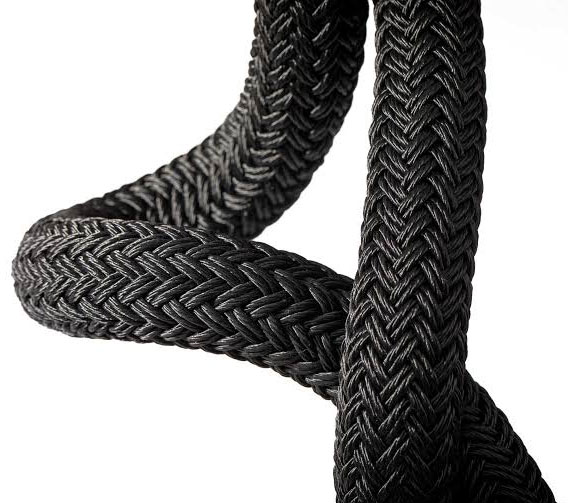
What is carrying the tension during the pull, seen close up. The outer sheath in this picture is a continuous woven structure ru nning the whole length of the article, not a wrapping applied over a finished rope; that is the layer that meets the duct, takes the abrasion, and transmits the load. Two consequences belong to this s tage. First, a sheath of this kind distributes the load rather than concentrating it, which is part of why a braided pulling line behaves the way it does under tension. Second, it is a surface: everything that happens to the rope at the entry happens to this layer, and a sheath that has been glazed, flattened or worn smooth has already been through the process described in this section. N othing in the photograph shows the tension the rope is carrying, and nothing in it shows whether the rope is within its allowance — that is what the gauge is for.
6. The Duct Mouth: Where These Jobs Are Actually Won or Lost
Ask an experienced crew where a pulling rope dies and the answer is usually the same point, and it is a point that is built, not bought. At the entry to the route, two things meet: a change of dire ction, and the highest tension of the run. The rope is pressed against the edge while being dragged across it. Everything that follows is a consequence.
| Property of the entry | What it does to the rope | What is worth doing about it |
|---|---|---|
| The radius of the edge the rope turns over | It sets how concentrated the pressure is. A small radius presses the load into a few filaments; a generous one spreads it over more material. | Increase it. A properly formed bell mouth or a roller at the entry is the single highest-value change available on most instal lations. |
| Friction at the contact | It adds directly to the pulling tension and it generates the heat described in Section 5. It is also the part of the resistanc e that robs the rope of its margin. | Reduce it — by radius, by a roller, or by the lubricant the cable maker permits. Removing the cause beats resisting the effect . |
| Debris and grit carried to the entry | It turns a smooth contact into an abrasive one, and it is dragged along the rope rather than past it. | Clean the entry as part of the job, not as an afterthought. A swept entry is cheaper than the metre of rope it saves. |
| Whether the rope is aligned with the bore as it enters | Misalignment puts the angle change into the rope instead of into the hardware, which is where the concentrated pressure comes from in the first place. | Set the winch and the entry so the rope runs fair into the bore. This costs nothing and is routinely skipped. |
| Whether the entry is treated as a component of the job | If it is nobody's responsibility, it is the place where every failure in the sequence arrives at once. | Give it an owner at the survey stage, and record what was done. Sections 3 and 10 both assume somebody has. |
One conclusion follows that is worth stating as bluntly as it deserves. When a site finds that its pulling ropes keep dying in the same place, the instinct is to buy a stronger rope. That answer resists the effect instead of removing the cause, and it is the more expensive of the two by a wide margin, because the money is spent again on every future pull. A bell mouth with a prope r radius, an aligned entry and a swept bore do not consume themselves, and they make every rope in the store last longer — including the one that was previously being blamed.
And a note about the entry that applies to the whole page rather than only this section. The entry is the one place in the sequence where a rope's condition is decided in a way that can be predicte d, measured and designed out. That makes it the place where the survey, the hardware and the rope choice all meet, and the reason this page spends a section on it rather than a paragraph.
7. The Handover Points: Where Duty Changes, and Where Mistakes Get In
A cable installation is a sequence, which means it is mostly made of joins — between stages, between machines, between pieces of rope, and between shifts. These are the points where a rope changes duty, and they are structurally where the wrong article ends up doing the wrong job. There are five of them, and they are the same five on almost every job.
| Handover | What has to change hands | The mistake that gets in here |
|---|---|---|
| Survey to store | Route length, bends, duct material, entry condition, expected tension — in writing. | A requirement that exists only in somebody's head, so the rope is chosen by what is on the shelf rather than by the route. |
| Store to site | The right rope for the stage, identified as such, with its condition known. | The cardinal one. Ropes of different duties look alike, sit on the same shelf, and are the same colour often enough that memory is the only thing separating them. |
| Pilot line to pulling line | A joint between a light line and a heavy one, made up so that it passes the route and the tension can be applied through it. | A joint improvised on site because the right connector was not ordered, and a joint nobody can inspect afterwards. |
| Shift to shift | What has been pulled, how hard, where the rope has been, and what happened to it. | A rope that has been wet, dragged through grit or left in the weather, handed on without anyone being told — and then relied o n for something it no longer is. |
| Live working to the pulling crew (or the reverse) | A clean separation between the articles used near energised parts and the articles used in the pulling sequence. | The insulating article borrowed for a pull, or a pulling line carried into the live-working part of the job. Both directions c ost the qualification, and neither is visible afterwards. |
The rule that follows from the table is short, and it is the reason Section 1 puts the insulating article outside the sequence: the identification of a rope has to survive the handover, bec ause that is where the decision is made. Nobody re-derives the rope's qualification on the morning of the pull; they pick up the rope that is there. So the marking has to do three jobs at onc e — a woven tracer that survives everything the rope is dragged through, a band that states what the article is, and paperwork filed where the method is written — and a site that has only one of the t hree has built a handover it cannot control.
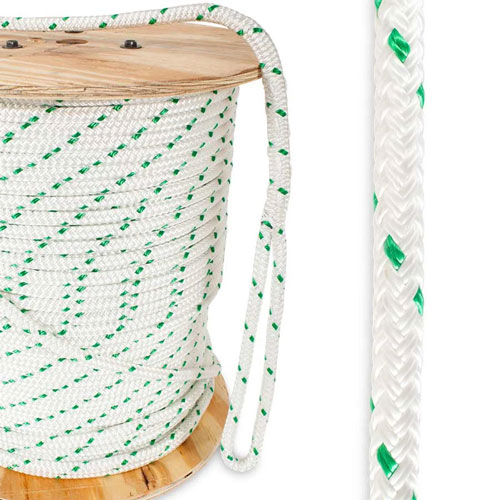
The marking that survives a handover, and what it can and cannot establish. The tracer on this rope is green; on the rope at the top of the page it is red. Both are woven in, which is the whole point at this stage: a mark that is part of the braid cannot be rubbed off by the route, cannot be cut away with a worn band, and cannot be left in the van. Note also that the tracer is intermittent, appearing and disappearing along the length — which means it identifies the rope by type and not as an indiv idual article. That is enough for somebody reaching for a rope at six in the morning to know what they are holding. It is not enough to carry a test reference, a length, or a batch, which is why the b and and the paperwork exist alongside it and not instead of it.
8. The Insulating Article Is Not a Stage in This Sequence
Everything so far has been about pulling. The third name in the line is about something else, and the sequence reading makes the difference unusually clear: the insulation rope for power co nstruction does not appear anywhere in the stages of a cable pull. It belongs to the live-working part of the job, it is judged by a different set of rules, and the only thing it shares with the other two is that it happens to be a rope.
What governs it is its own standard, and there are two documents either side of the Atlantic that carry the subject. The international one is IEC 62192, Live working — Insulating ropes, pu blished in the same text in Europe as EN 62192. The corresponding specification for rope with special electrical properties is ASTM F1701, and its full title is worth reading twice: Standard Speci fication for Unused Rope with Special Electrical Properties.
That word in the title is the most useful sentence on this page for any buyer. A specification written for unused rope is telling you that the electrical qualification is a property o f a new article. It is not a wear allowance. It is not a rating that declines gradually and predictably. It is not maintained by the rope serving well, and no amount of inspection res tores it once it has been lost. These articles are also examined and tested in more than one condition — dry and wet — with the wet condition being the one that matters, because it separates an articl e that is genuinely insulating from one that merely happens to be dry at the moment. Modern practice adds a further step: articles of this kind are routinely checked for dielectric behaviour in the fi eld, before use and at intervals, rather than relying only on the factory test.
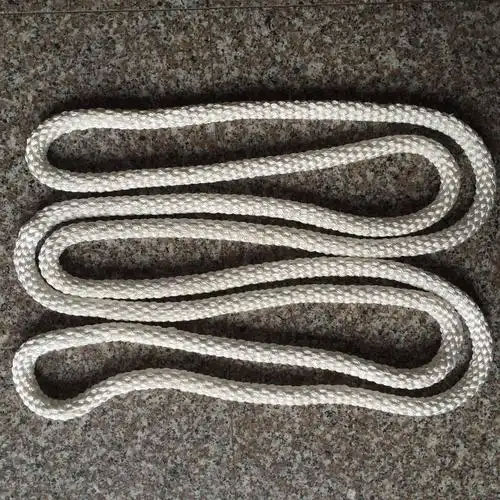
The surface the qualification actually rests on, in a photograph that cannot confirm it. This rope is new, clean, dry and undefo rmed, which is exactly the condition the electrical qualification applies to, and there is still nothing in the picture that says whether it holds one. A rope with a test behind it and a rope being so ld on its appearance look identical here. That is the difficulty in one image: the condition can be seen, the property cannot — which is why Section 9 treats storage and drying as the property itself rather than as care and maintenance, and why an article coiled away wet is no longer the article that was tested, however sound it looks in the morning.
Put that beside the pulling stages and the consequences for the sequence are immediate and practical.
The insulating article must not be used as a pilot line or a pulling line. Those stages are designed around being dragged through grit and wet, and every one of those conditions is pr ecisely what takes the qualification away. Using the article there spends the qualification and gets no pulling benefit in return, because the construction that keeps a rope clean and dry is not the c onstruction that maximises grip and abrasion life.
And the pulling ropes must not be carried into the live-working part of the job. They are working lines. They have been in the duct, in the grit, in the weather, and possibly in the m ud; whatever they may be made of, they are not articles with an electrical qualification and they are not in a condition to be treated as one.
Two honest boundaries belong with this section, because this page would rather be useful than flattering. This page does not quote a voltage class, a test voltage or a leakage figure.Those belong to the standard, to the edition your own procedure references, and to the documentation of the specific article; a class printed in a catalogue line, unattached to a test on that rope , is exactly the kind of claim the sequence above exists to prevent. Ask for the class, the test and the document together. And an insulating rope is not a substitute for a safe method.The article reduces the consequences of contact; it does not make contact acceptable and it does not replace isolation, approach distance or the permit the work requires. Where the site's method sa ys the line is to be treated as live, the article is one of the controls in that method and never the only one.
9. After the Pull: Recovery, Cleaning, Drying, and the Decision
The last stage consumes no tension and gets the least attention, and it is where the next job's failures are planted. What has to happen after the pull is decided by what the rope has been through, and by which of the three it is.
| After the pull | Pilot line and cable laying rope | Insulation rope for power construction |
|---|---|---|
| Inspect | Along the whole length, both faces and both edges, looking above all at the zones the route actually worked — the entry, the b ends, and wherever the rope was dragged. | The same, plus the surface condition that the qualification depends on. The published removal criteria for a synthetic article differ from what matters here, and the distinction is argued on the page named at the end of this one. |
| Clean | Worth doing, because grit left in a rope abrades it from the inside on the next job. | Part of the specification, not housekeeping. A surface carrying a foreign layer is no longer the surface that was tested, and deposits that conduct are the worst case. |
| Dry | Good practice, and normal for storage. | The condition of the article. Dried through the whole braid, in air, away from heat that would damage the fibre — and never coiled away wet, which is how a rope is issued in a conditi on it was never tested in. |
| Decide | A judgement on visible damage and remaining life, made by somebody competent to make it. | A judgement that cannot be made by looking, because the property has no appearance. It needs a rule about service interval and a rule about what triggers a re-check — a wetting, a contamination, a hard pull, a drop, or time. |
| Store | Coiled, off the floor, out of the weather, and away from anything that will cut or compress it. | All of that, plus physically separate from the working lines. The most likely way to lose the qualification i s not a rope failing; it is a handler picking up the wrong one because both were coiled on the same shelf. |
Two things about this stage are worth saying plainly, because both are cheap and both are routinely missed.
Write the tension down. The record from the pull — the figure the gauge showed, where the resistance came from, what the entry did — is the only input that makes the next survey bette r than this one. A rope that is retired after a hard pull is a rope that paid for information, and information that is not written down is thrown away with it.
And keep the insulating article's history in the same place as the method. Its qualification rests on documentation and on the regime that preserved its condition, so the record of wh en it was last dry, where it has been, and what it holds a test for belongs with the procedure rather than in the packaging it arrived in. This is the least glamorous sentence on this page and it is t he one that decides whether the article is still the article it was bought as.
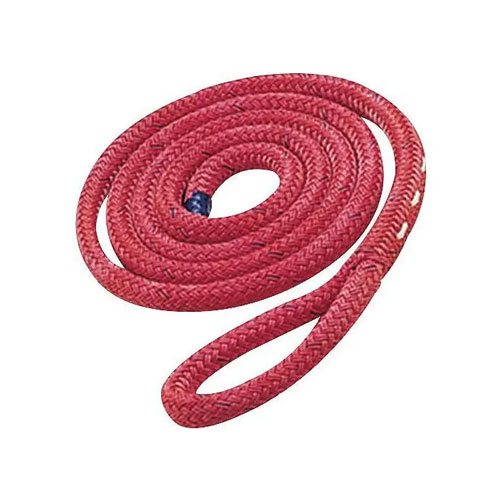
The end of the sequence, and one more thing the colour cannot be trusted for. This rope is red, the rope at the top of the page is white with a red tracer, and the rope in the sheath photograph is black. Colour on these articles does three genuine jobs — it makes a line visible against ground and against other lines, it lets a site assign its own colours to its own stages, and it lets a coil be identified from a distance without uncoiling it — and there is one thing it must never be asked to do. There is no colour that means insulating. A red rope can be an ordinary cable laying rope and a white one can be the tested article, and the reverse is equally true. That is why the decision at the end of a pul l has to be made from the marking and the record rather than from the coil, and why a site that trusts the colour will eventually make exactly the handover mistake Section 7 is about.
10. What the Order Has to Say, Stage by Stage
An enquiry for this family is easier to write and far easier to answer when it is organised by the stages above rather than by properties. Eight lines do it, and the first is the one that keeps the other seven honest.
| Line | What to write | Which stage it serves |
|---|---|---|
| 1. The stage, named | Pilot line, pulling line, or the insulating article for live working. If a rope is wanted for more than one, say which is prim ary and say it explicitly. | All of them — this is the line that decides which article the rest of the order is about, and it is the one an order most ofte n leaves out. |
| 2. The route, from the survey | Length including bends, duct material and bore condition, entry shape and radius, and the expected pulling tension with how it will be measured. | Pilot line and pulling line. These figures size both, and they are the reason the survey stage exists. |
| 3. Length, with the allowance stated | Finished length, and whether it is the route length or the route plus working ends. | The pilot stage above all, where running out is the classic failure. |
| 4. Diameter, construction and elongation | Diameter, braided or laid, single or double braid, and the elongation the pull can tolerate. | The pull, where elongation decides whether the tension figure and the cable's behaviour agree. |
| 5. The joint and its hardware | How the pilot line will be connected to the pulling line, and what has to pass the route with it. | The handover between the two pulling ropes, which is where improvised joints appear when the hardware was not ordered. |
| 6. For the insulating article: the class and the reference | The standard and edition your procedure cites, the class required, and whether field dielectric checks will be performed and a t what interval. | The live-working stage only. This is the single line that decides whether the article is an insulating rope at all, and no oth er line can substitute for it. |
| 7. Colour, tracer and marking | Any colour scheme the site runs, the tracer wanted, and what the band must state — in particular whether it must state that th e article is the insulating one. | The handover points, where a rope is picked up by somebody who reads the band and recognises the tracer and derives nothing. |
| 8. Fibre, ends, packing and documentation | The fibre type and, if a named fibre is a requirement rather than a preference, that it is a requirement. Then the ends, how t he coil is packed, and what paperwork must accompany the batch. | All stages; and the documentation is what carries the live-working qualification to the place where the method is written. |
Three closing notes on the order itself, in the order they save the most trouble.
Write the stage before the material. Almost every mismatch in this family begins with an order that named a fibre and left the duty to the supplier. The stage is the specification; th e fibre is a line inside it.
Send the picture of the entry. Section 3 asks for it and Section 6 explains why it governs. Where a route has an entry that anybody would describe as awkward, one photograph with some thing in it for scale will produce a better quotation than any amount of adjectives.
And where the three duties are genuinely mixed on one site, buy them as marked articles and store them apart. That is not a storage tip, it is the control that Section 7 depends on: t he failure that matters most here is not a rope breaking, it is a sound-looking rope being used at a stage its qualification does not cover, with nobody able to tell.
Frequently Asked Questions
What is the difference between a power guide rope and a cable laying rope?
They are two consecutive stages of the same job. The power guide rope goes through the route first — it is the light line that establishes the path, and it is then used to pull something heavier be hind it. The cable laying rope is that heavier line: it carries the pulling tension and drags the cable in. A pilot line is chosen for length, weight and handling; a pulling line is chosen for tensile capacity, low elongation and abrasion resistance at the entry. Buying one to do both means compromising both.
Where does the insulation rope for power construction fit into that sequence?
It does not, and that is the most useful thing this page can say. An insulation rope for power construction belongs to the live-working part of the job, where the question is contact with energised parts. It is not a premium version of either pulling rope; using it as one spends the qualification it was bought for and gains nothing, because the construction that keeps a rope clean and dry is no t the construction that maximises grip and abrasion life.
Is a rope called a DuPont rope automatically an insulating rope?
No. DuPont is a company and a fibre brand; an insulating claim is an electrical qualification of a finished article. A rope can be made of a branded fibre and be an ordinary working line, and an in sulating article need not be that fibre. Appearance, colour and brand tell you nothing about the qualification, which is why the class, the test and the document are what to ask for.
What does the word DuPont in the name actually specify?
Loosely, a fibre type — and nothing else. It does not state diameter, construction, tensile capacity, elongation, or any electrical qualification. If a named fibre is a requirement for you, write i t on the enquiry as a requirement and ask for the batch documentation; that turns a name into something confirmable. This manufacturer does not claim a branded-fibre origin unless the documentation is on the order.
How do I size a cable laying rope?
From the real pulling tension with an allowance, and from the route rather than from the cable weight alone. Friction over the whole run, the number and severity of bends, and the internal conditio n of the duct all add to what the rope has to carry. Then add margin for the abrasion the entry will take, because the strength figure describes a new rope and the rope in service is no longer new. If nobody can state the expected tension, the survey stage was not finished.
Why does our pulling rope always fail at the duct mouth?
Because that is where a change of direction meets the highest tension of the run: the rope is pressed against an edge while being dragged across it. The remedies that work are at the entry rather t han in the rope — a generous radius, a proper bell mouth, a roller, a fair lead into the bore, and an entry that has been swept clean. Upgrading the rope resists the effect; fixing the entry removes t he cause, and it makes every rope in the store last longer.
Does elongation really matter on a pulling job?
Yes, and it is the property most often left off an order. A high-stretch pulling line extends as the load comes on and stores energy that returns when the load releases, so the pull loses control e xactly when the cable starts to move and the tension you believe you have applied is not the tension in the rope. Low elongation is what makes the gauge and the cable agree.
What should we do when the cable stops moving?
Find out why, or reduce the resistance — those are the methods. Increasing the tension converts a mechanical problem into a rope problem at the moment when the rope is already at or beyond what the survey predicted, which is exactly when its allowance stops being an allowance. A procedure for a stalled pull should exist before the winch starts, and it should not consist of the word more.
Can an insulating rope be used in the rain or in a wet duct?
It can be used in wet conditions as a working line, but a wet rope should not be relied on as the insulating article, because the wet condition is precisely what the qualification is tested against . The practical arrangement is a second article, so that one can dry while the other works. A rope that has been wet has to be dried through the whole braid, not just on the surface, before it returns to insulated duty.
Is there a cut class or a wear class for these ropes?
Not in the sense a buyer usually means. A lifting standard contains no cut class because cut ratings belong to the standards written for gloves and protective clothing, and measured on those articl es. For the ropes on this page the honest position is the same as for wear: the words describe constructions rather than grades, and what can be quoted is the construction, the test where one applies, and the figure for the article.
What marking should the rope carry?
Three layers, because no single one covers a handover. Tracer yarns woven into the braid identify the type permanently and cannot be rubbed off by the route. A band at the coil states what the arti cle is and, for the insulating article, the reference of the test it holds. And the batch paperwork carries that reference to where the method is written. A site with only one of the three has built a handover it cannot control.
What should I send with an enquiry?
The eight lines in Section 10, organised by stage: which of the three articles, the survey figures for the route, the length with the allowance stated, diameter, construction and elongation, the jo int and its hardware, the class and test reference for the insulating article, the colour, tracer and marking you want, and the fibre, ends, packing and documentation. Add a photograph of the entry wi th something in it for scale.
Contact Lift Sling Rigging Co., Ltd
The power guide rope and the cable laying rope are made to order in braided construction at the diameter, length and marking the stage calls for, and the DuPont wire power construction insulation r ope is supplied against the class and the standard your procedure references rather than against a colour or a fibre name. On every enquiry we will say which of the three we are quoting, which stage i t is for, and what the article is and is not qualified to do.
Tell us the stage first, then the route. A pilot line is sized by length, weight and handling; a pulling line by the expected tension with its allowance, the bends, the duct and the entry; the insu lating article by the standard, the class and your intended test interval, because that is the only line that decides whether it is an insulating article at all. Then send the picture of the entry, an d say which of the three duties the rope has to serve if more than one is in the frame. Where the answer is that a rope you already have is being used at a stage it does not belong to, we will say so — that conversation costs nothing and is usually worth more than the quotation.
Three arguments are already made properly elsewhere on this site and are not repeated here. That being non-conductive is not the same as being insulating, and what the distinction does and does not cover, is set out on the cable sling page. What a branded fibre decides for a lifting article, and what it leaves open, is on the DuPont flexible sling page. And the published criteria that retire a synthetic article, with what an inspector should look for, are on the wear resistant flat lifting belt sling page.
Telephone and WeChat: 18066002268
E-mail: 702461526@qq.com
Address: Lifute Industrial Park, Taizhou City, Jiangsu Province, China
HS code: 630790
- Previous:Large tonnage hoisting ropes, large tonnage lifting ropes, large tonnage hoisting ropes
- Next:Firefighting rope
-
Drone Anti-collision Net
-
Extra Large Capacity Cargo Net
-
Cargo Webbing Net
-

Color changing nylon double buckle loop nylon braided rope
-

Two end buckle lifting rope, double buckle round lifting rope, double fork nylon lifting rope, non jointed nylon lifting rope
-

Emergency escape lifeline, fire escape rope, fire safety escape emergency rope, steel wire core fire rope

