 Language
 简体中文
简体中文
- On the 2018 National Day holiday, Lifet completed six 100 ton large tonnage lifting belts as a gift
- The role of suspension net in the transportation of goods turnover
- Cargo soft lifting net, lifting net, lifting net, lifting net, bag, climbing net
- Precautions for using Lifutiden elevator
- How to make circular lifting straps
Contact: Wang Lili
E-mail:18066002268
Phone:702461526@qq.com
Address: Lifute Industrial Park, Taizhou City, Jiangsu Province
Lifute Hoisting Co., Ltd. 18066002268 produces lifting belts, lifting nets, nylon ropes, soft ladders, steel wire rope rigging, paper ropes, safety belts, safety nets, lifting chains, steel coil hoists, crossbeam hoists, flat lifting belts, circular lifting belts, electric traction ropes, high-altitude safety belts, and anti fall safety netsMining reflective lifting belt, single pillar, reflective sling, single hydraulic pillar, anti fall rope. The five phrases in this page‘s name are not five products, and not even five kinds of product.
Hits: ℃
Release time:2026-09-27 16:15
Lift Sling Rigging Co., Ltd manufactures Mining reflective lifting belt, single pillar reflective lifting belt, initial mining support warning reflective belt, coal mining machine pillar lifting be lt, luminous reflective lifting belt. Mining Reflective Lifting Belt, Single Pillar, Reflective Sling, Single Hydraulic Pillar and Anti Fall Rope — The Five Words in the Name, and the Three Different Jobs Behind Them
Mining Reflective Lifting Belt, Single Pillar, Reflective Sling, Single Hydraulic Pillar and Anti Fall Rope — The Five Words in the Name, and the Three Different Jobs Behind Them
The short answer. The five phrases in this page's name are not five products, and not even five kinds of product. They fall into three groups, and the three groups are not intercha ngeable. One of them — reflective — is a property of how the article is seen and says nothing at all about what it can carry. Two of them — single pillar and single hydraulic pil lar — name the thing being handled in a coal face, not the sling that handles it. The last one — anti fall rope — names a different duty entirely, where the article arrests a person rath er than raising a load, under a different set of standards and with a different inspection regime.
So the useful thing this page can do is not to repeat the five phrases. It is to separate them, and then to say what each one obliges a buyer to write down before an order makes se nse. A buyer who asks for a reflective lifting belt and receives a belt that is genuinely reflective but has never been told which of the three visibility mechanisms they meant has bought a marking, n ot a specification. A buyer who asks for an anti fall rope and receives a lifting sling in the same colour has bought the wrong class of equipment.
Everything below is organised around that separation. Section 1 splits the name into its three jobs. Section 2 takes the one word that is most often used loosely — reflective — and splits it into t he three mechanisms it actually covers. Section 3 deals with the two phrases that name mine equipment rather than slings. Section 4 sets the lifting duty and the fall-protection duty side by side and keeps them apart. Sections 5 to 10 cover what the underground environment does to a webbing or rope article, the three forms it can take, the marking that is a legal condition of use rather than decor ation, the inspection that follows from it, the lines an enquiry should carry, and storage.
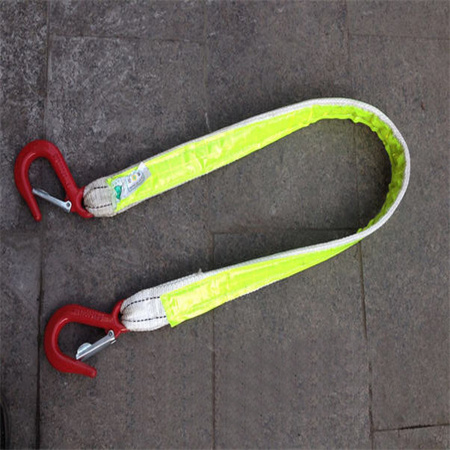
This is the article this page is about, and it is the clearest illustration of the problem the page has to solve. The band is a high-visibility yellow-green, which is a fluorescence and not the same thing as retroreflection. Both ends are folded, closed inside white protective sleeving and stitched, then fitted with red snap h ooks. So the photograph shows a property (the colour), a construction (the sleeving at the ends) and a duty (hooks at both ends, which suits a belt that is passed round something and hooked back on it self). What the photograph cannot tell you is the one thing a specification needs most: what the article is rated for. A fluorescent webbing assembly with two hooks is equally plausible as a lifting b elt and as a fall-arrest lanyard, and those two are built and inspected under different rules. That ambiguity is the whole reason this page exists.
1. The Five Words in the Name, and the Three Different Jobs Behind Them
Read one word at a time, the name on this page separates into three groups that behave completely differently when you try to buy something.
The first group is a property. The word reflective describes how the article is seen. It is a statement about light, not about load. Nothing about the word tells you a fibre, a width, a ply count, a rating or a length, and no amount of reflection will make a 2 tonne article carry 4 tonnes. It is nonetheless the first word a buyer tends to reach for, because visibility is the thing a person notices, and a rating is the thing a person reads off a band later.
The second group names the load. Single pillar and single hydraulic pillar are both ways of writing the same piece of mine equipment: in the coal-mining English of t he standard glossaries the single hydraulic prop is a roof support, an individual steel prop with an internal hydraulic cylinder that is set between the floor and the roof, advanced as the working fac e moves forward, and withdrawn by hand at the end of its row. It is what the sling is being asked to handle. It is not a description of the sling at all.
The third group names a different duty altogether. An anti fall rope is not a lifting article. It arrests a person who is falling. It is built to a different family of standa rds, marked differently, and removed from service on different criteria. Sections 4 and 8 treat this in full.
The practical consequence is that the same five phrases can be read as one product or as three, and only the buyer knows which. The table below is the version of the name this page will work from.< /p>
| Phrase in the name | What it actually names | What it does not tell you | What you have to add |
|---|---|---|---|
| Mining reflective lifting belt | A lifting article that is made visible, used in a mine. Two of the three words are a property and a place; only one is an arti cle. | The form, the fibre, the rating, the length, the ends. Which of the three visibility mechanisms. | Form, fibre, working load limit, effective length, end type, and the mechanism by which it is meant to be seen. |
| single pillar | The load. In a coal face, an individual roof support standing between floor and roof. | Anything about the sling. It describes the work, not the equipment. | The mass being handled, the surface condition, and how the article is meant to be attached to it. |
| reflective sling | A finished article with a visibility property. The word sling implies a form and an end, neither of which is stated. | Whether the body is flat webbing or a sleeved round construction, and whether there is a fitting at either end. | The form and the ends, both of which are separate pages of this catalogue. |
| single hydraulic pillar | The same load, written out in full. In the mining glossaries this is the individual hydraulic prop used as a roof support. | Nothing further about the sling, but it does confirm the duty is handling steel, not carrying a rated load over a distance. | Contact protection at the prop, because a prop has machined edges and hydraulically contaminated surfaces. |
| anti fall rope | A different duty. The article arrests a person in a fall. It is not a lifting article and must not be marked as one. | The rest of the fall-protection system: harness, energy absorber, connector, and anchor, each of which is its own component st andard. | The duty must be stated in writing. A rope sold for lifting is not the same rope as one sold for fall arrest. |
One vocabulary caution before the rest of the page. Single pillar is a working phrase rather than a defined term, and it is used loosely across the industry for more than one arrangement. This page therefore treats the two pillar phrases as a description of the work and not as a certified specification, and it does not offer them as a rating of any kind. If your site u ses the phrase in a narrower sense than the one above, the enquiry lines in Section 9 will still gather everything the order needs.
2. Visibility Is Three Different Mechanisms, Not One Word
The line this page inherited describes the product as luminous reflective in a single breath. Those are two different physical mechanisms, and adding a third — fluorescence — makes three. They are not grades of the same thing, they do not work in the same conditions, and they fail differently. Buying on the word reflective alone leaves the choice of mechanism to whoever packs the order.
Retroreflective material returns a directed beam back toward its source. That is the precise behaviour: light arriving from a lamp is reflected preferentially back along the direction it came from, rather than scattering in all directions. The practical result is that a retroreflective band looks brightest to exactly the person holding the light, and much less bright to everyone e lse. It therefore only performs when something is shining at it — a cap lamp, a machine work light, a headlamp on a vehicle. A retroreflective strip in a genuinely dark place with no lamp pointed at i t is a dark strip.
Fluorescent material absorbs ultraviolet and short-wavelength visible light and re-emits it at a longer wavelength. That is why a fluorescent yellow-green reads as brighter than ordin ary yellow: the material is returning more visible light than falls on it in the visible range, having converted some of the ultraviolet. It performs in daylight and under lamps with the right spectru m, and it adds nothing whatsoever in the dark. The band in the photograph at the top of this page is fluorescent. Without a lamp shone at it in the dark it is simply a pale green band.
Photoluminescent material stores light and re-emits it after the light source has gone. This is the mechanism behind every glow-in-the-dark marking, including the escape-route marking s used in underground workings and tunnels. It is the only one of the three that works with no lamp at all, and it is also the one with the two obvious weaknesses: it has to be charged by prior exposu re to light, and its output fades over the minutes and hours after the light is removed. It is a marking for finding a way out, and it is not a substitute for either of the other two.
The clearest evidence that these are two materials and not two words for one material is in the standard most buyers of high-visibility articles already work to. EN ISO 20471 does not ask a garment to be reflective or fluorescent. It requires both — a minimum area of fluorescent material and a separate minimum area of retroreflective material — and it grades the garment into cl asses by how much of each it carries. A standard that had to specify both areas is a standard that was written by people who know the two are not interchangeable.
| Mechanism | What it does to the light | When it works | When it does nothing |
|---|---|---|---|
| Retroreflective | Returns a directed beam preferentially back toward the lamp that sent it. Brightest to the light holder. | Whenever a lamp, cap lamp or machine light is aimed at the article. | In the dark with no light source aimed at it. With diffuse light it is far less effective. |
| Fluorescent | Absorbs ultraviolet and short-wavelength visible light and re-emits it at longer, visible wavelengths. | In daylight and under lamps with a suitable spectrum. Makes the article stand out against a dull background. | In the dark. Completely. A fluorescent band underground with the lamps off is an ordinary coloured band. |
| Photoluminescent | Stores energy from incident light and releases it slowly afterwards as visible light. | After charging, with the light off. The only one of the three that works in complete darkness. | If it has not been charged, and it fades progressively once the light is removed. |
There is one more thing about visibility that the words do not carry, and it matters more in a mine than anywhere else. A fluorescent colour has a service life. Fluorescent dyes an d pigments are degraded by exposure to light — which is the very thing they are designed to react to — so a fluorescent article that has spent months on a dusty bench under a bright doorway is not the article the photograph shows. Section 10 deals with storage, and the reason it is worth a section is that the property being sold is one that decays.
3. "Single Pillar" and "Single Hydraulic Pillar" Name the Load, Not the Belt
In a coal face, the individual roof support — the single hydraulic prop of the mining glossaries — is a steel prop with an internal hydraulic cylinder, standing between the floor and the roof and h olding the immediate roof up while people work underneath it. Rows of them are advanced as the face moves forward and withdrawn again at the end of their run.
That description is not background colour. It defines the job, because the article that serves a prop is shaped by four things about the prop that have nothing to do with lifting a rated load over a distance.
A prop is heavy, and it is handled in the awkward place rather than the convenient one. A complete single hydraulic prop is a two-person object in most configurations, and it is not l ifted from a pallet in a workshop. It is stood up in the roadway, dragged along the floor, got into position under the roof and pinned there. The load is not the problem; the position is. That is a di fferent duty from a factory lift, and it is the reason a short belt with hooks at both ends is a sensible form for it while a long endless sling often is not.
A prop has machined edges and a base plate. The base, the collar and the valve block are the places where a webbing article gets loaded against a corner. The safe operating practices attached to the US rigging rules are explicit on this point: slings are to be padded or protected from the sharp edges of their loads. On a prop the edge is not incidental to the load, it is part of i t, and the padding has to be planned rather than improvised with a rag from the roadway.
A prop carries hydraulic fluid and general mine grime. The relevance is not chemical attack on the fibre so much as the way contamination behaves in inspection. A wetted, dust-loaded band hides the abrasion and the cut that inspection is looking for underneath it. Section 8 comes back to this, because it changes the order of inspection: look at the article before it goes back on t he rack, not after it has been used again.
A prop is set in the dark. In a working face the lighting moves with the machinery. A prop being set or withdrawn is regularly handled in the pooled light of whichever cap lamp happen s to be pointed that way. That is exactly the condition in which the distinction in Section 2 stops being academic: a fluorescent band does its work here under the cap lamp only if the lens behaves re troreflectively, and a band that is merely fluorescent contributes nothing at all.
So the page carries the pillar phrases because they describe the work, and it holds them apart from the parts of the name that describe the article. Everything about the fibre, the form, the ends a nd the rating is settled by Sections 6 and 9, and none of it can be read off the word pillar.
4. A Lifting Belt and an Anti Fall Rope Are Not the Same Article
The last phrase in the name is a different duty, and the mistake it invites is the most expensive one on this page. The two articles can look alike. Both can be webbing, both can be rope, both can carry hooks, and both can be sold in a high-visibility colour. They are nevertheless different classes of equipment, and the similarity is the trap rather than the reassurance.
A lifting belt raises a load. It is rated to a working load limit, it is built and proof-loaded so that the strength is a large multiple of that limit, and the whole arrangement of th e lift — the angle of the legs, the number of them, the hitch — is designed on the assumption that the article is the strong part of the system and the load is inert. The marking lives on the band, an d the removal criteria are the ones in Section 8.
An anti fall rope arrests a person. The requirement is not strength in the abstract but a controlled maximum arrest force. The European family of personal fall protection sta ndards works to keep the impact delivered to the body below 6 kN, and the component that does that work is an energy absorber rather than the rope. The components are separately standardised and none of them is a rope with a stitched eye: full body harnesses are covered by EN 361, lanyards by EN 354, energy absorbers by EN 355, retractable type fall arresters by EN 360 and anchor devices by EN 795 , and a system is assembled out of components that were each approved for that role. The one component an impact is measured through is the energy absorber, and its job is to keep the force below that limit rather than to hold the load.
The consequences for buying are blunt, and worth stating in plain words.
| Question | A lifting article | A fall-protection article |
|---|---|---|
| What is being held | A load. In this page's case, mine equipment such as a prop or a machine part. | A person, if they fall. |
| What the design is dominated by | Strength and resistance to abrasion at the load's edges. | Limiting the force delivered to the body, which is why an energy absorber is part of the system. |
| What the rating means | A working load limit that must not be exceeded, with a large margin of strength over it. | A maximum force transmitted to the wearer, and a maximum number of users — typically one. |
| Can it be used for the other job | No. A lifting sling has no place in a fall-protection system, and no lifting rating authorises it for one. | No. A fall-arrest lanyard or rope has no place under a load, and its rating is not a lifting rating. |
| What a used one costs you | A dropped load. The article is the strong part of the system and the failure is at the article or the hitch. | A fall, or an arrest force the body cannot take. There is no second chance and no partial result. |
This page therefore sells both duties and keeps them apart in writing. When you order, say which one you are ordering. If you need a rope that will be part of a fall-protection system, it must be s pecified and marked as a fall-protection component and supplied with the documentation that goes with that role. It will not be the same line item as a lifting rope of the same diameter and colour, an d it should not be priced as one.
5. What a Mine Does to a Webbing Article
An underground working is not a hard place to lift in. It is a hard place to keep an article in a condition you can still read. Six things act on a webbing or rope article at once, and the last of them is the one that causes the others to be missed.
| What acts on it | What it does to the article | What it does to your inspection |
|---|---|---|
| Coal and rock dust | Packs into the weave and between the filaments. It is abrasive in its own right, and it is fine enough to work into a rope's s tructure. | It fills the very feature you are looking for. A cut, a snag or a worn patch looks like more dust until the band is wiped. |
| Sharp steel at the load | The props, rails, mesh, conveyor structure and base plates are all edged. A webbing band loaded across a corner loses filament s at the contact point. | Damage is concentrated in a small area and is easy to overlook if you run your eye along the band rather than along the contac t zone. |
| Hydraulic fluid and oil | Wets the fibres and holds dust to them. Repeated contact softens the grime load on the article. | The same effect as dust, and worse, because the oil darkens the band and reduces the contrast you need to read a cut. |
| Water and standing moisture | Keeps the article wet for long periods and carries alkaline or acidic mine water into the fibres, which is one of the conditio ns a synthetic webbing sling is removed for. | A wet band is heavier, darker and harder to read. Discoloration and stiff or brittle patches are easy to attribute to water wh en they may be chemical damage. |
| Heat and spatter | Maintenance welding and cutting around machinery drops hot metal. Melting, charring or weld spatter that reaches the load-bear ing element is a removal condition in its own right. | On a sleeved article, spatter can damage the core without leaving much on the cover. On a flat band it is usually visible, but only if the band is looked at rather than assumed. |
| Darkness | Nothing directly. But it determines whether the article can be found, handled and inspected at all, and whether the colour it was bought for is doing any work. | This is the compounding one. Inspection that happens only in good light happens rarely; inspection that can be done where the article lives happens every shift. |
The sixth row is the reason the visibility property is worth money in this environment and not merely a colour preference. Every mechanism in Section 2 is a way of making a small object findable in a large, dark, busy place. A band that is easy to find is a band that goes back on the rack; a band that is not is a band that gets left in the roadway, run over by a shuttle car, and inspected never .
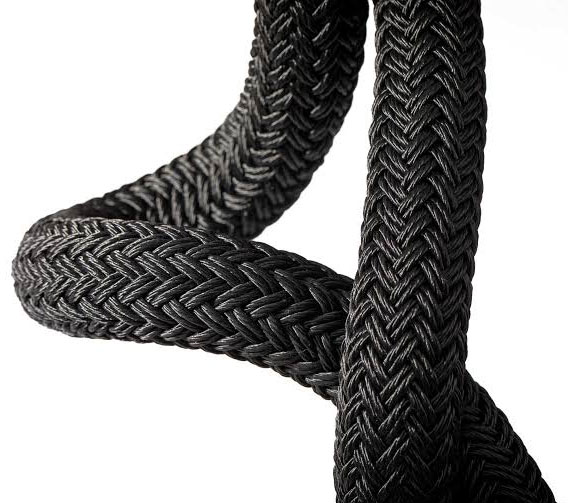
A double-braided rope construction, and a fair illustration of the sixth row of the table above. There is nothing wrong with a b lack rope underground, and black is a perfectly sound choice for a rope that will be dragged along a floor every day. But the colour is not doing any visibility work, and a rope in this colour in this environment has to be judged by feel and by lamp rather than by a glance. That is a legitimate engineering decision as long as it is a decision: the article is being bought for abrasion and for handl ing, and the visibility is coming from somewhere else, or from nowhere at all. A buyer who specifies a dark rope and then asks why nobody can find it has simply not written down two requirements inste ad of one.
6. The Three Forms an Article of This Kind Can Take
Once the three jobs in the name have been separated, the article itself still has to be chosen, and the first choice within it is the form. Three are relevant to this page. Each has a page of its o wn on this site and the arguments are not repeated here.
| Form | What it is | Why you would choose it here | Where it is argued out |
|---|---|---|---|
| Flat webbing belt | A flat woven band, either endless or with an eye at one or both ends, and in this page's case dyed in a visibility colour. | The widest contact face of the three, so the load is spread; the easiest of the three to print a rating on, which is why the p hotograph at the top of this page can be read without a catalogue; and the easiest to see when it is bright. | Endless webbing sling, eye and eye sling, lifting straps catalogue entry |
| Round sling | A load-bearing core of parallel or laid yarns inside a woven protective sleeve, formed into a continuous loop. | The sleeve can be replaced by nothing and protects far more than a flat band's edge treatment; the loop is continuous, so ther e is no stitching in the load path to inspect. The trade is that damage to the core can be hidden by the sleeve. | Endless round sling, eye type round sling, one tonne round webbing sling |
| Rope | A braided or laid rope, supplied in a diameter and cut to a length, with eyes spliced or served at the ends as required. | The only one of the three that is genuinely made to length rather than selected from a range, and the only one that can be thr eaded through a confined route. This is also the form the anti-fall duty lives in, which is precisely why the marking has to say which duty it is. | Double braided nylon rope, cable sling, firefighting rope |
One note on the third row, because it is where the two duties in this page's name come closest to each other. A rope is a rope. The same braid, the same diameter and the same colour can be made up as a lifting line, as a tag line, or as a component of a fall-protection system, and the three are not interchangeable even when the physical object looks identical. What separates them is the standar d they were made and tested to and the marking that records it. If there is one sentence worth carrying away from this page it is that one.
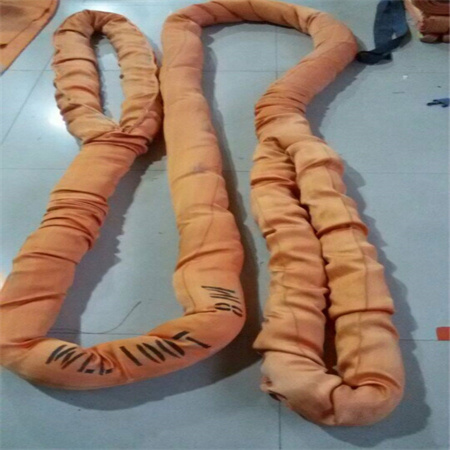
A round sling, and the reason the form choice is not merely aesthetic. Everything doing the work is inside the sleeve; what you are looking at is a cover. That is the strength of the form, because the cover is what the edge of a prop or a base plate actually meets, and it is also its weakness, because a break in the core can s it under an intact-looking cover. The figure printed on the sleeve is the working load limit. The colour of the sleeve is a capacity code for this family and is not part of this page's argument. Read the printed figure, not the colour, and read it before the sleeve is loaded rather than after.
7. Marking: What Is Printed on the Band, and the Label That Travels With It
Marking on a lifting article is not decoration and it is not a courtesy to the buyer. It is a condition of lawful use. OSHA 29 CFR 1910.184 requires that a sling not be used without an affixed and legible identification marking, and the removal criteria for synthetic webbing slings begin, in the first position on the list, with a missing or illegible identification. That ordering is worth pausi ng on: before cuts, before abrasion, before chemical damage, the first thing that takes a webbing sling out of service is that you can no longer read what it is.
This connects directly to Section 2, and it is the reason visibility and marking belong in the same page. Both are about legibility. A fluorescent band with a faded print on it, or a dark sleeve wi th a dark print on it, fails the first removal criterion while being perfectly strong. The property that makes an article easy to find in a roadway is the same property that makes its marking readable in the light available, and in this environment the available light is whatever the person inspecting it happens to be carrying.

Where the rating actually lives. The figures are printed directly on the webbing, in the direction a person handling the sling r eads them, and the reinforced eyes at both ends are sleeved in a contrasting colour so the contact points stand out from the body of the band. Nothing on this photograph is decorative. The print is th e identification whose legibility the removal criteria protect, the sleeving marks where the load enters, and the colour of the body is a capacity code. If a sling came to your site with the print wor n off and no label attached, it would be out of service on that ground alone, however sound the band looked.
A lifting article should carry, at minimum, the working load limit in a language the user reads, the effective length where length matters, the fibre or material, the form, and an identification th at ties the article to its batch and its documentation. Where a customer's site uses a colour code to signal capacity, the colour is a convenience on top of that list and never a replacement for the p rinted figure, because colour convention varies between sites while the printed figure does not.
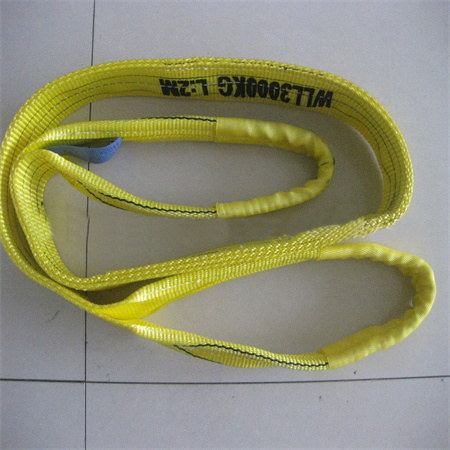
The second half of the marking requirement, and the one most often lost on a mine site. A printed figure can be abraded off a ba nd by the load itself. A separate identification label is what survives that, carries the batch detail, and lets the article be traced to the test record that covers it. On this pair the print and the label are both present, which is the position to be in. An article that arrives with one and not the other is incomplete, and an article that has lost the label in service is a removal item, not some thing to be re-labelled from memory.
8. Inspection: What You Look At, and What Takes the Article Out of Service
The routine is not complicated and it is not optional. A sling and all of its fastenings and attachments are to be inspected for damage or defects by a competent person designated by the employer < strong>each day before being used, with additional inspections during use where service conditions warrant, and any damaged or defective sling is to be removed from service immediately. In a mine the clause about service conditions is doing more work than it does in a warehouse, because the conditions warranting extra inspection are the everyday conditions of the place.
The removal criteria for the two synthetic forms on this page are set out side by side below. They are the removal criteria published in ASME B30.9 and adopted in OSHA 29 CFR 1910.184, reproduced h ere so that an inspector working to this page has them in one place; they are not a substitute for the standard itself or for the employer's own procedure.
| Condition | Flat webbing sling | Round sling | Why this matters underground |
|---|---|---|---|
| Missing or illegible identification | Removal item. Listed first. | Removal item. Listed first. | Dust and oil take the print off faster than any load does. |
| Acid or caustic burns | Removal item. | Removal item. | Mine water is not neutral everywhere. If the water at your site is aggressive, that belongs in the enquiry. |
| Melting or charring, or evidence of heat damage | Removal item. | Removal item. | Maintenance welding happens around the equipment these articles serve. |
| Weld spatter reaching the load-bearing element | Covered by the heat condition. | Removal item where it exposes core yarns. | On a sleeved article, check the cover for burn marks and look inside at the openings. |
| Holes, tears, cuts or snags | Removal item. | Removal item where they expose the core yarns. | The contact zone at a prop edge is where to look first, not the middle of the band. |
| Broken or worn stitching in load-bearing splices | Removal item. | Not applicable; an endless loop has no stitched splice. | A stitched eye is the one place where the strength depends on thread rather than yarn. |
| Excessive abrasive wear | Removal item. | Removal item where it exposes the core yarns. | This is the condition a mine produces fastest, and the one dust hides best. |
| Broken or damaged core yarns | Not applicable. | Removal item. | The reason a sleeved article needs its cover felt along its whole length, not just looked at. |
| Knots | Removal item. | Removal item, except for core yarns inside the cover. | A knotted sling has been shortened in the field, which is itself prohibited. |
| Discoloration, or brittle and stiff areas | Removal item. May indicate chemical or ultraviolet damage. | Covered by the general heat and damage conditions. | Ultraviolet damage is a real route for a fluorescent article, which is made to react to light. |
| Fittings pitted, corroded, cracked, bent, twisted, gouged or broken | Removal item. | Removal item. | Hooks on an article of this kind are hardware with their own removal criteria; inspect them as such. |
One practical addition that is specific to this page and not in the standard. Wipe before judging. A band that has been in a coal face for a shift is a band whose surface is a laye r of dust, and the whole first column of the table above is a list of features that dust conceals. On a sleeved article, run the cover through the hand along its full length as well as looking at it, because a damaged core announces itself as a flat spot or a soft place long before it becomes visible at the openings. And inspect the article's storage place as well as the article: an inspection reg ime that depends on finding the sling in the dark is an inspection regime that will not be operated.
9. Ordering: What to Send, and What the Name Does Not Tell Us
The five phrases in this page's name settle less than half of an order. This section is the list that closes the gap, and it is written as a set of lines to copy into an enquiry, because a message that answers these lines can be quoted from without a further round of questions.
| Line | What to write | Why the name does not cover it |
|---|---|---|
| 1. Duty | Lifting, or fall protection. State it in words. If it is fall protection, say so and say what the rest of the system is. | This is the single most important line and it is the one the name leaves open, because the name carries both duties at once. |
| 2. Form | Flat webbing belt, round sling, or rope. | The name says sling and belt, which between them could mean either of the first two. |
| 3. Working load limit | The rating you need, and the number of legs if the arrangement has more than one. | No figure in the name refers to a rating. Reflective is not a rating and pillar is not a rating. |
| 4. Effective length | The length as it will be measured in use, and whether that is between bearing points or end to end. | Not mentioned in the name at all. Two people quoting the same length can mean two different measurements. |
| 5. Ends and fittings | Eyes, hooks, buckles, or endless; how many at each end; and the fitting type where one is required. | The photograph on this page shows hooks, but the name does not commit to them. |
| 6. Visibility mechanism | Retroreflective, fluorescent, or photoluminescent, and the colour you want the body to be. | Reflective is the word in the name and it does not distinguish between the three. See Section 2. |
| 7. What it will meet | The prop or machine part's mass and surface, whether there are machined edges, whether the article will be dragged, and whethe r the site water is aggressive. | The pillar phrases say what the load is in general terms but nothing about how it will be met. |
| 8. Quantity and pattern | How many, and whether they are wanted as a single order with sleeves, padding and any tags supplied together. | Not mentioned. Buying the padding separately is how padding ends up improvised on site. |
| 9. Marking and language | What has to be printed on the band, and in which language, plus whether your site uses a colour code that has to be matched. | The name says nothing about marking, and marking is the first removal criterion. |
| 10. Documentation | Whether you need a test record per batch, a declaration, or the packing and shipping paperwork to a given destination. | Not covered, and on an export order these decide what travels with the consignment. |
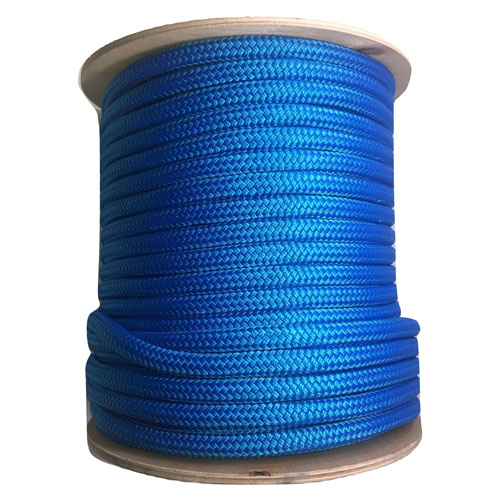
The rope form, on the reel it arrives on, and the reason line 4 of the enquiry is worth getting right. A rope is not selected fr om a range the way a woven sling is; it is cut to a length, and the length is a dimension of the order rather than a property of the product. The same rope on the same reel becomes a lifting line, a t ag line or a fall-protection component depending on what is specified with it and what is marked on it. The reel tells you nothing about which of those it is, which is exactly the point: the duty has to be written down before the rope is cut, not after.
10. Care, Storage and the Article That Decays
Most of this page has been about separating things that look alike. This last section is about a property that behaves differently from every other property on the page: the one being sold actually wears out on its own, with use of a completely different kind — exposure to light.
A fluorescent article is degraded by the very thing that makes it work. Fluorescence is a reaction to light, and a reaction that runs continuously consumes something. A fluorescent-dy ed band left on a rack under a bright window, or hung in a doorway where daylight reaches it for months, will be measurably duller than the one in the photograph, and it is the fluorescent component t hat has gone, not the weave. Store these articles away from daylight and away from strong ultraviolet sources. That is not fussiness about appearance: the fluorescence is a specified property of the a rticle, and a faded one no longer has the property it was bought for.
A photoluminescent article has to be charged. Its whole method is storage and release, so an article that has been kept in a dark store will not glow until it has been exposed to ligh t. If the article's role on your site depends on it being visible in the dark, the charging has to be part of the routine — which means knowing where it is going to be charged, and by whom.
Storage is part of the visibility argument. The point of a bright article in a mine is that it can be found. An article kept in an unlit corner of a store, in a bag, behind other equi pment, has had its main advantage cancelled by its storage. Store it where the light reaches it and where it can be counted, so that an article that is missing is noticed before it is needed.
Store dry, off the floor, and away from the things that damage it. A webbing or rope article should be kept clear of standing water, out of reach of chemical spillage, away from heat, and out of the path of anything that drops hot metal. An article found with discoloration, or with areas that have gone stiff and brittle, is a removal item rather than something to be cleaned, becau se those two symptoms are the published indicators of chemical or ultraviolet damage.
Do not re-label from memory. An article that has lost its identification label has lost the link to the batch and the test record that covers it, and that is a removal condition, not an administrative one. Replacing a label by hand writes a claim about an article that nobody has verified. Keep the batch together so the documentation can be found, and put the article aside if the m arking goes.
Rotate, and keep the batch traceable. Where several articles are in service together, working through them in order spreads the wear evenly and keeps every one of them inside the peri od its documentation covers. A store in which the newest article is always the one taken first is a store in which the oldest articles are inspected least and fail first.
| Do | Do not |
|---|---|
| Store away from daylight if the article is fluorescent, so the specified property is still there when it is issued. | Leave a fluorescent article hanging in a bright doorway as a convenience, which spends its fluorescence while it waits. |
| Charge a photoluminescent article before it is relied on in the dark. | Assume it glows because it glowed when it was new. |
| Store where the light reaches and where the article can be counted. | Store a bright article in the dark, which cancels the reason it was bought. |
| Keep the batch together with its documentation. | Re-mark an article by hand because the original marking has gone. |
| Wipe an article before inspecting it. | Judge a dust-covered band by looking at it. |
| State the duty in writing on every order, lifting or fall protection. | Move an article between the two duties because it looks suitable. It is not. |
Frequently Asked Questions
Is a reflective lifting belt just an ordinary sling in a bright colour?
No, and the difference matters in both directions. The visibility is a real specified property rather than a dye choice, which is why Section 2 spends as long as it does on which of the three mecha nisms is meant. But the visibility is also only a property: a reflective band is not stronger, is not rated differently, and does not gain capacity from being seen. Buy the rating on its own terms and the visibility on its own terms, and make sure both are written on the enquiry.
What is the difference between reflective and luminous?
Reflective in the everyday sense means retroreflective: the material returns a directed beam toward the lamp that sent it, so it appears brightest to whoever is holding the light and only when a li ght is aimed at it. Luminous normally means photoluminescent: the material stores light and re-emits it afterwards, so it works with no lamp at all but only while it still has charge, and it fades. Th e line this page inherited used the two together as one phrase. They are two mechanisms, and the third one, fluorescence, is a third.
Do I need retroreflective or fluorescent on a mine site?
Both do different jobs and the honest answer is that it depends on where the article will be seen. Fluorescent does the work in daylight and under suitable lamps, against a dull background. Retrore flective does the work when a lamp is aimed at the article, and it is the one that behaves when the light is coming from the person who needs to see it — a cap lamp, a machine light, a vehicle headlam p. Photoluminescent is the only one that survives with no light at all, which is why it is used for escape-route marking rather than for equipment. If you are not sure, say so on the enquiry and descr ibe where the article will be seen and by whom.
What does "single pillar" mean in this context?
In a coal face it names the roof support: the individual hydraulic prop that stands between floor and roof, is advanced as the face moves, and is withdrawn by hand at the end of its run. In the nam e on this page it describes the load being handled rather than the article handling it. It is a working phrase rather than a defined term and it is used loosely across the industry, so this page treat s it as a description of the work and does not offer it as a specification.
Can a belt like this be used in a coal face?
That is what it is for, with two conditions attached. The first is that the contact points are planned: a prop has machined edges and the safe operating practices for slings require that they be pa dded or protected from the sharp edges of the load. The second is that the inspection has to survive the environment, which means wiping the article before judging it and inspecting the contact zone r ather than the middle of the band. Sections 5 and 8 deal with both.
Can I use this lifting belt as fall protection?
No. A lifting article has no place in a fall-protection system and no lifting rating authorises it for one. Fall protection is a separate family of components working to keep the force delivered to a person below a defined maximum, and a system is assembled from components approved for that role. If you need a fall-protection rope, order one as a fall-protection component and say so in words.
Why is an anti fall rope on the same page as a lifting belt?
Because the name on this page carries both duties, and separating them is the reason the page exists. A rope sold for lifting and a rope sold for fall arrest can be the same braid in the same colou r and still be different articles, because what separates them is the standard they were made and tested to and the marking that records it. This page sells both and marks them differently, and the en quiry line for duty is the first line in Section 9 because it decides what everything else means.
How often should an article of this kind be inspected?
Each day before it is used, by a competent person designated by the employer, with additional inspections during use where service conditions warrant, and immediate removal from service of anything damaged. In a mine the extra-inspection clause is doing real work rather than acting as a formality, because the conditions that warrant extra inspection — dust, edges, moisture, heat — are present e very shift. Do not treat a periodic formal inspection as a substitute for the daily one.
Does the fluorescent colour fade?
Yes, and that is a property of the material rather than a fault. Fluorescence is a reaction to light, and it is consumed by exposure to exactly the wavelengths that trigger it. An article kept in d aylight for months will be duller than one kept in a store, and the part that has degraded is the fluorescent performance, not the weave. Store these articles out of daylight if the fluorescence is a requirement of the job.
What happens if the printed rating wears off?
The article comes out of service. A missing or illegible identification is the first item on the published removal criteria for synthetic webbing slings, ahead of cuts, abrasion and chemical damage , and the supporting rules do not permit a sling to be used without an affixed and legible identification marking. It is also not something to be corrected by hand: re-marking an article from memory w rites a claim about it that nobody has verified. Keep the identification label in place, since the label is what survives the abrasion that takes the print off the band.
Can you match the colour code our site uses?
Yes, if it is written on the enquiry. Site colour conventions differ and a colour is a convenience layered on top of the printed rating, never a substitute for it. Tell us the figure that has to ap pear on the band and the colour you expect the body to be, and the two will be produced together. Note that where the colour is also doing visibility work, it is worth saying which mechanism is intend ed, because a deep colour chosen for a code and a fluorescent colour chosen to be seen are not the same choice.
What about export paperwork and the HS code?
These articles are classified under HS heading 6307.90 in our usual export documentation, and the classification is confirmed per order against what is actually being shipped. Tell us the destinati on, the documentation you need to receive, and whether the shipment has to travel with batch test records. On export orders the paperwork decides what can be released at the far end, so it is worth se ttling at the enquiry stage rather than after the goods are made.
What should I send with an enquiry?
The ten lines in Section 9. In practice the four that decide most of the order are the duty, the form, the working load limit and the effective length, and the one that is most often missing is the duty. Send those four in the first message and the rest can follow, and the quotation will be for an article rather than for a name.
Contact Lift Sling Rigging Co., Ltd
The mining reflective lifting belt and the reflective sling are made in flat webbing and in round form, the anti fall rope as a rope article with the duty stated on the order, together with the pad ding, sleeving and marking that go with them. The article itself is made to order: form, fibre, working load limit, effective length, ends and visibility mechanism are all set by the lines in Section 9 rather than chosen from a shelf.
Tell us the duty first — lifting or fall protection — then the form, the working load limit and the effective length. Say which visibility mechanism you need and what will be shining at the article , and whether your site uses a colour code that has to be matched. Tell us the mass and surface of what will be handled, whether it has machined edges, and whether the article will be dragged. Add the quantity, the marking and the language it has to be written in, and the documentation you need to receive. With those on the enquiry we will confirm the construction, the marking that will be printed on the band, the identification label and the documentation that travels with the shipment, and quote the articles as one order.
Where a site is deciding between a flat belt and a round sling for the same job, the two forms are argued out on the endless webb ing sling and endless round sling pages; where the question is what a damage inspection should look for, the regime is set out on the three tonne webbing sling page; and where the environment is the problem rather than the lift, the fire-resistant and rope pages are the nearest this catalogue comes to it: fire resistant rope, firefight ing rope, fire rescue rope and the high temperature resistant rope.
Telephone and WeChat: 18066002268
E-mail: 702461526@qq.com
Address: Lifute Industrial Park, Taizhou City, Jiangsu Province, China
HS code: 630790
- Previous:Polyurethane lifting strap | Polyurethane flat lifting strap
- Next:Lifting straps, lifting slings, nylon lifting slings, flat l
-
Drone Anti-collision Net
-
Extra Large Capacity Cargo Net
-
Cargo Webbing Net
-

Color changing nylon double buckle loop nylon braided rope
-

Two end buckle lifting rope, double buckle round lifting rope, double fork nylon lifting rope, non jointed nylon lifting rope
-

Emergency escape lifeline, fire escape rope, fire safety escape emergency rope, steel wire core fire rope

