 Language
 简体中文
简体中文
- On the 2018 National Day holiday, Lifet completed six 100 ton large tonnage lifting belts as a gift
- The role of suspension net in the transportation of goods turnover
- Cargo soft lifting net, lifting net, lifting net, lifting net, bag, climbing net
- Precautions for using Lifutiden elevator
- How to make circular lifting straps
Contact: Wang Lili
E-mail:18066002268
Phone:702461526@qq.com
Address: Lifute Industrial Park, Taizhou City, Jiangsu Province
Lifute Hoisting Co., Ltd. 18066002268 produces lifting belts, lifting nets, nylon ropes, soft ladders, steel wire rope rigging, paper ropes, safety belts, safety nets, lifting chains, steel coil hoists, crossbeam hoists, flat lifting belts, circular lifting belts, electric traction ropes, high-altitude safety belts, and anti fall safety nets Polyurethane lifting strap | Polyurethane flat lifting strap. Polyurethane is a chemical family rather than a single material, and the members of that family do not age alike in a wet place: a coating built on an ester-linked soft segment is attacked by water over the years, while one built on an ether-linked soft segment resists it, and neither the chemistry nor the difference is visible on the article or stated in its name.
Hits: ℃
Release time:2026-09-27 16:42
Lift Sling Rigging Co., Ltd manufactures Polyurethane sling, adhesive flat sling, steel coil sling, wrapped polyurethane sling, polyurethane flat sling. Polyurethane Lifting Strap | Polyurethane Fl at Lifting Strap — Polyurethane Is a Chemical Family, Not a Grade, and the Family Decides What a Wet Place Does to It
Polyurethane Lifting Strap | Polyurethane Flat Lifting Strap — Polyurethane Is a Chemical Family, Not a Grade, and the Family Decides What a Wet Place Does to It
The short answer. Two things are true about the word in this page's name that are not true about any other word in this catalogue, and neither of them is on the label.
The first is that polyurethane is a family, not a material. It is the name of a class of polymers, and the members of that class do not behave the same way in a wet place. The link ages in the soft segment decide whether water attacks the coating over the years or leaves it alone, and a buyer who writes the word polyurethane on an enquiry has specified a family rather t han a result. Section 2 is about that, and it is the centre of this page.
The second is that the same coating can be put on a strap in two completely different ways, and this page's own product line names both of them. An adhesive flat sling and a wrappe d polyurethane sling are not two finishes of one article; they are two constructions. The first bonds the coating to the woven band. The second puts the coating on as a separate covering with a load-b earing core inside it. They fail differently, they are inspected differently, and a name that uses both phrases has not chosen between them. Section 4 sets them side by side.
What neither fact changes is the one number that decides whether a lift is safe. A polyurethane lifting strap is still rated by a working load limit that comes from the band and the ends, in the hi tch the maker names. The coating is a contact-face material. It is chosen because of what happens where the strap meets the load, and it is not part of the arithmetic. Sections 5 and 6 are about what the coating does change, and Section 9 is about what has to be written on the article so a user can tell one coating from another after the paperwork is gone.
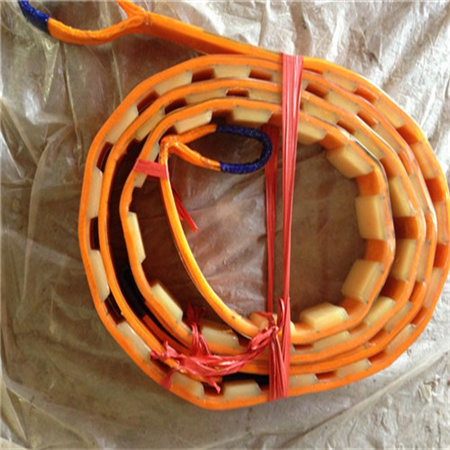
This is the page's own photograph, and it makes the first point better than a paragraph can. Look at what is doing the looking a nd what is doing the carrying. The orange material is the coating: it is the part you see, the part that touches the floor and the load, and the part that gives the article its colour. The pale layer showing through the rectangular windows is the woven band underneath. The windows are cut in the casing at regular intervals, and whatever else they are for, they have the effect of letting you see th e layer that carries the load without cutting the article open. So the photograph contains both halves of this page's argument at once: the coating is the outside, and the outside is not what holds th e weight. What the photograph cannot tell you is which polyurethane the orange casing is made of, and that is exactly the fact the label has to carry.
1. What the Two Names in the Title Actually Name
The title on this listing reads Polyurethane lifting strap | Polyurethane flat lifting strap. The vertical bar is doing the work of the word or: they are two ways of writing the s ame request, and the second simply says out loud that the article is flat. Neither version adds a capacity, a length or a construction. So the title names an article and a material, and stops.
The product line this page inherited goes further and names five things: polyurethane sling, adhesive flat sling, steel coil sling, wrapped polyurethane sling an d polyurethane flat sling. Read carefully, those five phrases are not five products and are not four synonyms of one product. They fall into three groups, and the groups answer three differen t questions.
| Phrase | Which question it answers | What it leaves open |
|---|---|---|
| Polyurethane sling Polyurethane flat sling | What the contact face is made of. It says the outside of the article is a polymer, and that the article is flat rather than tu bular. | Which member of the family. Section 2. Also the capacity, the length and the ends. |
| Adhesive flat sling Wrapped polyurethane sling | How the coating is attached to the band: bonded to it, or fitted over it as a separate covering. Section 4. | Nothing about strength. The two constructions differ in how they age and how they are inspected, not in what they can carry. |
| Steel coil sling | The load, not the article. It says what is being handled: a coil of steel strip, which is heavy, smooth-faced and usually handled as a coil rather than as a heap. | Everything about the strap. It is a description of the job, and Section 7 explains why the coating is chosen for that job. |
So the five phrases reduce to: a contact-face material, two ways of attaching it, and one kind of load. Only the first of those is a fact about the article, and even that one is a family name. The rest of this page works through them in that order.
2. Polyurethane Is a Family, and the Member Decides the Wet Job
This is the part of the page that nothing else on this site covers, and it is the reason a buyer should not stop at the word in the title.
Polyurethane is a class of polymers built from isocyanate and a polyol, and it is the polyol — the soft segment — that decides how the finished coating behaves when water is around. Two chemistries dominate, and they are not interchangeable in a wet application.
An ester-linked soft segment hydrolyses. The ester group is vulnerable to attack by water molecules, and the attack is a chain reaction: once the linkage is broken, the break exposes more linkage. In practice this shows up as a coating that softens, swells, chalks or cracks with age in warm and humid conditions, long before anything has been lifted with it. Hydrolysis is an ageing mechanism, not an overload mechanism: it does not need a load to happen, and it does not announce itself with a warning.
An ether-linked soft segment resists it. The ether linkage is not attacked the same way by water, and coatings built on it hold up far better in humid, condensing or persistently wet service. That is the reason the two chemistries both exist and both keep being sold: the ether version is the one to specify when the article lives in a wet place, and the ester version is the one tha t keeps turning up when nobody specified anything.
There is a second front too, and it runs the same way: the ester-based members of the family are also the ones more susceptible to biological attack, which is the same chemistry being attacked by a different agent. Both fronts point at the same conclusion.
What this means for an enquiry is short and blunt. Writing the word polyurethane does not choose a member of the family. If the article is going to be stored or used where it stays wet, in a humid climate, near condensing equipment, or simply for a long time in an unheated store, the chemistry has to be named on the enquiry and confirmed on the label. Asking for a polyurethane lifting strap without naming the chemistry is asking for whichever the maker happens to stock, and the two do not age alike.
| Question to ask | Why it is the first question |
|---|---|
| Which soft-segment chemistry is the coating made of? | It decides whether moisture is a problem over the life of the article, and it is not visible and not testable on the bench. Ei ther the paperwork names it or nobody knows. |
| Will the article be stored or used wet, and for how long? | This is the exposure that makes the chemistry matter. A strap kept dry inside a workshop is a different proposition from one l eft on a rack in an unheated store through a humid season. |
| Is there a stated storage life, and does it start at manufacture or at issue? | A coating that ages without load needs a date to be managed against. If no period is stated, the ageing is being managed by no body. See Section 8. |
| What in the coating's condition is a reason to stop using it? | The published removal criteria for a synthetic webbing sling are about the band, not the coating. Coating damage is therefore a criterion the buyer has to define. Section 6. |
3. The Four Numbers a Coating Is Specified By
A coating is an engineered layer, and like any engineered layer it is described by numbers. Four of them matter, and none of the four appears in the title of this page.
| Number | What it decides | What happens if nobody writes it down |
|---|---|---|
| Chemistry of the soft segment | Whether water is an adversary over the article's life. Section 2. | You receive a family member rather than a specification, and you find out which one in a year's time. |
| Coating thickness | How much material stands between the band and the load's surface, and therefore how long the protection lasts before the band is exposed. | Two articles that look identical in a photograph can differ by a factor here, and the thinner one reaches the band sooner. |
| Hardness of the coating | How the surface behaves against a smooth load: a softer face conforms and holds on a smooth face, a harder one slides more rea dily. | The friction at the contact face becomes whatever the maker's standard compound gives, which may be the wrong end of the range for what you are lifting. |
| How the coating is attached | Whether the coating is part of the band or a separate covering around it. Section 4. | You get one of two different articles, with two different ageing stories, without having chosen. |
One honest note about the second and third of those. Neither the thickness nor the hardness of a coating adds anything to the rating of the article underneath, and a maker who implies otherwise is selling a number that does not exist. What the two numbers do is decide how long the outside survives and how it behaves where it touches the load. That is a real and purchasable thin g; it is simply a different thing from capacity.
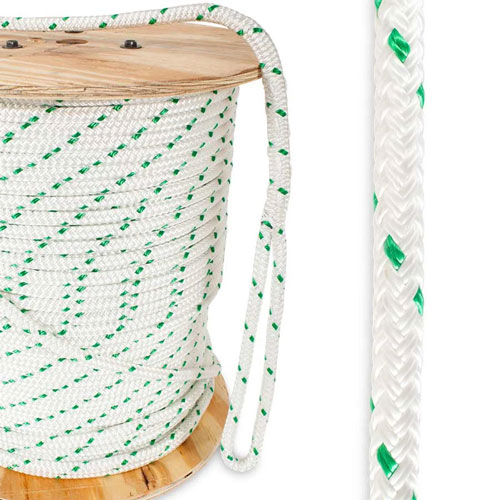
Not this page's article, and worth a moment anyway, because it shows the point of Section 3 from the other direction. The green flecks are not decoration and not a colour code: they are yarns placed into the structure during manufacture, so that the identity of the article is part of the article rather than a tag added afterwards. This page's article has the same problem to solve and a harder version of it, because a coating is opaque. Whatever identifies the coating chemistry has to survive on the outside of something that is handled hard, and Section 9 is about where that information can live.
4. Bonded or Wrapped: Two Ways to Put the Same Coating On
The product line on this page names an adhesive flat sling and a wrapped polyurethane sling. Those two phrases are not alternative wording for one article. They are the two constr uction families in this part of the catalogue, and the difference is where the coating sits in relation to the load path.
Bonded, or adhesive, construction. The coating is applied to the woven band and stays with it: the outside of the strap and the band are one object. There is no separate covering to s hift, no gap between the two layers for grit to work into, and nothing to slide out of position when the strap is dragged. The trade is that the band and its coating age together and cannot be separat ed for inspection: to judge the band you judge it through the coating, and the place where the two meet is a joint that can fail on its own. That joint has its own vocabulary — whether the coating sti ll adheres, whether it has begun to lift or flake, whether it peels from the band — and every one of those words is a question about the joint rather than about either material.
Wrapped, or jacketed, construction. The coating is a covering around a load-bearing core, and the two are separate objects. The covering can be shaped, coloured and sized to a job ind ependently of what it contains, and the core does the carrying. The trade here is the mirror image: the covering stands between you and the core, so a break in the core can sit under an intact-looking outside. The photograph at the top of this page is of this construction, which is why the covering is cut into windows — with the two layers separated, the only way to see the inner one without takin g the article out of service is to leave openings in the outer one.
| Question | Bonded / adhesive | Wrapped / jacketed |
|---|---|---|
| Where the coating sits | On the band, as part of it. | Around the core, as a separate covering. |
| The failure this construction owns | The joint between coating and band: loss of adhesion, lifting, flaking, peeling away at an edge. | Damage to the core hidden under a covering that still looks sound. |
| How you inspect it | Look for a gap opening between the two layers, and for the coating going stiff or brittle rather than flexible. Both layers ar e checked at once. | Look at the covering and feel along it for a flat or soft place, and use the openings if the maker has provid ed them. Two materials, two checks. |
| When it is the better choice | Where the article is dragged and grit could work between two layers, and where the coating chemistry is chosen so the two laye rs age at the same rate. | Where the outer surface has to be a particular material, colour or shape regardless of the core, and where the covering can be renewed or is expected to wear out first. |
| Effect on capacity | None. The rating comes from the band and the ends. | None. The rating comes from the core and the ends. |
Two consequences follow, and both belong in an enquiry. First, say which construction you want. The two are not a finish option and the choice changes what you will be looking at d uring inspection for the whole life of the article. Second, if the answer is either, then the two also need different information on the label, because a user has to be able to tell one from the other without the paperwork. Section 9.
5. What the Coating Changes at the Load, and What It Does Not
A coating changes exactly one thing about a lift, and it is not the strength. It changes the interface: the place where the article touches the load. Everything else in the arithme tic is decided by the band, the ends, the hitch and the angle, and a polyurethane surface is not a term in any of it.
What the interface is worth depends on what the coating is touching.
Against a smooth, hard face the coating is chosen for how it behaves in contact: a face that conforms to the load and holds rather than sliding across it can make the difference betwe en a hitch that settles and a hitch that creeps. This is the reason the phrase steel coil sling appears in this page's own product line — a coil is the classic smooth, heavy, hard-faced load, and Section 7 deals with it on its own.
Against a load whose surface must be protected the coating is a barrier rather than a grip. The thing being protected is the load, not the strap, and that is a different motive with a different specification: the coating's job is to be softer and more compliant than what it presses against, and to stay that way. It is worth saying plainly that the same article cannot always serve both motives well, because the compliant face that protects a finished surface is not necessarily the face that grips hardest.
Against a genuinely sharp edge a coating is not the answer. This is the one place where a coated strap is routinely over-credited: a soft polymer layer is not edge protection, and a c oating that has been cut through at a corner has stopped being either a grip or a barrier at exactly the point where the band is most loaded. The rule for sharp edges does not change because the artic le has a coating on it.
| What the buyer may believe the coating does | What it actually does |
|---|---|
| Increases the working load limit | Nothing of the sort. The limit is a property of the band and the ends, in the hitch the maker names. |
| Protects the band from abrasion, so the article lasts longer | A coating does put material between the band and the load, and that is a real effect. But how much life that buys, and the fou r ways a flat band is made to resist wear, are argued on the wear resistant flat lifting belt sling page, and this page does not repeat it. |
| Makes the article suitable for a sharp edge | No. A coating is a compliant layer, not edge protection, and a cut-through coating leaves the band exposed at the worst place. The sharp-edge rule is unchanged. |
| Makes the article safe in a wet place | Only if the chemistry was chosen for it. Water is friendly to some members of the polyurethane family and hostile to others, a nd the word on the label does not distinguish them. Section 2. |
| Means the article needs no separate protection at a corner | No. Where a corner is genuinely sharp, separate protection is still the answer, and it is argued on the circular lifting straps page among the families of protection. |

Where a coating is and is not in this picture. The blue band carries its identifying figures printed straight onto the webbing, in the direction a person handling it reads them, and the two eyes are reinforced and sleeved in a contrasting colour so the contact points are distinguishable from the body at a glance. On this page' s article those same places are the ones the coating covers, which is the whole problem of Section 9: a coating takes the best surface for printing on and turns it into an opaque one, so the identity of the article has to be moved somewhere it can still be read after the coating is on. Note also what a coating does not do here — it does not change the colour convention, and it doe s not change the figures. Those still have to match the band underneath.
6. The Coating's Own Condition Is an Inspection Item
This section exists because of a gap that buyers fall into, and the gap is easy to state. The removal criteria published in ASME B30.9 and adopted in OSHA 29 CFR 1910.184 are a list about the
That is backwards. The coating is the part of the article that has been asked to do the most handling, and it is the part most able to hide what is happening underneath. The honest position is that a coated article needs the standard list plus four extra things the buyer should agree on before the article is ever issued.
| What to look at | What it looks like | Why it is worth agreeing a limit in advance |
|---|---|---|
| Loss of adhesion | A coating that has begun to lift away from the band, first at an edge or over an eye, with a gap you can see into. | It is the failure this construction owns, and once it starts it spreads. A stated length of lift that is acceptable makes the decision a rule rather than an argument. |
| Change in flexibility | The coating has stopped bending with the band, and has become stiff or brittle in places, or cracks when the article is flexed . | This is what ageing looks like from the outside, and it is the visible end of the process described in Section 8. Stiffness in patches usually means uneven exposure, which is worth knowing about. |
| Breach of the coating | A cut, a gouge or a worn-through patch that reaches the band, and particularly one where a corner of the load has been pressin g. | At that point the article changes category: it is no longer a coated strap, it is a band with an opening in its cover, and the band's own criteria now apply at that spot. |
| What the coating is carrying | Grit, metal swarf or process material embedded in a soft face after a job, which then works against the article on the next li ft. | A soft coating is a collection point. Whether it is cleaned or written off is a site decision, and making it explicitly is che aper than discovering it by result. |
The practical routine that follows is short. Inspect the article as a coated object rather than as a sling with something on it: look at the coating first because it is what you can see, then look at the band at every point the coating has opened, then handle it, because a compliant coating is supposed to feel compliant and one that no longer does is telling you something. And write the four li mits above into the site's procedure, because a criterion that exists only in a conversation cannot be applied on a night shift.
7. Steel Coil and Other Smooth Loads
The third group of phrases in this page's product line names a load rather than an article, and it is worth a section because it explains why a coating is chosen at all in this part of the trade.
A steel coil is a length of strip wound into itself. It arrives heavy, it presents a smooth, hard, unbroken cylindrical face to anything that touches it, and it is usually handled as a coil — set down, picked up, turned — rather than dismembered. Three properties of that shape decide what the sling has to do.
It is smooth, and smooth faces are where a coating earns its place. A face that is glossy and uniform gives a plain woven band less to hold against than a rough one does. This is not a strength question: the band can carry the load with room to spare and still let the hitch settle, shift, or need re-seating. A coating chosen to conform to that face changes how the article behaves in contact, and that is the whole of its contribution to the lift.
Its surface may be the customer's product, not scrap. A coil is often a finished or semi-finished good — a surface that will be painted, coated, rolled or sold as it is. So a strap us ed on it has a second job: not to be the thing that leaves the mark. That is a barrier motive rather than a grip motive, and it is worth writing down which of the two is the priority, because Section 5 explains why one face does not always do both well.
It is heavy and it is handled in tight places. A coil is normally rigged close in, with limited room for a long sling and limited room to reach behind it. That puts the contact under the eye of the article, or under a covering sleeve, which is precisely where a coating is most likely to be cut or worn through. Section 6's third row is the one that applies here.
Two things this page will not do for a coil, and it is worth being clear about both. It will not supply a rating for a coil duty that has not been described to it: the rating depends on the hitch, the angle and how the coil is actually held, and none of that is in the word coil. And it will not present the coating as a substitute for a device designed to grip a coil's face or bore. Whe re a coil needs a purpose-made handling device, a coated lifting strap is not that device, and no coating changes that.
8. Storage and Ageing: the Failure That Needs No Load
Everything else on this page has been about a lift. This section is about the only failure mode discussed here that happens while the article is hanging on a rack doing nothing, and it is the reaso n the chemistry in Section 2 matters more than it looks at the ordering stage.
Hydrolysis is driven by time, water and warmth, and by nothing else. A coating built on an ester-linked soft segment is attacked by water over the years; heat and humidity accelerate it; and the damage accumulates whether or not the article has ever been used. There is no load in the mechanism and therefore no sign of one: the article does not look used, it looks old.
Which means a coated article has an age, and the age has to be managed. The practical question for a buyer is not whether the coating will eventually change — it will — but whether th e article's documentation gives a date to work from and a period to work to. Ask for both. An article whose only date is on the delivery note cannot be managed on a rack, because the rack holds severa l deliveries at once and the note is in the office.
Storage conditions are part of the specification, not housekeeping. A coated strap kept dry, out of standing water, off a concrete floor that stays damp, away from condensing pipework and out of a room that heats and cools with the weather is a different article in five years from the same strap kept otherwise. Temperature matters twice: warm air holds more water, and warm materia l reacts faster.
Do not store a coated article folded tight or under pressure. A coating that is asked to hold a sharp fold for years sets in that fold, and a set coating cracks at the crease the firs t time the article is loaded. Coil it loosely or lay it flat, and if it arrived coiled, keep it that way.
One boundary worth stating, because it keeps this page from wandering into another's ground. Light and the band's own ageing are a separate subject, argued where storage meets wear and where the fi bre is discussed. This section is only about the polymer layer: what water does to it, what warmth does to that, and the fact that it can happen with the article untouched.
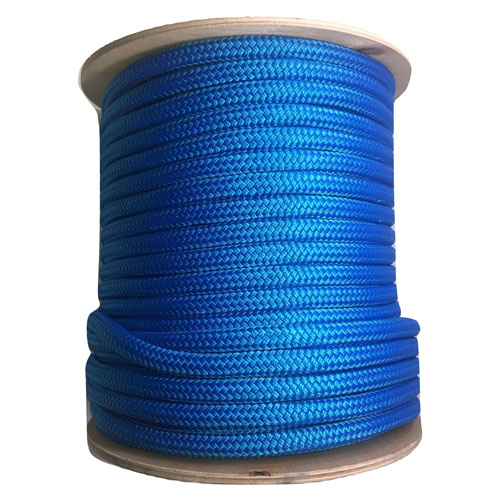
Storage, in the form it takes for an article that arrives wound rather than folded. The reel is the storage method and it is doi ng a job: keeping the material at a radius it can tolerate, off the floor and off itself, with nothing pressing a crease into it. A coated strap deserves the same treatment, and can be coiled and hung instead. What the reel cannot do is keep humidity out, and Section 8 is about the failure that a good storage method does not address on its own — because the polymer layer ages on a time scale that no amount of careful handling resets. The honest summary is that storage delays the ageing and never stops it, which is why the date matters as much as the rack.
9. Marking: Where the Information Lives When the Outside Is Opaque
The last section of the argument follows directly from the first. A polyurethane lifting strap and a polyurethane flat lifting strap have an opaque outside, and the two facts that a user most needs — which chemistry and which construction — are exactly the facts that a glance cannot recover. So they have to be carried deliberately.
The starting point is the same as it is for any synthetic sling: the supporting rules do not allow a sling into service without an affixed and legible identification, and a missing or illegible ide ntification is the first item on the published list of reasons a synthetic webbing sling is removed. On an uncoated article that identification is normally printed on the band, which is the best surfa ce the article has. A coating takes that surface away. Whatever is printed on the band is now behind the coating, and what you can read from outside is only what the coating itself ca rries.
So the marking has to be planned as part of the construction rather than added at the end, and the plan has to answer four questions.
| Question | Why it is decided before manufacture |
|---|---|
| Where can the information physically live? | On the coating itself, on a label attached to or through the article, on a tag that travels with it, or in windows left in the covering so the band beneath can be read. Each of those has a different survival rate, and the choice affects how the article is made. |
| What has to be readable, by whom, and in what light? | The person inspecting the article is answering a different question from the person using it, and a site that works in poor li ght or outdoors reads a surface differently. Contrast and surface finish matter as much as the characters. |
| How will the marking survive the article's own handling? | Print on a soft polymer face abrades, and a coating that is dragged across a floor loses its surface from the same side every time. Print that is moulded into the layer lasts differently from print laid on top of it. |
| What is the second copy of the information? | Because the outside of a coated article is the part most likely to be consumed first, the batch record held in the office is d oing real work rather than paperwork. The label points at the record; the record is what survives the article being used hard. |
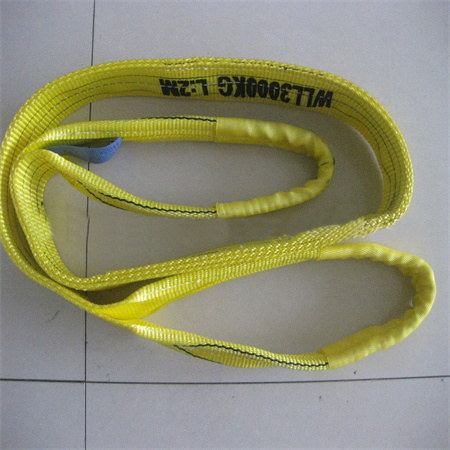
Two copies of the same information, which is the arrangement a coated article needs. The printed figures on the band will be beh ind the coating on this page's article and can never be read again once it is made; the small blue label is the copy that stays outside. That is the shape of the answer to Section 9: put what has to b e read on the outside, accept that the outside is what wears fastest, and keep a record on the shelf that outlives both. One thing this photograph does not show, and it matters here: nothing on either article says what the outside is made of. On an uncoated sling that is a small omission. On a coated one it is the single most useful sentence the label could carry.
So the one line this page would add to a marking specification, if a buyer asked for a recommendation, is this: the label should name the coating, not just the article. A sling lab elled only with its capacity, length and fibre tells the user everything about the lift and nothing about the outside, and it is the outside that decides how the article behaves against a coil face, w hether it is suited to a wet store, and which of the two constructions in Section 4 it belongs to. That is a sentence, not a redesign, and it is the difference between an article whose polyurethane is a specification and one whose polyurethane is a word.
10. Ordering: the Lines That Get the Coating Right
The two phrases in this page's title settle an article and a material. Everything that decides whether the article is the right one is in the list below, and the first four lines are the ones that a plain request for a polyurethane lifting strap leaves out.
| Line | What to write | Why the title does not cover it |
|---|---|---|
| 1. Coating chemistry | Which soft-segment chemistry the polyurethane should be, and whether the article will be stored or used wet. | The title names the family and stops there. This line decides whether water is an adversary over the article's life. Section 2 . |
| 2. Construction | Bonded to the band, or a separate covering over a core. Say which. | The page's own product line offers both and picks neither. The choice changes how the article ages and what you inspect. Secti on 4. |
| 3. Thickness and hardness of the coating | How much material, and whether the face should conform and hold or be harder and slide more readily. | Neither number is in the title, and both decide how the outside behaves and how long it lasts. Section 3. |
| 4. What the coating is for | Grip on a smooth face, protection of the load's surface, or both — and which one wins if they conflict. | The title says polyurethane; it does not say why. The two motives can pull in opposite directions. Section 5. |
| 5. Working load limit | The rating needed, and the number of legs if the arrangement has more than one. | No figure in the title refers to capacity. The coating does not add to it. |
| 6. Effective length and ends | Length as measured in use, and the end configuration: eyes, fittings, or endless. | Not in the title at all, and on a coil duty the rigging room is usually tight. Section 7. |
| 7. Colour or code | Any colour the site expects, and whether the colour has to match a code already in use. | A coating is the most visible part of the article and therefore the easiest thing to misread as a capacity signal. If a colour is wanted, it should be for a stated reason. |
| 8. Marking and language | What has to be readable, where it should live, and in which language — including a line naming the coating. | A coating makes the article opaque, so this cannot be left to a standard print on the band. Section 9. |
| 9. Storage and a date | Where the article will be kept, and whether a stated storage life has to be marked on it. | The coating ages without load, so a date is a management tool rather than a formality. Section 8. |
| 10. Documentation | Per-batch records, the declaration you need, and the packing and shipping paperwork for the destination. | Not in the title, and on a coated article the record is the copy of the identification that survives the article being used ha rd. |
If an enquiry carries the first four lines, the rest follow quickly, because the article is then being specified rather than recognised. Send those four and the two phrases from the title, and the quotation will be for a coating as well as for a strap.
Frequently Asked Questions
Is a polyurethane lifting strap just a flat sling with a plastic coating on it?
Mechanically, that is close to what it is, and that is exactly why the material word deserves attention. The article is a woven band with a polymer layer, and the layer does not become part of the load path just by being there. What the layer does is decide how the outside behaves: how it sits against a smooth face, whether it protects the surface it is pressed against, how it ages in a wet pla ce, and what the article looks like while it is being inspected. Those are four real properties and none of them is capacity.
What is the difference between the two phrases in the title?
The vertical bar is doing the work of the word or. Polyurethane lifting strap is the general request; polyurethane flat lifting strap adds that the article is flat rather than tubular. Neither phra se carries a rating, a length or an end configuration, so both are the beginning of a specification rather than the whole of one.
Why does the chemistry of the polyurethane matter so much?
Because polyurethane is the name of a family rather than a single material, and the members of the family do not age alike in the presence of water. A coating built on an ester-linked soft segment is attacked by water over the years and the damage accumulates without any load being involved; one built on an ether-linked soft segment resists that. When a buyer writes the word polyurethane and no thing else, the member of the family is left to whoever fills the order.
How would I know which chemistry I have been sent?
From the documentation, or not at all. It is not visible, and it is not something a buyer can reasonably test on arrival. That is precisely why Section 2 puts it first and why Section 9 recommends that the label name the coating rather than only the article. If no paperwork names the chemistry and the article will live somewhere damp, that is worth a question before the order rather than after it.
What is hydrolysis, in plain terms?
It is water breaking chemical bonds, and in a coating it is an ageing mechanism rather than an overload. It needs time, moisture and warmth, and it does not need the article to have been used. From the outside it appears as a coating that softens, swells, goes chalky, becomes stiff in patches, or cracks when the article is flexed — and the article does not look worn out, it looks old.
What does "adhesive flat sling" mean compared with "wrapped polyurethane sling"?
They are the two constructions in this part of the catalogue. In the adhesive one the coating is applied to the band and stays with it, so the two are one object and the joint between them is the t hing to watch. In the wrapped one the coating is a separate covering around a load-bearing core, so the covering can be chosen independently — and, in exchange, a break in the core can sit under a cov ering that still looks sound. The two are inspected differently and they are not a finish option.
Does the coating add to the working load limit?
No. The working load limit is a property of the band and the ends, in the hitch the maker names, and the coating is not a term in that arithmetic. A coating quoted as though it raised a rating is a coating being sold on a number that does not exist.
Is a coated strap suitable for a sharp edge?
No, and this is the most common over-credit given to a coating. A polymer layer is compliant rather than cut-resistant, and once it has been cut through at a corner the band is exposed at exactly t he point where it is most loaded. Where a corner is genuinely sharp, the answer is separate protection, and a coating does not change that.
Why is a coating chosen for steel coil work?
Because a coil presents a smooth, hard, unbroken face, and a smooth face is where the contact between article and load behaves differently from a rough one. A face that conforms and holds can make the difference between a hitch that settles and one that keeps shifting — and on a coil the surface may also be the customer's product, so the article may additionally be asked not to be the thing tha t marks it. Those are two motives, and Section 5 explains why one face does not always serve both well.
How should a coated strap be stored?
Dry, off a floor that stays damp, away from condensing pipework and out of rooms that heat and cool with the weather, and not folded tight or stored under pressure. The coating ages with moisture a nd warmth whether or not the article is used, and a sharp fold held for years sets into the material and cracks at the crease the first time the article is loaded. Coil it loosely or lay it flat, and if it arrived coiled, keep it that way.
My site's removal criteria do not mention coatings. What should we do?
That is the gap Section 6 is written about. The published criteria for a synthetic webbing sling are a list about the band, and a coating is not on it — so a coated article with a sound band and a failing coating has no stated rule, and the usual answer in practice is to keep using it. The four things worth agreeing in advance are loss of adhesion, a change in flexibility, a breach that reaches the band, and what the coating is carrying after a job. Write them into the procedure, because a criterion that lives only in a conversation cannot be applied on a night shift.
Can you supply this article, and what do you need from me?
Yes, made to order. Send the two phrases from the title, the coating chemistry you need or the conditions the article will live in, whether it is bonded or wrapped, the thickness and hardness of th e coating you want, the working load limit, the effective length and the ends, the colour if a site code applies, and the marking and documentation you have to receive. The first four of those are the ones a plain request leaves out, and they are the ones that decide whether the article is right in a year's time.
Contact Lift Sling Rigging Co., Ltd
The polyurethane lifting strap and the polyurethane flat lifting strap are made to order in bonded and in wrapped construction, in the coating chemistry and thickness the job calls for, with the ma rking planned around an opaque outside rather than printed and hoped for. Capacity, length, ends, coating and marking are all set by the ten lines in Section 10 rather than chosen from a shelf.
Where a lift is being planned against a smooth load, say what the load is and how it will be held, and say whether the priority is grip at the face or protection of what is under it — because those two can pull in opposite directions and the answer changes the coating. Where the article will live somewhere damp or be stored for a long time, say so in the first message, and ask for the chemistry and a date in the reply. Where a corner is genuinely sharp, say that too, because a coating is not the answer to it and a separate protection is.
Where a flat band is being considered against a tubular one for the same job, the two forms are argued out on the endless webbing sling and endless round sling pages; where the question is how long a band lasts against an abrasive load, that is argued on the wear resistant flat lifting belt sling page; where the load has to be protected from the article rather than the other way round, the familie s of protection are set out on the circular lifting straps page; and where the strap has a double-buckle end, the wear question changes shap e and is treated on the double buckle flat wear-resistant sling page.
Telephone and WeChat: 18066002268
E-mail: 702461526@qq.com
Address: Lifute Industrial Park, Taizhou City, Jiangsu Province, China
HS code: 630790
- Previous:Wear resistant lifting belt
- Next:Mining reflective lifting belt, single pillar, reflective sl
-
Drone Anti-collision Net
-
Extra Large Capacity Cargo Net
-

Cargo Webbing Net
-

Color changing nylon double buckle loop nylon braided rope
-

Two end buckle lifting rope, double buckle round lifting rope, double fork nylon lifting rope, non jointed nylon lifting rope
-

Emergency escape lifeline, fire escape rope, fire safety escape emergency rope, steel wire core fire rope

