Language
 简体中文

- On the 2018 National Day holiday, Lifet completed six 100 ton large tonnage lifting belts as a gift
- The role of suspension net in the transportation of goods turnover
- Cargo soft lifting net, lifting net, lifting net, lifting net, bag, climbing net
- Precautions for using Lifutiden elevator
- How to make circular lifting straps
Contact: Wang Lili
E-mail:18066002268
Phone:702461526@qq.com
Address: Lifute Industrial Park, Taizhou City, Jiangsu Province
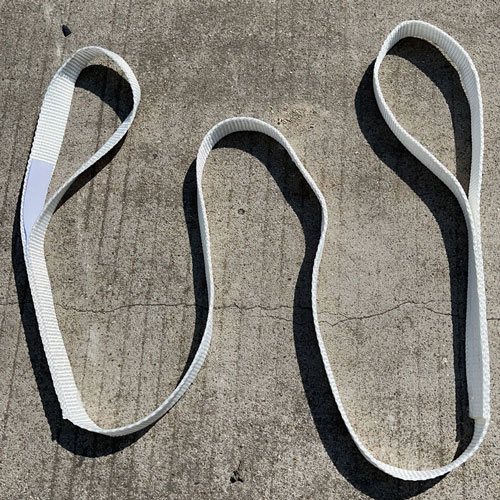
An eye and eye sling is a flat woven webbing sling with a soft eye sewn at each end, and the eyes decide what the article is: the European standard classifies flat woven slings by their ends, so one type has no eyes at all, one type carries soft eyes, one carries metal fittings and one carries reevable fittings. The rated load depends on six published factors and two of them are about the eye - the diameter of curvature the sling is used over, and the fabrication efficiency of the fold and the stitching. Nothing placed in an eye should be wider than one third of its length. HS 630790. Phone 18066002268.
Hits: ℃
Release time:2026-09-19 13:14
Lift Sling Rigging Co., Ltd produce Eye & Eye Sling,Nylon Eye & Eye Lifting Sling,Eye & Eye Nylon Sling,Flat Eye & Eye Sling.
Eye & Eye Sling — the Type Letter, the Sewn Eye, and Three Rules of Geometry
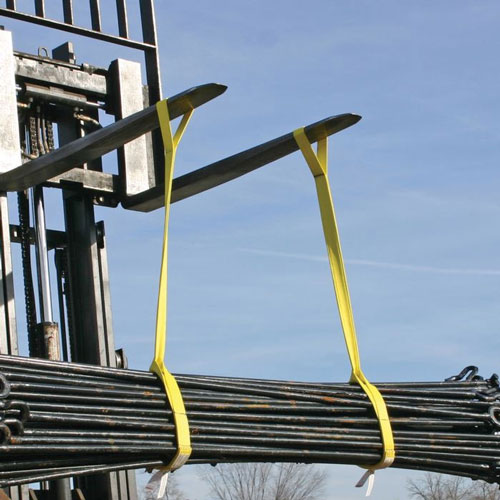
An eye and eye sling doing the job the eyes exist for: two soft eyes hung on a beam, the band taking a bundle of steel bar in a basket. The yellow is the colour code's three-tonne entry, which is why this photograph is also a lesson in reading the band.
1. What an Eye & Eye Sling Is, and the Four Letters That Identify It
The phrase eye and eye describes where the sling's two ends go and what shape they are: each end is turned back on itself, overlapped and stitched, forming a soft eye — a loop of webbing with no metal in it. In the trade this is also written eye to eye, and a manufacturer's own catalogue describes the construction precisely: a closed loop eye connector on each end, sewn into single, double or multi plies, in eye and eye type or endless grommet shape. The same source notes that the most common synthetic web slings are eye and eye duplex slings with flat or tapered eyes, because those eyes connect easily to a movable anchor point — which is the commercial reason this form outsells the endless one in general lifting.
What the phrase does not tell you is which article you are buying, because the European standard classifies flat woven webbing slings by their ends rather than by their material. The standard's own text groups them into type A, endless flat woven slings made from one or two webbing layers; type B, single flat woven slings with soft eyes, made from one, two, three or four layers; type C, single flat woven slings with metal fittings; and type Cr, the variant with reevable fittings. Read that list again as a buyer and the consequences are plain: the eye and eye sling in the ordinary sense of the phrase is type B, and three of the four letters in the standard describe articles that a quotation for "an eye and eye sling" might equally be taken to mean. The standard also states how the designation is written, and the rule is worth having verbatim: the designation shall give the type letter and number of layers, e.g. A2. That is why a quotation which names a letter and no number has supplied half the identity of the article, and why "type B" and "type B2" are not the same specification.
The ply count attached to type B is the second half of the identity, and it is the half that decides both the weight of the band and its resistance to cutting. A single-ply sling is one thickness of webbing; the same width in four plies carries far more, and a supplier's own process description notes that the sewing step is where the configurations diverge — simplex, duplex, up to four plies — with the eyes reinforced as part of the same operation. So type B, two ply is a specification, while "eye and eye sling" is a description of the shape.
| The letter | What the standard calls it | What you actually receive | When to ask for it |
|---|---|---|---|
| Type A | Endless flat woven webbing sling, one or two webbing layers. | No eyes at all: one continuous loop of flat woven band. | When the lift wants a cradle or a choke and no hardware near the load. This is the article described on this site's endless sling page. |
| Type B | Single flat woven sling with soft eyes, one to four layers. | The eye and eye sling in the ordinary sense: a folded, stitched soft eye at each end, nothing metallic anywhere. | For hooks, shackles, rings and movable anchor points, which is most general lifting. State the ply with the letter. |
| Type C | Single flat woven sling with metal fittings. | The same band, terminated in metal rather than soft eyes — thimbles, links or similar. | Where the attachment is fixed, or where a soft eye would be cut. Note that the fitting must be rated at least as high as the sling. |
| Type Cr | As type C, with reevable fittings. | Fittings that can be taken off and refitted, so the band can be re-rigged or replaced round the hardware. | For hire fleets and repair-minded operations; ask which part is the rated item, because the answer changes who certifies what. |
| Any letter, at goods-in | Whatever the label names, once the label has been read. | The article the label describes, which is why the standard number on the label is the first thing to check. | Always. A missing or illegible identification is itself a removal criterion, before any question of wear arises. |
Two practical notes follow. The first is about naming: because the catalogue writes this product as eye and eye, eye to eye, duplex eye eye and sometimes simply flat web sling, a purchase order that uses the trade name alone is ambiguous in exactly the way §2 and §4 describe. Add the letter and the ply. The second is about the eye's shape: the eyes on this construction are made flat or tapered, and the two are not interchangeable in every fitting — a tapered eye fits a narrower hook or shackle pin than a flat eye of the same band width, because the taper narrows the folded material at the bearing point. Ask which one the quotation supplies.
2. The Eye Is Sewn, and the Seam Is a Load-Bearing Splice
Every soft eye on every flat woven sling is a joint: the band is turned back, overlapped, and stitched through with a pattern of thread. The standard is explicit that the layer count and the stitching belong together — the eye's job is to carry the full rated load across that overlap, which is why the trade describes the reinforcement as part of the sewing operation rather than as a finishing touch, and why one manufacturer's process list puts the sewing step after dyeing and fusing and before final inspection, calling it the most important of the steps.
The consequences of that single fact run through the whole life of the sling, and the safety guidance states them without hedging. The list of things to look for when inspecting a synthetic web sling includes, as a distinct item, broken or worn stitching in load bearing splices — which is what an eye is. On repair the same body of guidance is just as direct, and the instruction is a prohibition rather than a procedure: damaged webbing material is listed among the things that shall not be repaired, load-bearing splices shall not be repaired, and temporary repairs of webbing or fittings shall not be made at all. What may be repaired, and then only by the manufacturer or a qualified person, is the hardware at the ends of an assembly, and even then the sling must be proof tested afterwards and marked to show who did the work.
So the eye has a status that is easy to underestimate: it is the one part of the sling that is simultaneously the strongest feature of the design — the overlap is engineered to carry the rated load — and the one part that is permanently unrepairable. A cut in the band reduces capacity; a failed splice ends the article. That asymmetry is the reason this page gives the eye its own sections rather than folding it into a paragraph about construction.
| What the eye is | What that means for use | What it means for paperwork and repair |
|---|---|---|
| A fold of the band turned back on itself | The eye is made of the same webbing as the body, so it wears like the body and is inspected by the same eyes. | The identification tag covers the whole article. There is no separate rated component to certificate. |
| An overlap of one to four layers, stitched through | The overlap is where the load crosses from the band into the fitting. It is thick, stiff and the least flexible part of the sling. | The ply count is a specification item, not a manufacturing detail — it appears in the type designation the standard uses. |
| A load-bearing splice, in the inspection language | Broken or worn stitching here is a named removal criterion, separate from cuts and abrasion in the band. | A splice may not be repaired: no re-stitching, no patching, no temporary fix, by anyone. |
| Reinforced as part of the sewing operation | A reinforced eye resists the cut and the wear that a bare folded band takes at a hook. | Ask for it by name on the order. On this page's own photographs, the white sling shows its joint; the yellow one is working in a basket. |
| A joint the maker certifies | The rated load on the label is a statement about the finished article, eyes included — see §4 on what the rating depends on. | If the eyes are re-made by anyone other than the manufacturer, the certificate no longer describes the goods. |
One inspection habit follows from this section and is worth stating before the geometry that comes next. Because the eye is the stiffest, thickest part of the sling and the place where nine tenths of the visible thread lives, it is also where damage is easiest to see and easiest to ignore — a sling whose band is perfect and whose eye stitching is worn is a sling that has failed. §6 sets out what to look at.
3. Three Rules That Are All Geometry
The rules that decide whether a correctly made eye sling behaves like the certificate says are not about materials, and none of them is about strength in the abstract. They are three pieces of geometry, and each of them has a published form that removes the guesswork.
The first is the width of whatever goes into the eye. The United States safety guidance sets it as a ratio: an object in the eye of a sling shall not be wider than one third of the length of the eye. A hook, a shackle pin, a ring or a beam flange that is too fat for the eye concentrates the load on the two inside shoulders of the loop instead of spreading it along the bearing length, and the fabric that was designed to carry the load across a wide overlap is being asked to carry it across a narrow one. The rule is memorable because it is a fraction rather than a dimension: no matter how big the sling, the object should be no more than a third of the eye's length, which leaves two thirds of the eye's length as bearing surface.
The second is where the load sits in the hook. The guidance for rigging practice is that the load applied to a hook shall be centred in the bowl of the hook, to prevent point loading on the hook — and the same sentence appears in the mechanical guidance for web slings, which adds the case that catches people out: when centring is not possible, the sling eyes or the connection points must be protected. A soft eye loaded on the tip of a hook is not merely at risk of slipping off; it is being loaded on a point rather than a surface, which is the condition the eye's construction is least able to survive.
The third is that nothing may squeeze the eye. The published rigging practice states that slings shall not be constricted, bunched or pinched by the load, the hook or any fitting — and the mechanical guidance applies the same rule to the case that matters most for hardware: web slings should not be constricted or bunched between the ears of a clevis or shackle or in a hook, and where a sling is used with a shackle it is recommended that it be rigged in the bow of the shackle rather than over the pin or between the ears. When that is not possible, the guidance says to protect the eyes or the connection points. Bunching is the quiet version of the same problem: a wide flat eye squeezed into a narrow opening folds in on itself, and the load enters the joint through a fraction of the overlap the maker certified.
None of the three rules requires a measuring instrument, and all three are visible failures. That is why they belong at the top of a page about this form rather than in a footnote: an eye sling is usually not underrated in a way you can see, but it is very often mis-rigged in a way you can.
| The rule | How it is stated in the guidance | What breaks when it is ignored | How to check it in five seconds |
|---|---|---|---|
| The one-third rule for the eye | An object in the eye shall not be wider than one third of the eye's length. | The bearing length. Load concentrates on the shoulders of the loop instead of spreading along the overlap. | Lay the eye flat, halve its length, halve again — the hook or pin must fit inside one of those thirds. |
| The load centred in the bowl | The load applied to a hook shall be centred in the base (bowl) of the hook to prevent point loading, unless the hook is designed for point loading. | Both the hook and the eye. The eye is loaded on a line rather than over a surface, and the hook on a point rather than in its bowl. | Stand back and look at the hook: the sling should sit in the bottom of the curve, not hanging on the lip. |
| No constriction, bunching or pinching | Slings shall not be constricted, bunched or pinched by the load, hook or any fitting; not between the ears of a clevis or in a hook; rig in the bow of a shackle where possible. | The width of the load path. A folded eye enters the joint through a fraction of the certified overlap. | Look at the eye where it meets the fitting: it should be flat and full width, not gathered into a bundle. |
| Protect the eye when the geometry is unavoidable | When the load cannot be centred, or a shackle cannot be rigged in the bow, protect the sling eyes or the connection points. | Nothing, provided the protection is real protection. It is the escape clause, and it is conditional on doing something. | Ask what the protection is made of and whether its own strength is adequate. A sleeve is protection; a rag is not. |
| Edges and corners, always | Web slings in contact with edges, corners, protrusions or abrasive surfaces shall always be protected with material of sufficient strength and construction. | The band first, and the eye if the corner is at the eye. A soft eye at a bare corner is the classic way to lose a sling in a day. | Run a gloved hand along the contact path. If a corner catches the glove, it will cut the sling. |
The table's last two rows are the ones to keep, because they are the two cases where the geometry cannot be fixed and the protection has to be. On this page's own photographs the yellow sling is doing exactly what the guidance asks: the band passes under a bundle in a basket, the eyes sit in the hardware, and the load is spread along the band rather than gathered into a point.
4. What the Rated Load Actually Depends On
A buyer who has only ever read a colour code tends to think of the rated load as a property of the webbing: this width of this fibre equals this many tonnes. The published guidance lists a longer set of factors, and two of them describe the eye rather than the cloth.
The six factors given are material strength, design factor, type of hitch, angle of loading, diameter of curvature over which the sling is used, and fabrication efficiency. The first two are the familiar ones. The third and fourth are what the sling is doing. The fifth — the diameter of curvature — is the one-third rule in another form: the radius the band is bent over changes how the load distributes through it, which is why a fat shackle pin and a sharp corner are the same problem stated twice. And the sixth, fabrication efficiency, is the one no colour code can express: the rated load assumes the eye's fold, overlap and stitching were made well enough to develop the strength of the band, and a certificate is a statement that they were.
The same guidance explains what the label has to carry, and its wording is precise enough to be worth quoting: new slings are marked by the manufacturer to show the rated load for each type of hitch and the type of synthetic web material, and they may also carry the manufacturer's code or stock number and the maker's name or trademark. Note the plural in the first item. The label does not carry one number; it carries the load for the vertical, the choker and the basket, because those are three different loads on the same article. This site's endless sling page tables the multipliers that convert one into the others, and they apply here unchanged — a basket doubles only in the ideal geometry, and a choker costs 20 to 25% before the choke angle costs more.
Two of the guidance's limits belong in this section because they are conditions on the rating rather than advice about it. Horizontal angles below 30 degrees are not to be used except on the recommendation of the manufacturer or a qualified person, and the choker rated load applies provided the angle of choke is 120 degrees or more — below that, the published instruction is to use reduced values from the manufacturer or a qualified person rather than the label. In both cases the rule is the same in shape: the label's number is valid over a stated range of geometry, and outside that range the number has to be recalculated by somebody competent.
| What the rating depends on | Whether the eye is involved | What the buyer can specify or check |
|---|---|---|
| Material strength | No — it is a property of the fibre and the weave. | The fibre and the width, which the label names. Polyester is the standard choice for this construction. |
| Design factor | No — it is a decision recorded in the type test. | The factor and the standard, in writing. The European general-purpose minimum is 7:1, and lower factors are sold for the one-journey article. |
| Type of hitch | Indirectly — the hitch decides whether the eye is loaded at all, or whether the band carries the load and the eye merely connects. | Plan the hitch before ordering. A basket and a bare-end choke make very different demands on an eye sling. |
| Angle of loading | No, but it multiplies whatever the eye is carrying. | Keep multi-leg angles at 30 degrees or more from horizontal unless a qualified person says otherwise, and steeper where possible. |
| Diameter of curvature | Yes — this is the one-third rule expressed as a rating factor. | Match the eye to the hardware: pin and hook diameters small enough for the eye, and pads wherever the band bends over a corner. |
| Fabrication efficiency | Yes — this is the eye itself: the fold, the overlap, the ply count and the stitching. | The type letter and the ply on the order, and the maker's name on the label. This is the factor a cheap quotation is cheapest at. |
There is one more item in the guidance's list of what the rated load is based on that deserves its own sentence, because it is the bridge between this page and the article sold by the metre: the rated loads shown in the tables are based on the factors above for the slings the tables describe, and for other materials and configurations the guidance directs the user to the manufacturer's own values. A type B sling in a ply and fibre the table does not cover is not thereby unrated; it is rated by a document rather than by a table, and the buyer should ask for that document by name rather than assuming the table applies.
5. What Must Not Happen to the Eye
Sections 2 and 3 described the eye and the geometry it needs. This section is the list of things that end the sling early, and every entry in it is a published prohibition rather than a piece of advice — which is why they are quoted in the language of the guidance rather than paraphrased.
The choke point may never be on the eye. The most explicit statement of this rule in the material consulted for this page reads: web slings used in a choker hitch shall be of sufficient length to ensure that the choke point is always on the sling body — not on the sling eye, fitting, base of the eye or fitting, load bearing splice or tag. Read the list of exclusions carefully, because it is longer than most riggers assume: it is not only the eye that is excluded but the base of the eye, the splice and the tag. The practical instruction that follows is a purchasing one — a sling used in a choker has to be long enough that the choke closes round the body — and the same guidance warns against trying to solve a short sling with a knot or a twist, which is prohibited in its own right.
The tag must be kept out of the working zone. The guidance is explicit that tags and labels should be kept away from the load, the hook and the point of choke. On an eye sling the tag is often sewn near an eye because that is where there is a double thickness to sew into, which puts it exactly where the choke and the hook arrive. If the label cannot be kept clear, the sling is being used in a way that will destroy its own identification — and on this construction, losing the label means losing the rating.
A fitting must seat properly, and a shackle should take the bow. The rigging guidance requires the openings in fittings to be the proper shape and size to ensure that the fittings seat properly on the web sling, the crane hook or other attachments, and adds that web slings should not be constricted or bunched between the ears of a clevis or in a hook; where a sling is used with a shackle it is recommended that it be rigged in the bow of the shackle, and where that is not possible the eyes or connection points must be protected. For an eye sling this is the whole reason the eye exists: it is an interface, and the interface has to match the thing it interfaces with.
If the sling carries metal fittings, there is a second family of rules. This matters for type C and Cr rather than for the soft-eyed type B, but the two are frequently confused in a quotation, so the rules belong here. The guidance requires that fittings have a rated load at least the same as the sling, that they have sufficient strength to sustain twice the rated load without visible permanent deformation, that their materials suit the sling and the environment, and that their surfaces are clean and sharp edges removed. It also instructs that slings equipped with metal fittings should not be dropped, and that distorted or corroded fittings are among the conditions that cause removal from service. A soft eye has none of those failure modes and one of its own — wear in the fold — which is the trade the buyer is making between type B and type C.
| The prohibition | Why it is prohibited | What to do instead |
|---|---|---|
| Choking on the eye, the base of the eye, the splice or the tag | The choke point applies a bending and a compressive load. The splice is a stitched joint that is strong in tension and not designed for that. | Order a sling long enough for the choke to close on the body. This is a length decision made at purchase, not at the load. |
| Letting a tag sit at the load, the hook or the choke | The label is the identification, and the identification is a removal criterion. Destroying it destroys the sling's status even if the band is perfect. | Rotate the sling so the tag falls outside the bearing zone, or specify where the tag goes so the maker can place it out of the way. |
| Rigging a shackle over the pin or between the ears | The eye is constricted there, so the load enters through part of the overlap rather than the whole bearing width. | Rig in the bow of the shackle. Where that is impossible, protect the eyes or the connection points, as the guidance requires. |
| Using a fitting smaller in rating than the sling | The assembly is only as strong as its weakest rated part, and the fitting is usually the part nobody checked. | Require fittings rated at least as high as the sling, able to take twice the rated load without visible permanent deformation, with clean surfaces and sharp edges removed. |
| Shortening a sling with a knot or a twist | A knot concentrates stress and reduces strength; the guidance prohibits it outright and permits adjustment only by manufacturer-approved methods. | Buy the right length. If a range of lengths is needed, that is an argument for more than one sling, not for a knot. |
| Pulling a sling from under a resting load | The load's weight becomes an abrasive and compressive force on the band and on the eye if the eye is at the pull point. | Place blocks under the load before setting it down so the sling can be withdrawn freely. |
One sentence closes the section, and it is the one to carry away: on this construction the eye is not a handle. It is the interface through which the certified load passes, and every prohibition above exists because the eye is being asked to do something other than pass the load straight through along the band.
6. Two Eyes, Two Splices, and the Inspection That Follows
An eye and eye sling has two of the thing §2 described: two folds, two stitched joints, two places where the load enters and leaves the band. That is the practical difference between inspecting this form and inspecting an endless sling, and it is why the inspection regime is worth setting out on this page rather than leaving to a general note.
The published regime has two tiers and one record-keeping wrinkle. Before use, slings are to be inspected each day by a qualified person for damage or defects. Beyond that, periodic inspections are to be made at intervals determined by the frequency of use, the severity of service, the nature of the lifts and the experience of similar slings in the same service — and the guidance puts a ceiling on the interval: no greater than 12 months, with a working rule of yearly for normal service, monthly to quarterly for severe service, and at the qualified person's recommendation for special or infrequent service. The wrinkle is about records: the guidance notes that although its own sling standard does not require records of inspections, the ASME standard does contain provisions on them — so the answer to "do we have to write this down" depends on which document the buyer's own quality system follows.
The list of things to look for is the one that makes the eye's status concrete, and the items that concern this construction are the first, the fifth and the last. Missing or illegible sling identification is a removal criterion, and on an eye sling the identification is a tag sewn near an eye — the part most exposed to hooks and chokes. Broken or worn stitching in load bearing splices is a removal criterion, and this construction has two of them. And the list ends, as it should, with other conditions that cause doubt as to continued use — with the instruction that where any such damage or deterioration is present, the sling or attachment is to be removed from service immediately. A separate rule in the mechanical guidance says the same thing from the other direction: a sling that appears to be damaged is not to be used unless inspected and accepted as usable by a qualified person.
The remaining items on the published list are worth having in full, because the eye is inspected with the same eyes as the band and a reader who only checks the joints will miss the rest: acid or caustic burns; melting or charring of any part of the sling; holes, tears, cuts or snags; excessive abrasive wear; knots in any part of the sling; discoloration and brittle or stiff areas; and, where the sling carries them, pitted, corroded, cracked, bent, twisted, gouged or broken fittings.
| The inspection | When it happens | What to look at on THIS form | What it costs to skip |
|---|---|---|---|
| Pre-use check | Each day before use, by a qualified person. | Both eyes, both splices, and the tag. Run the hand along the fold where the load enters, and look for thread standing proud or broken. | The whole point of a pre-use check is that it happens before the lift. A damaged sling is removed immediately, not at the end of the shift. |
| Periodic inspection | At intervals no greater than twelve months: yearly for normal service, monthly to quarterly for severe service. | The same two joints under better lighting, plus the full band, plus the fittings where the letter is C or Cr. | Slow wear in a splice is invisible to a glance and obvious to an examination. The interval exists to make the examination happen. |
| The record question | Depends on the standard the buyer's quality system follows: the US sling standard does not require inspection records, the ASME standard contains provisions on them. | The identity of the sling, which is the label, and the date. Neither can be reconstructed after the fact. | Nothing at the lift, and everything at an audit — which is where an unrecorded inspection programme goes wrong. |
| Removal from service | Immediately, when any listed damage or deterioration is present. | Two eyes means two chances to find the reason. A sling with one sound joint and one broken splice is a failed sling. | The one thing the guidance does not allow is judgement about whether a damaged splice is "still all right". |
| Repair or re-test | Only after repair, reconditioning and proof testing by the manufacturer or a qualified person, with the work marked and the proof test certificate kept. | Relevant only to fittings, and to slings incorporating previously used or welded fittings. | This route does not exist for the eyes: the splice is on the do-not-repair list, so the outcome for a damaged eye is always a new sling. |
For a buyer the practical consequence of two splices is a stocking one. Because the failure of one eye retires the whole sling, and because the eyes are the parts nearest the hardware, an eye and eye sling used hard is best bought in matched pairs or sets rather than one at a time — replacing one leg of a two-leg set with a sling from a different batch is how a set stops being matched, and matching is the property §9 asks for when more than one leg is ordered.
7. Heat, Chemicals and Cleaning: Where the Authorities Disagree
Two published sources consulted for this page give different upper temperature limits for polyester and nylon slings, and rather than picking one, this page reports both — because the difference is small, real, and exactly the kind of thing a buyer should be able to see for themselves.
The United States safety guidance states that nylon and polyester slings shall not be used in contact with objects or at temperatures in excess of 194 °F (90 °C), or below minus 40 °C — that is a contact-temperature limit, written as a prohibition. Manufacturer specifications for the same fibres state a range of −40 °C to +100 °C, and sales pages for European slings repeat the wider figure. The gap is ten degrees at the top, and the honest reading of it is straightforward: the two documents are answering slightly different questions — one is an upper limit for contact with a hot object in service, the other is the range over which the manufacturer considers the material serviceable — and where the guidance and the specification disagree, the lower figure is the one to work to. Welding spatter, hot pipe and freshly cut steel are all far above either number, so the practical answer in those situations comes from padding and from the maker, not from the label's range.
Chemicals, sunlight and cleaning follow the same pattern of published rules that are more specific than most users expect. On chemicals, the guidance is to consult the sling manufacturer before use in a chemically active environment, and it lists acid or caustic burns among the removal criteria — with the chemical exposure named as something to record when it is found. On storage and sunlight, the mechanical guidance requires slings to be stored where they will not be subjected to mechanical, chemical or ultraviolet damage, or extreme temperatures, and a manufacturer's own usage rules for this construction add that slings shall not be stored in a chemically active area, under ultraviolet light or near heat.
Cleaning is the item most people get wrong, and the published rule is unusually blunt: do not machine- or power spray wash, and do not dryclean web slings, as a loss of strength is possible through mechanical or chemical damage. Where a sling has to be cleaned, the guidance is to use mild soaps and soft brushes that do not damage the fibres. The reason for the prohibition is that the two convenient methods are the two damaging ones: a pressure washer drives foreign material into the weave and abrades it, and drycleaning solvents attack the fibre. For an eye sling there is a further practical consequence that follows from the construction itself: the eye is the thickest part of the band, so it is the slowest part to dry and the hardest part to rinse — a sling washed in place and put away damp will be holding water and any residue in exactly the joint that is not repairable.
| The exposure | What the published documents say | What to do about it |
|---|---|---|
| Heat in service | No contact above 90 °C on the guidance's wording; manufacturer ranges run to +100 °C. Both agree on the lower bound of −40 °C. | Work to the lower figure, and treat anything glowing or freshly worked as out of range regardless. Melting or charring is a removal criterion. |
| Cold in service | Below −40 °C is outside both documents. | At low temperature the fibre stiffens: check for brittle or stiff areas, which are on the removal list. |
| Chemical contact | Consult the manufacturer before using in a chemically active environment; acid or caustic burns are removal criteria; do not store in a chemically active area. | State the chemical environment on the enquiry. It decides the fibre, and the fibre decision is cheaper than the sling. |
| Sunlight and storage | Store away from mechanical, chemical and ultraviolet damage and extreme temperatures; consult the maker for retirement criteria after long exposure. | Keep slings in their packaging until the lift. Discoloration and brittle or stiff areas are the visible signs. |
| Washing | Machine washing, power spray washing and drycleaning are all prohibited; mild soap and soft brushes only. | Rinse gently, dry fully before storage, and pay attention to the eyes — the thickest part of the band holds water longest. |
| Pulling against a snagged load | Slings shall not be used for pulling against stuck, snagged or restrained objects where loading conditions are unknown; any sling used that way may be returned to lifting service only under known loading within rated capacity. | If the condition is unknown and the sling is used anyway, the guidance requires it to be marked not for lifting and taken out of lifting service permanently. |
One specification detail from the same manufacturer material belongs here because it is the kind of number that tells a buyer what the article is: elongation of this construction is given as less than 3% at the working load and less than 10% at the breaking load. That low stretch is why the article is chosen for precision work and why it is unforgiving of a rigging error — a polyester eye sling transmits a shock load almost as fast as it receives one, which is the mechanical reason for the standing instruction to avoid shock loading.
8. The Eye's Own Measurements, and the Band's
Sections 1 to 7 are about what the eye is and what must not happen to it. This section is about the numbers, because on this construction there are two sets of them — the band's and the eye's — and quotations usually carry only the first.
Start with what the standard covers, because it sets the outer bounds. The European norm for flat woven webbing slings applies to slings of polyester, polyamide or polypropylene from 25 mm to 450 mm in width, in single and multi-ply designs, and it is the document that defines the type letters of §1. Manufacturer ranges for the eye and eye construction run from about 1 m to 12 m in length, with longer or shorter on request. Within those bounds the specification is a short list, and every item on it is a decision the buyer makes rather than a detail the factory chooses.
Band width and ply together decide the capacity: the same width in four layers is a different sling from the same width in one, and the ply count is part of the type designation rather than a manufacturing footnote. Eye length is the measurement the one-third rule refers to, and it is the item most often left off an enquiry — a buyer who specifies "50 mm, two ply, 3 m, soft eyes" has not said how long the eyes are, so the maker picks a length that suits the band, and a hook that would have fitted a longer eye arrives too wide for the one supplied. Eye shape is the second item: the eyes are made flat or tapered, and the taper narrows the material at the bearing point so that a narrower hook or pin can seat properly.
Effective length is the measurement everyone thinks of and the one with a convention attached. The published method is to lay the sling flat and pull it taut by hand before measuring, which is the same method §7 of this site's endless sling page sets out for the closed loop — and it matters for the same reason, because a sling measured hanging is a different number from one measured flat. On an eye and eye sling the convention is simpler than on a loop, since there is a defined point at each end, but the technique is not optional. The standard also fixes how much a delivered sling may differ from the length that was ordered: the effective working length shall not differ from the nominal length by more than 3%. On a three-metre sling that is about ninety millimetres either way, and on a bridle the four legs have to fall inside it together — which is the tolerance decision behind the matched-set order named in §9.
The last item is the one that belongs to the eye rather than the band, and it only exists on two of the four letters: the opening in the fitting. Where the sling is a type C or Cr, the guidance requires the openings in fittings to be of the proper shape and size to seat properly on the sling, the hook and the attachment, and requires the fittings to be rated at least as high as the sling. A quotation for a fitted sling that names the band and not the fitting has specified half an article.
| The measurement | What it decides | How it is stated | What to check at goods-in |
|---|---|---|---|
| Band width | Capacity with the ply, and how the band distributes load on the surface it touches. | Millimetres. The standard's range runs from 25 mm to 450 mm. | Measure the flat band away from the eyes, not at a fold. |
| Ply | Capacity and cut resistance together. Type B is specified from one to four layers. | As a number with the type letter, which is how the standard classifies the article. | Look at the cut end or the eye's edge: the layers are visible where the band is folded. |
| Eye length | Whether your hook or pin is legally and safely able to sit in it: nothing in the eye may be wider than one third of its length. | Millimetres, and it should be on the enquiry rather than chosen by the maker. | Lay the eye flat, measure its inside length, and divide by three. That is the widest object it may take. |
| Eye shape | Which fittings will seat properly. A tapered eye narrows the material at the bearing point so a smaller pin can be used. | Flat or tapered, by name. Both are standard on this construction. | Compare the two eyes with each other; a sling whose eyes differ has been made to two drawings. |
| Effective length | Whether the sling reaches the load and whether a choker has enough length to close on the body rather than on an eye. | Metres or millimetres, with the measurement convention stated, and laid flat and pulled taut before measuring. | Measure all slings of a set the same way and record the figures; a bridle shares load in proportion to length. |
| Fitting opening, on type C and Cr | Whether the metal end will seat on the sling, the hook and the attachment — and whether its rating matches the band's. | The fitting's own rating and dimensions, named separately from the band's. | A fitting rated below the sling, or with a burr in its opening, is the commonest defect on a fitted sling. |
One sentence summarises the section for a buyer writing an enquiry: the band's numbers are on every quotation and the eye's numbers are on almost none. Eye length and eye shape are the two to add, and they cost nothing to specify.
9. What to Write on the Order
The reason this page keeps returning to words on paper is that an eye and eye sling has no feature that can be counted on to reveal a wrong specification. The band's colour gives its capacity on a general-purpose sling and nothing at all on the white one-way article; the eye's size gives away its length but not its ply; and the stitching looks the same whether the sling was made for seven-to-one or for five. The order is therefore the specification, and the label is the receipt.
| The line on the order | Why it cannot be left out | What a good answer looks like |
|---|---|---|
| The type letter | Type A is an endless sling, B has soft eyes, C has metal fittings and Cr has reevable ones. Three of the four are not the article this page is about. | A letter and a ply: "type B, two ply". It will appear on the label as the standard the sling was made to. |
| Fibre and factor | The fibre decides what the sling must be kept away from; the factor decides how much sling you are buying for the same rated load. | "Polyester, 7:1, to EN 1492-1", or an explicit statement that a lower factor is wanted and why. |
| Width, ply and length | These three decide the capacity and the reach, and length also decides whether a choker can close on the body. | Millimetres and metres with the measurement convention named, plus the number of slings if the set has to be matched. |
| Eye length and shape | Eye length sets the one-third rule, and eye shape decides which fittings seat properly. Neither is visible in a two-line description. | "Eyes 150 mm inside length, tapered" — or the fitting the eye has to accept, which lets the maker size it. |
| Reinforced or sleeved eyes | The eyes are the parts nearest the hardware and the parts that cannot be repaired. Reinforcement is a construction option, not a standard requirement. | The word for it, plus where the protection is wanted if it is partial. |
| Tag placement | The tag may not sit at the load, the hook or the point of choke, and on this construction it is often sewn near an eye — which is where all three of those are. | A direction rather than a demand: "keep the tag clear of the eyes where the process allows". |
| The environment | Chemical contact, temperature and sunlight all change the fibre choice and the storage rule, and all three are removal criteria when they go wrong. | The chemicals by name, the hottest and coldest contact expected, and whether the sling lives outdoors. |
| Markings and documents | The label must carry the rated load for each type of hitch and the web material, and the certificate is what makes the label a fact rather than a claim. | The standard number, the factor, the maker's name, the traceability code and — where the goods travel to Europe — the CE declaration. |
| HS code for the paperwork | It is the classification the importer will file under, and it should match what the invoice says. | 630790, which is the code this site's slings are exported under and the code the manufacturer specifications for this construction quote. |
The list is longer than a two-line email and shorter than a specification document, which is the right length for a purchase order. Its value is that every line is checkable at goods-in against the label, and the label is on the sling.
10. Where the Eye Form Is Chosen, and What It Gives Up
The commercial reason this is the most common synthetic web sling is stated plainly by the manufacturers: the closed loop eye at each end connects easily to a movable anchor point. The endless form described on this site's endless sling page is better at cradling and choking; the eye form is better at being attached — to a hook that has to be selected, a shackle that has to be sized, a ring, a beam flange or a lifting point that moves from lift to lift.
Four situations pull the choice towards the eyes. The first is a hook or shackle interface: the eye is the part that has to match the hardware, and an eye sling can be re-rigged onto a different attachment between lifts without changing the sling. The second is two-point lifting, where the load has two natural attachment points and two eyes connect to them directly — the eye and eye form is the natural two-leg sling, and it is the reason matched sets exist. The third is precision work, where a low-stretch polyester band and a known geometry matter more than the extra capacity a basket would give. The fourth is a load that must not be marked: the whole family is chosen because textile spreads contact stress and does not scratch, and the eye form keeps that property right up to the attachment, where a metal end would put hard material against the load. The manufacturers' own market note is that this construction is more popular than wire rope or chain in construction and with ship haulers for exactly that combination of reasons — lighter, non-marking, and easy to attach.
What it gives up is the two things the endless form does better. A sling with eyes cannot be rotated to spread wear, because the two joints are fixed and the hardware always arrives at the same two places; and its capacity is limited by what the eyes can accept, because the eye's bearing length — and therefore the one-third rule — is a constraint the endless loop does not have. An operation that needs both attachment and rotation is an operation that needs two slings, not one cleverer one.
| The situation | Why the eye form fits it | What to specify because of it |
|---|---|---|
| A hook, shackle or ring that has to be matched | The eye is made to accept hardware, and it can be re-rigged onto different hardware between lifts. | Eye length, so the one-third rule can be applied to the actual hook, and eye shape where the pin is small. |
| Two attachment points on the load | Two eyes connect to two points without a basket and without the band wrapping the load. | A matched set, with equal measured lengths, because unequal legs overload the short one. |
| Precision lifting of a machined or finished load | Low stretch, known geometry, and soft material at the contact — with no metal touching the load on a type B sling. | The fibre and the factor, and edge protection wherever a corner meets the band. |
| Construction and stevedoring work | Light, non-marking and quick to attach, which is why the trade uses it in place of wire rope and chain on these sites. | Reinforced or sleeved eyes and a tolerance for hard service — including accepting the inspection intervals severe service brings. |
| One journey, then the sling stays with the load | The same construction is sold in a lower factor for that market, and it is the article this site's one way sling page describes. | The factor, and the label: a one-journey sling is identified by its label rather than by its band. |
| A fixed attachment point on the load | A lifting eye, a welded pad or a permanent ring cannot be opened, swapped or rotated to suit the sling, so the sling has to suit it — which is the reverse of the hook case above. | Eye length and eye width to fit a point that will not change, and reinforcement at the eye, because the same two bearing points are used at every lift. |
11. One Letter, Three Rules, Two Splices
The whole page fits in a sentence. An eye and eye sling is a type B flat woven sling — soft eyes, one to four plies — or it is one of the three other letters that the same phrase can be taken to mean, so the letter belongs on the order. Its rated load depends on six published factors, two of which are about the eye: the diameter of curvature it is used over, and the fabrication efficiency of the fold and the stitching. Three rules decide whether it performs as rated, and all three are geometry: nothing in the eye wider than a third of its length, the load centred in the bowl of the hook, and the eye never constricted, bunched or pinched. And it has two load-bearing splices, which may never be repaired, and whose stitching is a named removal criterion — which is why the eyes are where an inspection should start and where a quotation should be least vague.
Two cross-references close it, because this page deliberately does not repeat what its neighbours own. The multipliers that convert a vertical rating into a basket or a choker rating — and the angle tables behind them — are on the endless sling page, and they apply to this construction unchanged; only the eye's own rules are different. The vocabulary of the one-journey article, and the standards that identify it by its label rather than its colour, are on the one way sling page. This page owns the eye.
The final practical point is about paperwork, and it follows from the fact that the eye cannot be checked by eye alone. A soft eye that is correctly folded and stitched looks almost exactly like one that is not, and the difference is buried in the overlap. That is the whole case for buying on a certificate rather than on an appearance: the rating of this article is a claim about work nobody can see, which is why the label and the document that stands behind it are the parts of the purchase worth paying attention to.
12. Frequently Asked Questions
Q1: What is an eye and eye sling?
Q2: What is type B, and what are types A, C and Cr?
Q3: How much can an eye and eye sling lift?
Q4: Why can nothing in the eye be wider than a third of the eye's length?
Q5: Can I use an eye and eye sling as a choker?
Q6: If an eye is damaged, can it be re-stitched?
Q7: How often should a webbing sling be inspected?
Q8: What temperatures and chemicals can it take?
Q9: What should I write on the order about the eyes?
Q10: How should a webbing sling be cleaned?
Contact
Lift Sling Rigging Co., Ltd produces eye and eye slings in polyester flat woven webbing — soft sewn eyes at both ends, in one to four plies, with flat or tapered eyes and reinforced eyes on request — with the working load limit marked for each type of hitch and an identification label carrying the standard, the factor, the material and the traceability code. Tell us the type letter and ply, the width and the length, the eye length and shape, and the hardware the eyes have to accept, and we will confirm the label, the certificate and the documentation that travel with the shipment.
Telephone and WeChat — 18066002268
E-mail — 702461526@qq.com
Address — Lifute Industrial Park, Taizhou City, Jiangsu Province, China
HS code — 630790
- Previous:Eye Type Round Sling
- Next:Endless Sling