Language
 简体中文

- On the 2018 National Day holiday, Lifet completed six 100 ton large tonnage lifting belts as a gift
- The role of suspension net in the transportation of goods turnover
- Cargo soft lifting net, lifting net, lifting net, lifting net, bag, climbing net
- Precautions for using Lifutiden elevator
- How to make circular lifting straps
Contact: Wang Lili
E-mail:18066002268
Phone:702461526@qq.com
Address: Lifute Industrial Park, Taizhou City, Jiangsu Province
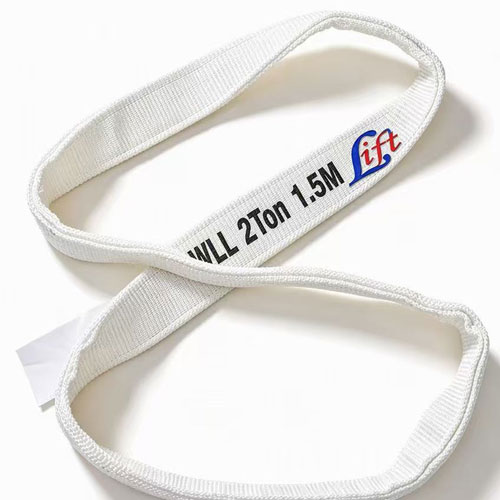
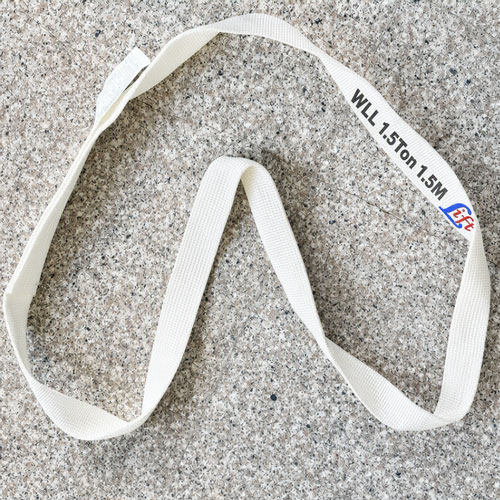
An endless sling is a flat woven webbing band closed into a loop: cradle it, choke it or hang it with no eye and no fitting on the article. The word is used for three different constructions under two European standards, and the loop own numbers are the ones buyers get wrong - a basket hitch doubles the rating only in a geometry most lifts do not have, a choker takes twenty to twenty-five per cent away before the choke angle takes more, and the length is quoted two ways with a factor of two between them. HS 630790. Phone 18066002268.
Hits: ℃
Release time:2026-09-19 11:51
Lift Sling Rigging Co., Ltd produce Endless Sling,Endless Lifting Sling,Endless Sling Belt,Endless Web Sling,Endless Loop Sling,Endless Round Sling.
Endless Sling — the Continuous Loop, the Three Hitches, and the Length Counted Twice
An endless sling as the form actually looks: one continuous white band, crossed over itself so both "ends" are visibly the same piece of webbing. The working load limit and the length are printed on the band, with the maker's mark beside them.
1. What an Endless Sling Is, and the Six Names Under One Word
The most useful thing a manufacturer can put on a page like this is the manufacturer's own listing line, because it shows the problem in the client's own words: Endless Sling, Endless Lifting Sling, Endless Sling Belt, Endless Web Sling, Endless Loop Sling, Endless Round Sling. Six entries. One product family. And a seventh term, round sling, which is not the same product at all even though the trade uses endless for it too.
The reason the names multiply is that endless is a word about construction, and a construction can be realised in more than one material and more than one standard. Two of the six entries above describe the same article (endless sling, endless lifting sling); one describes the band's form (endless loop sling); one describes the material family the trade associates with it (endless web sling); one is the phrase a warehouse uses when it orders by the pallet (endless sling belt); and one — endless round sling — quietly steps across a line into a different product, a different construction and, as §2 shows, a different European standard.
The common property is worth stating plainly, because it is what the buyer is actually paying for: there are no ends to fail and no fittings to lose. A sewn-eye sling has two eyes, each folded and stitched, and each an inspection point. An endless sling has one continuous band with a single joint where the loop closes, and nothing else on it except the print and the label. That is a real engineering advantage and it is also the reason the article is harder to inspect than the alternatives, a point §9 comes back to.
| The name on the listing | What it actually describes | What it leaves open, and what to ask instead |
|---|---|---|
| endless sling endless lifting sling | The category itself: a sling with no ends, used for lifting. | Which construction and which standard. Ask for the standard number, because this phrase covers at least two products made to different ones. |
| endless loop sling endless web sling | The form (a closed loop) and the material family (woven webbing) — the two things that make it a flat woven endless sling. | The fibre, the ply and the length convention. The name describes the shape of the band, not what the band is made of or how long it is. |
| endless sling belt | A purchasing habit rather than a product: the item ordered by the bundle or the pallet, usually in a standard length for tying a load that is then lifted. | Whether the goods are rated for lifting at all. A belt sold by the piece is not automatically a sling with a working load limit on it. |
| endless round sling | A different construction: a load-bearing core of synthetic yarn inside a woven tubular cover, formed as a continuous loop. In the trade a round sling is also simply called an endless sling. | Everything. This is the one name in the list that names another product, and it is governed by a different European standard — see §2. |
| flat round sling endless flat round sling | The hybrid some suppliers catalogue: described as a mix of the circular shape of a round sling with the flat webbing of a conventional sling, made to the flat woven standard. | Which standard the certificate will name, since the hybrid is offered under the flat woven document despite its round name. |
The practical consequence is one sentence. An enquiry that says endless sling, 2 tonne, 1.5 m has named a category, a capacity and a number, and has not said whether the article is a flat woven band or a sleeved core, whether the 1.5 m is the loop's circumference or its usable length, or which standard the goods will be made to. Those three answers are what this page is for, and they arrive in that order: the construction first, because it decides which document applies.
2. Three Constructions Under Two Standards: Telling Them Apart at Goods-In
The trade's own buying guides make the distinction in a single sentence, and it is worth quoting rather than paraphrasing: EN 1492-1 applies to flat woven webbing slings, while EN 1492-2 applies to roundslings. Both are European standards for man-made fibre lifting slings; they are not interchangeable, and the article in the carton belongs to one of them.
The flat woven endless sling is the article this page is titled after. It is woven as a flat band and closed into a loop, most often in high-tenacity polyester, and it is specified and marked under EN 1492-1. Suppliers of this construction describe it as produced with a herringbone weave for resistance to sharp corners, colour coded, and — in one European catalogue's words — a range of disposable polyester webbing straps used for multimodal transport, offered in a single-ply type as standard with a double-ply type on request, and carrying a safety factor of 7 unless another is asked for.
The round sling is a different build entirely, and its construction is the reason it is easy to identify once you have handled one. As one buyer's guide puts it, a typical polyester round sling consists of a load-bearing inner core made from high-tenacity synthetic yarn and a woven protective outer sleeve; many are manufactured as endless round slings forming a continuous loop. Another manufacturer describes endless round slings as made from polyester core yarn and designed with a seamless "endless" loop tubular cover. Two consequences follow for a buyer. First, the load is carried by the core, which you cannot see, so the sleeve is a cover and not the sling. Second, some slings of this family are built with a coloured warning core: the inspection guidance for web slings lists "exposed red core yarn" among the reasons to remove a sling from service, and adds the sentence that matters most for anyone inspecting one — if damage is present and the red yarns are not exposed, do not use the sling either.
The endless flat round sling is the hybrid that causes most of the confusion in the middle of a purchasing conversation, because its name contains both words and it is sold under one standard while sounding like the other. Suppliers describe it as a mix of the circular shape of a round sling and the flat webbing of a regular webbing sling, made according to EN 1492-1 with a CE type certificate available.
| The construction | What carries the load | The standard it is made to | How to tell it from the other two, in five seconds |
|---|---|---|---|
| Flat woven endless sling | The flat woven band itself, closed into a loop. | EN 1492-1 — flat woven webbing slings. | Feel the band: it is flat, it is the same width all the way round, and there is nothing inside it. The whole thickness is the load path. |
| Round sling (endless round sling) | A core of high-tenacity yarn inside a woven sleeve. The sleeve carries nothing. | EN 1492-2 — roundslings. | It is round in section rather than flat, and the cover slides over the core underneath it. A coloured warning core may be visible inside the sleeve. |
| Endless flat round sling (the hybrid) | The flat woven webbing, as in the first row, in a shape that borrows the round sling's circular form. | EN 1492-1, despite the round in the name. | Read the label rather than the name, and expect to be surprised: the standard number is the only reliable answer. |
| Any of the three, at goods-in | Whatever the label says, once the label has been read. | The one named on the label, which is why every compliant sling carries it. | Check the identity first and the construction second. A missing or unreadable identification tag is itself a reason to take the sling out of service, before any question of wear arises. |
Two practical notes close this section, and both are about not buying the wrong standard by accident. The first is that the word on the quotation is not the specification: a supplier who writes "endless sling" may be quoting any of the three rows above, and the round sling's capacity comes from a yarn core while the flat woven sling's comes from the band — so a price comparison between them is not a comparison of like articles. The second is that the standards carry their own marking requirements, and the fastest way to confirm which document you actually received is to read the label rather than to trust the invoice. A round sling made to EN 1492-2 must carry its maker's name, the working load limit, the applicable standard, the material type, the effective working length, a traceability code, the CE marking and the date of manufacture; the flat woven article carries an equivalent set under its own document. Whichever set appears on the label is the set you bought.
3. No Eyes and No Fittings: What the Continuous Form Actually Buys You
Most of what is written about endless slings is about price. The interesting part is mechanical, and it comes in three pieces.
The first is the one the rigging literature states as a rule and the endless form makes easy to obey. The guidance on choker hitches is explicit that the choke point should always be on the sling body, and never on the sling eye, on a fitting, on the base of the eye or fitting, or on a splice or a tag. On a sewn-eye sling that rule has to be remembered every time, because a choker is made by passing one eye through the other, and there is a permanent temptation to let the choke close on the eye it passed through. On an endless sling there is no eye to choke on: the whole article is body. The rule stops being a discipline and becomes a description of the object.
The second is symmetry. A continuous loop has no top and no bottom, no first end and no second end, and — this is the part with commercial value — no designated place where the crane hook goes. Between lifts the loop can be rotated so that a different arc of the band takes the bend, the corner and the choke. On a sling that is used repeatedly, that rotation is the cheapest form of life extension there is: wear is spread over the whole circumference instead of concentrated at two eyes. On an article bought to travel with one load and stay with it, rotation has no value at all, which is precisely why the same construction appears in both markets at two different prices and two different factors.
The third is what the form costs. A closed loop cannot be shortened, lengthened or adjusted. A sewn-eye sling can be re-reeved, or its eyes can be spread over two hooks to change the geometry; a loop can only be used as it is, doubled over on itself if it is long enough, or wrapped twice — which the rigging guidance lists as the double wrap configuration precisely because it gives better grip and load control on smooth or loose loads. And because there is no eye, there is also no obvious place to attach anything: taglines, softeners and edge protection have to be applied to a plain band. None of that is a defect, but all of it belongs in the lift plan before the sling is ordered, because the endless form is not a cheaper version of an eye sling. It is a different tool with a different set of moves.
| The property of a closed loop | What it means at the load | What it costs, and when the alternative is better |
|---|---|---|
| There is no eye, so there is nothing to choke on but the body | The choker rule — keep the choke on the body, off the eye, the fitting and the tag — is satisfied by the construction rather than by the rigger's memory. | Nothing. This is the form's clearest advantage over a sewn-eye sling for choke work. |
| No top, no bottom, no designated end | The loop can be rotated between lifts so wear is spread round the band instead of concentrating at two points. | Rotation is work, and it only pays on a sling that is reused. It also removes the wear history, which §9 shows is the form's real inspection problem. |
| The band is continuous and flat all the way round | A basket or a double wrap can be taken on any part of the band, and the load can be cradled without a fitting touching it. | Nothing, provided the corners are protected. A flat band is more cut-sensitive than a sleeved round sling on the same load. |
| The length is fixed at the mill | One article per job. Nothing to adjust on site, nothing to get wrong on site — and nothing to correct if the plan changes. | A changed lift means a new sling, so the length has to be right in the order. §7 is about the two conventions that decide what "right" means. |
| Nothing to replace but the band | No thimbles, no hooks, no shackles to match and inspect, and no mismatch between a fitting's rating and the sling's. | Where the lift needs a fitting — a hook that will not release, a shackle that must be sized — the endless form cannot supply it and a sling assembly is the right purchase. |
One construction option belongs here because it is quoted as a courtesy and should be ordered as a requirement: a protective sleeve or cover over part or all of the loop. It changes nothing about the rating and everything about how long the band survives a corner. The trade's own removal criteria for web slings list cuts, snags and embedded material as reasons to withdraw a sling; a cover is the cheapest way to stop those appearing where the load is hardest. Ask for it explicitly on rigid, machined or galvanised loads.
4. The Three Hitches, and the Three Numbers That Go With Them
The same endless sling carries three different loads depending on how it is put on. The trade's rigging guidance gives the figures, and they are worth committing to memory because they are the difference between a lift that is planned and a lift that merely happens.
A vertical hitch — the loop hung straight from hook to load — uses the full rated capacity on the label. That number, and only that number, is what the colour code and the printed working load limit refer to: both standards define the rating for a straight lift. Everything else on this page is a derating or a bonus.
A basket hitch — the loop cradled under the load with the load taken on both sides — carries twice the vertical rating, and the condition attached to that doubling is the part that gets forgotten. The rigging guidance states it precisely: a basket hitch has twice the capacity of a single leg vertical hitch when the legs are in a true 90° vertical fashion and the D/d ratio is 25:1, which typically requires a below-the-hook device such as a lifting beam or spreader bar, or two separate lifting devices. Take away the beam and the geometry degrades, and with it the number — the same source's table shows a basket carrying 170% at 60°, 140% at 45° and only 100% at 30°. A two-leg basket that looks like a bargain is often carrying no more than the vertical rating of one leg.
A choker hitch — the loop passed through itself and tightened round the load — carries less than vertical, not more, because of the stresses created at the choke point. The guidance gives the figure as a range rather than a number: 75 to 80% of the vertical capacity, with the least reduction when the angle of choke is 120° or greater, and — the sentence worth remembering — any angle of choke less than 120° can result in a capacity as low as 40% of the single leg. A second distributor's table gives the same figure as a flat "normally 80% of that for a vertical hitch", which is the same statement at the generous end of the range.
Nobody should be surprised that two documents put the choker figure differently. The derating is a function of the choke angle, and the angle is a function of how the sling is rigged on the day, so a single number cannot be right for every lift. What a buyer should take from the range is the shape of it: basket doubles only if you earn it, choker always costs you something, and the choker's cost is set by an angle the label knows nothing about.
| The hitch | Capacity against the label | The condition attached to the figure | Why the endless form suits it |
|---|---|---|---|
| Vertical (straight) | 100% — this is the rated capacity the colour and the printed figure refer to. | None, on a single leg. The guidance does warn that a single vertical hitch should never be used to lift loose materials, long loads or unbalanced loads. | Works, though a sewn-eye sling does the same job. The loop's advantages appear in the other two rows. |
| Basket | 200% at best, and only in the ideal geometry: 170% at 60°, 140% at 45°, 100% at 30°. | Legs at a true 90° and a D/d ratio of 25:1, which usually means a lifting beam or two separate lifting devices. Not for unbalanced or hard-to-balance loads. | The loop cradles a bundle with no eye and no fitting touching the load, and doubles over on itself for a double wrap where grip matters. |
| Choker | 75 to 80% of vertical as a working figure, and as low as 40% at a closed choke angle. | The angle of choke decides it: least reduction at 120° or more, and the reduction grows as the angle closes. | The strongest argument for the endless form: the choke can only ever close on the body, never on an eye, fitting, splice or tag. |
| Bridle (two, three or four legs) | Not a multiple of the label: each leg carries its own share, increased by the angle it runs at. | Legs share equally only if their lengths are equal, the pick is over the centre of gravity and the centre of gravity is centred in the load. | Loops are cut to a matched length set more easily than assembled slings, but the legs must be rigged at a workable angle — see §6. |
Two sentences close the section, because everything in §5 and §6 is a consequence of them. The figure on the band is the vertical rating and nothing else: it is the number the colour code repeats and the number the certificate names. And every configuration a rigger actually uses is either the vertical rating multiplied by the geometry of a basket or reduced by the geometry of a choke — which is why the two-dimensional tables that follow are not academic. They are the arithmetic that turns a printed figure into a lift plan.
Two of the words in this family already have pages of their own on this site, and between them they divide the market for the article that travels with one load and is not brought back: the vocabulary of that article belongs to the one way sling page, and the definition of the journey it makes belongs to the single use page. This page is the third of the three, and it owns the loop itself — the construction, the hitches and the length.
5. The Choke Angle: Where a Choker Lift Is Won or Lost
The choker figure of 75 to 80% is not the end of the arithmetic; it is the beginning of it. The reduction depends on the angle of choke — the angle at which the band closes round the load — and the rigging literature publishes that dependency as a table rather than a sentence, because a single number could not describe it. Two independent sources were checked for this page, and they say the same thing in two different ways.
The first presents the figures as a percentage of the sling's rated capacity in choker hitch, by angle band: 100% when the angle of choke is 120° or more, 87% between 90° and 120°, 74% between 60° and 89°, 62% between 30° and 59°, and 49% at an angle below 30°. The second presents a reduction factor against the same angle: 1.000 from 120° to 180°, 0.82 between 105° and 120°, 0.71 between 90° and 105°, 0.58 between 60° and 90°, and 0.50 below 60°, with the formula stated plainly: actual sling capacity = rated capacity × reduction factor.
Those two tables agree with each other where their angle bands overlap, which is worth seeing once. Both put the full rating at 120° or more; both put the mid-range figures in the 0.7 to 0.87 zone; and both put the worst case near half. That is also how the earlier warning about "as low as 40%" is arrived at, and the arithmetic can be done out loud: a choker at the generous end of its range starts at 80% of the vertical rating, and a thoroughly closed choke takes about 49% of that — which is 0.8 × 0.49, or roughly 39% of the number printed on the band. The two separate statements in the literature, one about the hitch and one about the angle, multiply into the third statement about the lift.
| Angle of choke | Source A: percent of the choker rating | Source B: reduction factor | What it means for a 2 t sling on the band |
|---|---|---|---|
| 120° or more (open choke) | 100% | 1.000 | About 1.6 t, the choker figure at its full value. This is the rigging to aim for. |
| 90° to 120° | 87% (90–120°) and 100% down to 120° in the source's own banding | 0.82 (105–120°) and 0.71 (90–105°) | Between about 1.1 t and 1.4 t. An everyday choker on a round or a bundle sits here. |
| 60° to 90° | 74% (60–89°) | 0.58 (60–90°) | About 0.9 t to 1.2 t. The two sources now differ visibly, which is the honest state of the subject: the figure depends on the load's diameter as well as the angle. |
| 30° to 60° | 62% (30–59°) | 0.50 (below 60°) | About 0.8 t to 1.0 t. A choker this closed on a two-tonne band is carrying a one-tonne load at best. |
| Below 30° (thoroughly closed) | 49% | 0.50 at the bottom of the band | Roughly 0.8 t, and about 40% of the printed figure once the hitch derating is included. This is the case the "as low as 40%" warning is about. |
The practical rule that follows is short. Rig the choke as open as the load allows, and if it cannot be opened past about 120°, buy capacity instead of hoping. Two further rules from the same guidance are worth repeating because they are cheap to obey and expensive to ignore: the choke should be pulled tight before the lift is made rather than allowed to tighten during it, and a sling used in a choker should be long enough that the choke actually grips the load — a choke that has not closed round the load is a load being carried by friction on a band that thinks it is vertical.
6. The Angle Between the Legs: the Same Penalty, Measured a Different Way
Flatten the legs of a lift and each leg carries more, even though the load has not changed. The rigging literature quantifies this as a tension multiplier applied to the share of the load carried by each leg, and the table is short enough to carry in the head: a leg running at 90° from horizontal has a multiplier of 1.000 — no penalty at all; at 60° it is 1.155; at 45° it is 1.414; and at 30° it is 2.000. The formula given with the table is direct: multiply the load weight per leg by the tension factor to find the increased tension in that leg.
The reason the 30° figure is exactly double is not a coincidence of the table — the multiplier is the reciprocal of the sine of the angle, so at 30° it is 1 ÷ 0.5 = 2.000 and at 45° it is 1 ÷ 0.7071 = 1.414. That is worth knowing because it turns a lookup into an estimate: the flatter the leg, the worse it gets, and the penalty accelerates as the angle falls. Between 90° and 60° the multiplier moves from 1.000 to 1.155, which is bearable; between 45° and 30° it moves from 1.414 to 2.000, which is not.
The reason this appears on a page about endless slings, and not only on a rigging page, is that the two published tables are the same table read in two directions. One source gives the basket hitch's capacity by angle as 200% at 90°, 170% at 60°, 140% at 45° and 100% at 30%. The other gives the tension multiplier by the same angles. Multiply the ideal basket figure by the reciprocal of the tension multiplier and the two agree: 200 × (1 ÷ 1.155) = 173, which the first source rounds to 170; 200 × (1 ÷ 1.414) = 141, which it rounds to 140; 200 × (1 ÷ 2.000) = 100, which it states exactly. So a buyer who has one table has both.
| Leg angle from horizontal | Tension multiplier on each leg | Basket capacity as percent of vertical, the other source's table | The arithmetic that reconciles them |
|---|---|---|---|
| 90° | 1.000 | 200% | 200 × 1.000 = 200. The ideal case, and the only one where the doubling is real. |
| 75° | 1.035 | Not tabulated by the second source | 200 ÷ 1.035 = 193. A steep basket loses almost nothing, which is why the angle is worth checking before the beam is ordered. |
| 60° | 1.155 | 170% | 200 ÷ 1.155 = 173, rounded to 170. The two documents agree. |
| 45° | 1.414 | 140% | 200 ÷ 1.414 = 141, rounded to 140. Still worth doing, at three quarters of the ideal gain. |
| 30° | 2.000 | 100% | 200 ÷ 2.000 = 100. The basket has given back the whole of its advantage, and a single vertical leg would have done the same job with less rigging. |
Two consequences for the endless form specifically. A loop is usually used in a basket or a double wrap for exactly the loads that make people flatten the legs — loose bundles, pipe, long goods — so the angle tables apply to this construction more often than to any other on this site. And because the loop has no fixed ends, the effective angle is set by where the band crosses itself, not by a sewn eye that forces a particular hook position; there is more freedom in the geometry, which means there is also more room to get it wrong. Rig the legs as steep as the load allows, and treat 60° from horizontal as the working floor rather than a target.
7. Length: Two Conventions, and a Factor of Two Between Them
This is the part of the purchase where experienced buyers still make expensive mistakes, and it happens because an endless sling has two different lengths and only one of them can be printed on the band.
There is the usable length — the length of the loop as it hangs, which is what decides whether it reaches round the load — and the circumference, which is the distance all the way round the band. On a closed loop of the kind shown on this page the two are related by a factor of two, and one European manufacturer's catalogue states the relationship as a warning rather than a footnote: circumference is usable length multiplied by 2. The same catalogue's own ordering code makes the convention explicit by defining the last two digits of the code as metres of "total length or circumference", so a four-metre code names a loop whose usable length is two metres.
The printed figures on this page's two photographs illustrate the ambiguity without resolving it, and that is the honest way to present it. Both bands read 1.5M; one is rated 2 tonnes and the other 1.5 tonnes. Nothing on either band says whether the 1.5 metres is the circumference or the usable length. A buyer reading it one way and a factory reading it the other will both consider the order correct, and the difference is a sling that either will not reach round the load or has a metre of spare band on every lift. The only fix is procedural: state the convention in the order, in words, and check it against the packing list. Whether that convention is the site's own or the customer's is a commercial decision; leaving it unstated is not.
Two more things about length come from the same body of guidance and belong in this section. The first is the method: web sling length is measured with the sling laid flat and pulled taut by hand, which means a measurement taken with the loop hanging, or with the band under tension from anything other than a hand, is not the length the standard is talking about. The second is tolerance, which differs with the thickness of the band: the published figures allow roughly ±1.5 inches plus 1.5% of the length for a single-ply sling, ±2 inches plus 2% for two-ply, and ±3 inches plus 3% for three- and four-ply, with an extra half inch on widths above six inches. Where several slings are ordered as a matched set — the common case when four loops are to be rigged as a bridle — the tolerance tightens to half of those figures, because unequal legs share the load unequally, which is the same warning that appears in §4's bridle row.
| What is written down | What it can mean | How to measure it, per the published method | The mistake it produces |
|---|---|---|---|
| "1.5 m", as printed on the band | Either the circumference or the usable length — the print alone does not say which. | Lay the sling flat and pull it taut by hand, then measure. Not hanging, and not under machine tension. | A sling half the intended size, or one twice as long as the lift plan assumed. Both are discovered at the load. |
| "4 m" in a manufacturer's ordering code | Where the maker defines the code as total length or circumference, four metres of band is a two-metre hanging loop. | Measure the loop as it hangs for the usable figure, and the whole way round for the circumference, and check the two against a factor of two. | Assuming the code gives the hanging length, which halves the sling the buyer thinks has been ordered. |
| A single-ply sling, measured on arrival | Anything inside roughly ±1.5 inches plus 1.5% of the length is within the published tolerance for that thickness. | Same method, and compare against the tolerance for the ply rather than against a nominal figure. | Rejecting a conforming sling for being 40 mm out, or accepting a non-conforming one against the wrong tolerance band. |
| "Four slings, matched set" | The tolerance halves, because the legs of a bridle share the load in proportion to their length. | Measure all four by the same method, and record the figures rather than the nominal size. | A bridle whose shortest leg carries the largest share, on a set that passed goods-in because each sling was individually in tolerance. |
The section closes with the sentence that belongs on every endless sling order, because it is the one thing the maker cannot infer and the buyer cannot check afterwards. Write the length convention, write the tolerance class, and write whether the set is matched. Three clauses, one line of the purchase order, and they remove the entire class of error this section is about.
8. What to Write on the Order
Sections 2 to 7 established that an endless sling is under-specified by every phrase in common use. This section turns that into a purchase order. Nine questions cover the whole article, and every one of them has an answer that can be put on a line of paper and checked at goods-in — which is the point, because on a sling with nothing on it but a band and a label, the paper is the only place the specification can live.
| The question | Why it has to be asked | What a usable answer looks like |
|---|---|---|
| Which construction, and which standard number? | The word endless covers a flat woven band and a sleeved yarn core, made to two different European standards (§2). | A document, not a word: "flat woven, EN 1492-1" or "round sling, EN 1492-2". It should be the number that appears on the label. |
| Which fibre, and to what temperature? | The fibre sets what the sling must be kept away from, and the temperature range differs between fibres. | A named fibre with its range. Polyester and polyamide are published as −40 °C to +100 °C; polypropylene as −40 °C to +80 °C on the round sling side. |
| Which ply, or which type code? | Thickness is a specification item and it drives both the price and the cut-resistance of the band. | A type designation and its ply. One European catalogue offers a single-ply type as standard and a double-ply type on request, and names them in its own type code. |
| What safety factor? | It is the single number that links the working load limit on the label to the load the sling is proved at. | A factor and its source. On the European general-purpose ranges the commonly specified minimum is 7:1, and one catalogue notes that another factor can be supplied on request. |
| Which length convention? | Usable length and circumference differ by a factor of two on a closed loop, and the band cannot tell you which one is printed on it (§7). | Words, not a number: "3 m usable length" or "6 m circumference". If it is only a number, the order has not specified the article. |
| Sleeve or cover, and how much of it? | A flat woven band is more cut-sensitive than a sleeved round sling, and the removal criteria list cuts and snags explicitly. | Where the protection goes: over the load contact, over the choke, or over the whole loop. It is a construction option and it changes nothing about the rating. |
| Is this a matched set? | The legs of a bridle share the load in proportion to their length, so unequal legs overload the short one (§4, §7). | A matched-set order, whose published tolerance is half the standard one, with the measured lengths recorded rather than the nominal size. |
| What documentation, specifically? | Lifting accessories are declared against a directive or a standard, and the declaration is what an audit will ask for. | A certificate naming the standard and the factor, the CE declaration where the goods are for Europe, and the test documentation the maker holds. |
| What must appear on the label? | On an article with no colour code of its own meaning and no fittings to size, the label is the identification. | At least: maker, working load limit, standard, material, effective working length, traceability code, CE marking, date of manufacture and — on the round sling side — the safety factor. |
The nine questions have one property in common: every one of them can be answered with a document or a number, and none of them can be answered with an adjective. That is what makes them usable in a purchase order and useless in a conversation, and it is also why the answers are worth keeping. When the sling arrives, the label is the only thing on the article that can be checked against them.
9. Inspecting a Continuous Loop
The published criteria for taking a web sling out of service are a list of things to look for, and they apply to this construction as much as to any other. What is different about a closed loop is where the wear can hide. A sewn-eye sling concentrates the load at two known places, so an inspector knows where to look. A loop that has been rotated, as §3 recommends, has spread its wear over an entire circumference, and a loop that has been choked has been stressed at the choke point wherever that happened to fall. There is no designated end, so there is no obvious first place to check.
Three of the criteria are worth pulling out for this form. The first is the identification tag: a missing or unreadable tag is itself a reason to remove the sling from service, before any question of wear arises — and on this article that rule does more work than on any other, because the tag is the only thing that says what the band is worth. The second is broken or worn stitches in the load-bearing splices: an endless sling's only joint is where the band closes the loop, which makes that joint the splice in question, and it is the one place on the article that should be examined every time. The third is the warning about cores, which applies to the round sling branch of this family: exposed coloured core yarn is a removal criterion, and the same guidance adds the sentence that catches people out — if damage is present and the coloured yarns are not exposed, do not use the sling either. A sleeve that has been scraped is a sleeve that has been scraped; it is not proof that the core inside it survived.
| What you find on the loop | Why it is on the removal list | What to do, and what it means for the order |
|---|---|---|
| The identification tag is missing or unreadable | Nobody can say what the sling is rated for. The published list puts this first, and for a loop with no other marking it is decisive. | Remove from service. Reorder with the label contents specified per §8 so that the replacement can be identified at the load. |
| Holes, tears, cuts, snags or embedded material | The band is the whole load path on a flat woven endless sling, so a cut in the band is a cut in the sling. | Remove from service. Where the cause was a load edge, specify a sleeve next time (§8) rather than accepting the same loss again. |
| Broken or worn stitches in the load-bearing splices | On a closed loop the joint that closes the circle is the only splice there is, and the load crosses it once per lap. | Remove from service, and inspect the joint first on every subsequent sling of this type. |
| Knots anywhere in the webbing | A knot raises the local stress far beyond the rating and is on the published removal list without qualification. | Remove from service. A knot in a loop usually means somebody was shortening it — which is exactly what the form does not allow (§3). |
| Acid or alkali burns; melting, charring or weld spatter | Chemical and thermal damage removes strength without necessarily changing the shape of the band, so it is easy to miss. | Remove from service, and record the exposure. If the environment repeats, the fibre choice in §8 is what needs changing. |
| Excessive abrasive wear, or crushed webbing | Both thin the load path. On a rotated loop this may present as a band that is uniformly tired rather than locally damaged. | Remove from service. Uniform wear across the whole loop is the case rotation is designed to produce, and it still ends in withdrawal. |
| Signs of ultraviolet degradation | Sunlight attacks synthetic webbing, and the published guidance lists the signs as a removal criterion. | Remove from service, and review storage: sealing slings in their packaging until the lift is the cheap half of this rule. |
| Damage to a fitting | On an assembled sling, a distorted, pitted or corroded fitting is a removal criterion of its own. | Not applicable here, and that is the point: this form has nothing to seize, nothing to mismatch and nothing to replace separately. |
| Any condition that leaves doubt | The published list closes with this, and it is a criterion rather than a caveat: doubt is sufficient reason. | Withdraw the sling and let somebody qualified make the call. On an article at this price the argument is not worth having. |
One structural point about inspecting this form, and it is the reason the section exists. Because the loop has no designated end and can be rotated, the wear pattern is not a history. On a sewn-eye sling the marks tell you where the last lifts happened. On a rotated loop they do not, so the inspection cannot be a reading of evidence — it has to be a search of the whole circumference, or it is not an inspection at all.
10. Where the Continuous Form Is Chosen, and Why
This is not a section about price, because the price argument for a loop over a sewn sling is obvious and the mechanical argument is more interesting. The form gets chosen for four situations, and each of them is a problem the endless loop solves in a way no other construction does as cleanly.
The first is a load the sling has to cradle: a bundle of pipe, a coil, a stack of sheet, anything without lifting points, where the sling passes underneath and takes the load over a broad area. Only a loop can do this without an eye and a hook changing the geometry, and the same source's guidance notes that the double wrap variant gives better grip on smooth surfaces and better control on loose material — the case where a bundle would otherwise slide out of the band.
The second is a load the sling must choke: a pipe, a pole, a beam, anything that can be gripped by a band passed through itself and pulled tight. §4 showed that this costs capacity, and §5 showed that the cost is set by an angle the label cannot know — but it is also the only hitch where an endless sling is easier to use correctly than an eye sling, because there is no eye to choke against.
The third is a surface that must not be marked. The buying guides for textile slings are consistent that they are chosen where chain or wire rope would damage the load, and on finished, painted or machined surfaces a flat woven loop spreads the contact stress over the width of the band with nothing hard touching the load. Where a fitting would leave a mark, the endless form removes the fitting.
The fourth is transport, and here the endless form appears in a market of its own: one European manufacturer describes its endless flat range as disposable polyester webbing straps used for multimodal transport, which is the same article this site sells as a one-journey sling — bought in quantity, used to move goods between modes, and not recovered. That commercial setting is what makes the light flat band the right choice, and it is also what makes §7's length convention matter so much: a thousand loops cut to the wrong convention is a thousand loops that do not fit.
| The situation | Why the endless form specifically | What has to be specified because of it |
|---|---|---|
| No lifting points: the load must be cradled | The band passes underneath and supports across its full width, with no eye and no hook in the contact area. | The length convention above all — a cradle only fits if the loop is the right size (§7) — and edge protection where the load corners. |
| A round or a bundle that has to be gripped | The choke is taken on the body of the band, which is the only place the guidance permits it to be taken. | Extra capacity, because a choker carries 75 to 80% and less as the angle closes (§4, §5). Buy the rating for the rigging, not for the label. |
| A smooth or finished surface | Soft textile over an even band spreads the contact stress, and a loop has no fitting to press into the load. | A sleeve over the contact area, and the fibre choice, which decides what the surface will tolerate. |
| Loose material or a slippery load | The loop can be taken round twice — the double wrap — which the guidance recommends precisely for grip and control on loose loads. | More length, since a double wrap uses the circumference twice, and a check that the wrap does not overlap at the bottom of the load. |
| Multimodal transport, in quantity | A light disposable flat loop is the cheapest thing that will move goods between modes and stay with them. | A single agreed length convention across the whole order, and a matched tensile set if the loops are to be rigged as a bridle. |
Two of these five situations are worth a second look before ordering, because they pull in opposite directions. The cradle and the choke both want length, and a cradle wants more of it than a choke does; but the angle tables in §6 punish whichever leg ends up flatter, so a longer loop is not automatically a more forgiving one. The endless form gives the rigger freedom of geometry — that is its advantage — and freedom of geometry is what the derating tables exist to price.
11. Two Reasons to Buy It, and One to Be Careful About
The commercial case for an endless sling is short and, on this site, it is the same case the disposable article makes: there is nothing on the sling to buy twice. No eyes to be reinforced, no fittings to be sized, matched and inspected, no thimbles to lose. A loop is one piece of woven band with one joint and one label, and its cost is the cost of the band. For a customer moving goods in quantity, that is the whole argument.
The mechanical case is shorter still. The endless form is the only construction that cradles a load and chokes a load with the same article and no hardware, and it does the choke the way the guidance demands — on the body, every time. Where a lift plan needs a basket over a bundle and a choke on a pipe in the same week, one length of loop does both jobs, and §4 and §5 tell the planner what each configuration is worth.
The caution is about identification, and it follows directly from everything above. This article has no colour code of its own capacity, no fittings that carry a rating, and no eyes whose size tells you anything; on a flat woven loop the print and the label are the entire specification. The band in the photograph on this page says WLL 2Ton 1.5M, which looks like a complete specification and is not one — it does not say which standard the sling was made to, which construction family it belongs to, whether the 1.5 metres is the circumference or the usable length, or which batch it came from. Every one of those answers lives in the paperwork, and the paperwork is the part of this purchase that a price comparison cannot see. Buy the loop for what it is, and specify it as though the band said nothing — because, apart from four characters and a number, it does not.
12. Frequently Asked Questions
Q1: What is an endless sling?
Q2: Is an endless sling the same as a round sling?
Q3: What should the label on an endless sling carry?
Q4: How much can an endless sling lift in a basket hitch?
Q5: How much does a choker hitch reduce capacity?
Q6: Why does a flatter sling angle reduce capacity?
Q7: How is the length of an endless sling measured and ordered?
Q8: What safety factor does an endless sling have?
Q9: What should come with the shipment?
Q10: When should an endless sling be taken out of service?
Contact
Lift Sling Rigging Co., Ltd produces endless slings as flat woven continuous loops in high-tenacity polyester, with the working load limit and the length printed on the band and an identification label carrying the items set out in §8. Tell us the construction and the standard you need, the working load limit, the length convention and the ply, and we will confirm the label, the certificate and the test documentation that travel with the shipment.
Telephone and WeChat — 18066002268
E-mail — 702461526@qq.com
Address — Lifute Industrial Park, Taizhou City, Jiangsu Province, China
HS code — 630790
- Previous:Eye & Eye Sling
- Next:One Way Sling