Language
 简体中文

- On the 2018 National Day holiday, Lifet completed six 100 ton large tonnage lifting belts as a gift
- The role of suspension net in the transportation of goods turnover
- Cargo soft lifting net, lifting net, lifting net, lifting net, bag, climbing net
- Precautions for using Lifutiden elevator
- How to make circular lifting straps
Contact: Wang Lili
E-mail:18066002268
Phone:702461526@qq.com
Address: Lifute Industrial Park, Taizhou City, Jiangsu Province
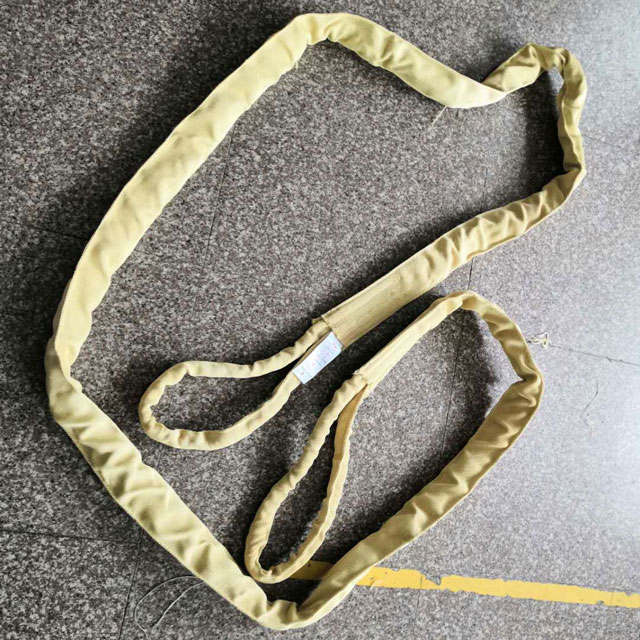
An eye type round sling is a round sling with a loop eye formed at each end: a high-tenacity yarn core inside a woven protective sleeve, with wear pads attached to both sides at the ends so the sling can be hung on hardware or rigged as a set. Because the core carries the load and the sleeve only protects it and states the capacity, what you inspect is not what carries the load - and the sleeve colour reads the straight-lift rating off the outside, in the standard‘s eight-colour code. Made to EN 1492-2, commonly at a 7:1 safety factor. HS 630790. Phone 18066002268.
Hits: ℃
Release time:2026-09-19 13:49
Lift Sling Rigging Co., Ltd produce Eye Type Round Sling,Eye & Eye Round Sling,Eye and Eye Polyester Round Sling,Eye & Eye Soft Round Sling
Eye Type Round Sling — the Core You Cannot See, the Cover You Can, and Four Names for One Article
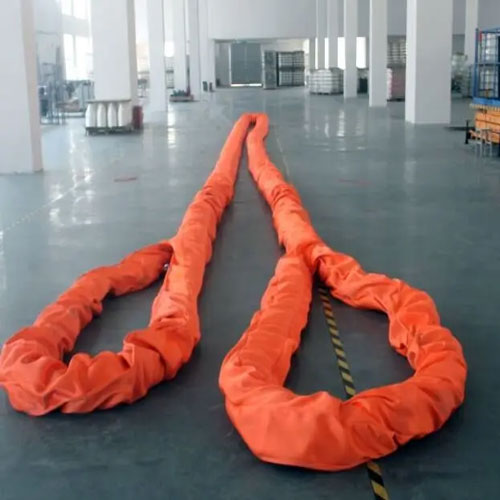
An eye type round sling doing nothing more complicated than lying on a floor, and still showing the three things this page is about: a sleeved continuous strand, a loop eye formed at each end, and an orange cover that reads as ten tonnes and above in the standard's colour code.
1. What an "Eye Type Round Sling" Is, and Why the Name Needs Explaining
The name is a description of a construction, and it is easier to understand once the two halves of it are separated.
A round sling is a lifting sling made from a high-strength continuous loop of synthetic yarn, completely encased by a tough tubular jacket that is colour coded by capacity and protects the fibres inside from abrasion and damage. That is the whole construction: no ends, no eyes, no fittings — one closed loop of sleeved strand. The manufacturers put it plainly when they describe the endless version: endless round slings are made from polyester core yarn and designed with a seamless "endless" loop tubular cover, and those continuous loop configurations help users adjust the load contact points and extend the sling's life.
"Eye type" then describes the variant that adds ends. The published description is unusually precise and worth quoting rather than paraphrasing: eye and eye round slings are manufactured in polyester outer sleeves to encapsulate the strands of the endless sling and are covered by attaching a wear pad to both sides of the sling to create loop eyes on each end. Two things follow from those words. The eyes are formed by attaching wear pads on both faces, not by folding the load-bearing material back on itself and stitching it — which is what a flat woven eye and eye sling does, and which is a different article governed by a different standard (§3, §6). And the strand core carries on through the eyes as one continuous load path, which is why this variant works with all hitch types: vertical, basket and choker.
The third thing to know about the name is that it is not stable. This page's own product listing names it four ways — Eye Type Round Sling, Eye & Eye Round Sling, Eye and Eye Polyester Round Sling and Eye & Eye Soft Round Sling — and the trade adds more. A buyer who orders by the trade name alone has named the shape and not the specification, so §7 to §9 deal with what the name leaves out: the standard, the factor, the length convention, the fibre and the label contents.
| The name you meet | What it is describing | What it is NOT telling you |
|---|---|---|
| Round sling | The construction: a continuous loop of high-tenacity yarn inside a protective tubular sleeve, colour coded by capacity. | Whether it has ends at all. The plain round sling has none — it is a closed loop. |
| Endless round sling | The same article described by its loop rather than its material, with a seamless endless tubular cover. | Anything else. This is the base form of the whole family, and the one this site's endless sling page discusses from the closed-loop side. |
| Eye type round sling eye and eye round sling | The variant with a loop eye at each end, made by attaching wear pads to both sides so that the ends can be used as eyes. | That the eyes are sewn load-bearing splices. They are pad-formed eyes over a continuous core — §6 explains why the difference matters at inspection. |
| Polyester round sling soft round sling | The fibre, and the fact that the sleeve is soft textile rather than a faced or reinforced end. | The standard, the factor or the length convention. Polyester is the common choice but it is not the only fibre the standard covers (§8). |
| Flat woven eye and eye sling | A different construction that the same phrase can be taken to mean: a woven band with a soft eye folded back and stitched at each end. | That it is a different standard as well — EN 1492-1 rather than EN 1492-2. This site's eye and eye sling page covers that article; this page covers the sleeved one. |
One sentence summarises the section, and it is the sentence to carry into a quotation. The name describes the ends; the standard describes the article. Eye type, eye and eye and eye to eye are all ways of saying "it has loop eyes", and none of them says whether the load path is a woven band or a sleeved strand core — which is the difference between the two standards, the two inspection regimes and the two price levels.
2. Two Parts, One Rating: the Core You Cannot See and the Cover You Can
Everything unusual about inspecting and buying this article follows from the fact that it has two components with two different jobs.
The core is the load path. It is a load-bearing inner core made from high-tenacity synthetic yarn, formed as a continuous loop. It is not visible, it cannot be examined directly, and its condition is the thing that actually decides whether the sling can hold the load. The sleeve is protection and information. It is a woven protective outer cover, and it does two jobs the same material cannot do: it shields the core from abrasion and from the ingress of grit, and it carries the colour that states the capacity in a straight lift. It carries no load, and a scuffed sleeve is therefore evidence of a condition rather than a measure of strength.
The published inspection rules turn that division into the most useful test on the page. Because some round slings are built with a coloured warning core inside the sleeve, exposed core yarn is a removal criterion. But the guidance does not stop there, and its second sentence is the one that catches people out: if damage is present and the core yarns are not exposed, the sling should not be used either. In other words, the absence of visible core is not a pass. A cut, a burn or an abrasion mark on the sleeve is a statement about what happened to the core underneath it, and the rule treats it that way.
There is a buying consequence as well, and it is the reason this section sits near the top of the page. The two-component construction is what makes the article light and flexible for its capacity — the core can be dense while the sleeve stays thin — and it is also what makes it opaque to a visual check. A flat woven sling's strength is spread across the width of a band you can see in full; this article's strength is inside a tube. Any purchase decision that rests on appearance alone is therefore resting on the sleeve.
| The part | What it does | What it means when it is damaged |
|---|---|---|
| Inner core of high-tenacity yarn | Carries the whole rated load, as one continuous closed strand. This is the load-bearing component. | You cannot assess it directly. Exposed core yarn is a removal criterion, and so is sleeve damage that leaves the core hidden (§6). |
| Woven protective outer sleeve | Protects the core from abrasion and grit, and carries the colour that announces the straight-lift capacity. | Treat it as evidence, not as a cosmetic issue: the sleeve is the interface between the working world and the load path. |
| Wear pads at the ends | Attached to both sides to create the loop eyes on this variant, and to take the wear the eyes incur. | A worn pad is the earliest visible sign on the whole article, because it is the part that meets the hardware. It is a maintenance signal, not a rating change. |
| The identification label | Carries the facts the sleeve colour cannot: the standard, the material, the length, the traceability code and the factor. | A missing or illegible label is itself a removal criterion. On an article whose strength is hidden, the label is the only proof of what is inside (§7). |
| The colour of the sleeve | States the working load limit in a straight lift, which is the fastest check available on site. | The published advice is that colour should never be the only source of capacity information — and §4 shows what an uncoded cover looks like. |
The section closes on the point that makes the whole page worth reading twice: on a flat woven sling the material that carries the load is the material you can see, so a visual inspection is a fairly direct measurement of the load path. On this article it is not, which is why the label, the certificate and the traceability code are not paperwork here — they are the only route to knowing what the sleeve is hiding.
3. It Is EN 1492-2, Not EN 1492-1 — and the Label Has to Say Which
The two European standards for synthetic lifting slings divide by construction, and the split is stated in a single line by the trade's own buying guides: EN 1492-1 applies to flat woven webbing slings, while EN 1492-2 applies to roundslings. Choosing the right one is described in those guides as one of the first steps when selecting lifting equipment, and the reason is that the two documents are not interchangeable: they describe different load paths, different end constructions and therefore different inspection rules.
What EN 1492-2 itself covers is broad. It is the European standard for round slings made of man-made fibres for general-purpose lifting; it covers roundslings made from materials such as polyester (PES), polyamide (PA) and polypropylene (PP), and it also covers certain multi-leg roundsling assemblies, with or without fittings. That last clause matters commercially, because it means a multi-leg assembly of round slings can be certified under the same document as the single sling — an important point for a buyer assembling a bridle.
The regulatory position is worth one paragraph, because it differs from the position of the standard quoted on this site's one way sling page. EN 1492-2 appears in the European Union's published list of harmonised standards, which is the list that gives a standard its presumption of conformity with the machinery directive. The standard cited for the one-journey article on that other page, DIN 60005, does not — a German national industry standard gives no presumption of conformity. The practical difference for a buyer is that on this article the route from the standard to the CE marking is the ordinary one: the manufacturer declares conformity against a document the buyer can name.
The commercial consequence of the split is a single instruction: put the standard on the order and check it on the label. Because the phrase "eye and eye sling" can describe a flat woven article with sewn splices (EN 1492-1) or this sleeved article with pad-formed eyes (EN 1492-2), and because both are sold with the same eight-colour cover code and comparable working load limits, the standard number is the only reliable way to tell a quotation from a delivery.
| The question | EN 1492-1 (flat woven) | EN 1492-2 (round slings) |
|---|---|---|
| What carries the load | The woven band itself, one flat layer or several plies. The load path is the material you can see. | A continuous strand core inside a sleeve. The load path is hidden. |
| What the eyes are | A fold of the band turned back and stitched: a load-bearing splice, which may never be repaired. | Loop eyes created by attaching wear pads to both sides of the sleeved sling, over an unbroken core. |
| What the covering does | Nothing — the band is the load path and the colour code is printed or woven into it. | Everything except the load: the sleeve protects the core and carries the colour code on its outside. |
| How to tell them apart at goods-in | The material is flat, uniform in width, and the whole thickness is load-bearing. | The material is tubular in section and the cover slides over a core inside it; a coloured warning yarn may be visible in the sleeve. |
| What the label must name | The standard, the material, the length, the working load limit, the type and ply, and the traceability code. | The same family of facts under its own document, and on this article more of them, because the sleeve cannot be read for length or material (§7). |
Two sentences finish the section. The first is for a buyer: because both standards use the same colour code and both describe "eye" slings, the standard number is the only line on the label that cannot be guessed by looking. The second is for a specifier: because EN 1492-2 also covers multi-leg roundsling assemblies with or without fittings, an order for a matched set of round slings is an order under this standard too — and the matched-length tolerance in §8 is what makes the set a set.
4. The Colour Code That Works Here — and What the Cover Cannot Tell You
This is where the sleeved construction earns its keep. On any synthetic sling the colour code is the fastest capacity check on site, but on this article the colour sits on a part whose only other jobs are protection and identification, so the code can be read at a glance without touching the load path at all.
The published code for round slings is the same eight entries the flat woven family uses, and it reads the working load limit in a straight lift off the colour of the outer cover: violet or purple for 1 tonne, green for 2, yellow for 3, grey for 4, red for 5, brown for 6, blue for 8, and orange for 10 tonnes and above. Most manufacturers add a second, finer signal as well — black yarns woven in as one stripe per tonne — which turns the sleeve into a counting exercise rather than a memory test. Between them, the colour and the stripes let a trained person identify a sling across a yard.
Two cautions belong with the code, and both are published alongside it. The first is that the colour should never be treated as the only source of capacity information; the identification label should always be checked before use. The second is that the code is a statement about straight-lift capacity, not about the lift being made — the guide that states the code adds, in its own buying tips, that the true required capacity has to be calculated after applying the correct mode factor for a vertical, choked or basket hitch. This site's endless sling page tables those multipliers; they apply to this article unchanged, because they are properties of the hitch and not of the material.
There is a third caution that this page can make because it has the photographs, and it is the most useful one for a buyer. The two photographs here show an orange cover — ten tonnes and above — and a pale cream one. Cream is not one of the eight code entries. An uncoded cover is not a non-compliance; it is simply a sleeve that is not stating a capacity, which means that on that sling the colour check the code exists to provide is unavailable and the label is the only source. Any buyer who has been taught "read the colour" needs to know what an uncoded cover looks like when they meet one, and it looks like an ordinary pale sleeve.
| Cover colour | Straight-lift capacity it announces | The check that goes with it |
|---|---|---|
| Violet or purple | 1 tonne | One black stripe should be present if the maker uses the stripe convention. Confirm against the label. |
| Green | 2 tonnes | The most common general-purpose size. Check the length on the label at the same time, because green slings look alike. |
| Yellow | 3 tonnes | Check the sleeve for abrasion at the eyes, where this size meets its hardware most often. |
| Grey | 4 tonnes | Grey is the least conspicuous cover on a dirty site — the stripes, where fitted, are doing more work here than anywhere else. |
| Red | 5 tonnes | A capacity at which the hitch multipliers matter enough to be calculated rather than assumed. |
| Brown | 6 tonnes | Check that the hardware in the eye is rated at least as high as the sling, which is a requirement rather than advice. |
| Blue | 8 tonnes | Note that the code skips 7 tonnes: the next step above brown is blue at 8, so a 7-tonne requirement is met by an 8-tonne sling. |
| Orange | 10 tonnes and above | The largest band in the code, so the colour alone cannot distinguish 10 from 20 tonnes. On this colour, read the label. |
| Any other colour, including pale or off-white | Nothing. The cover is not stating a capacity, as the second photograph on this page shows. | Treat the label as the only source, and treat a missing or illegible label on such a sling as a removal criterion rather than an inconvenience. |
One practical sentence closes the section. The code is the reason this article is popular on sites where slings are selected quickly by people who are not rigging engineers, and it is also the reason an uncoded cover is worth understanding before it is met: the colour is a convenience the standard offers, and the label is the obligation the standard imposes.
5. The Seven-to-One Factor, and the Certificate That Proves It
The strength requirement for this article is stated as a ratio rather than a number, and the ratio is the one that links the figure on the label to the load the sling can actually take before it fails.
For general-purpose round slings manufactured according to the standard, the published position is that the commonly specified minimum safety factor is 7:1 — which the same source explains in the plainest possible terms: a sling with a 1 tonne working load limit has a minimum breaking force of approximately 7 tonnes under the applicable test conditions. Two consequences follow. The first is that the working load limit and the breaking force are not two facts about the sling but one fact expressed twice, so a quotation that names a capacity without naming a factor has not specified the article. The second is that the factor belongs in the paperwork as well as in the material: the published buying advice is to verify that the supplier provides a manufacturer's certificate confirming the 7:1 factor and full compliance with the standard, and the marking list for this article includes the safety factor where required among the items the label may have to carry.
What the factor does not do is tell you what the sling will lift. It is a statement about the ratio between the rated load and the breaking load; the load a particular lift imposes depends on the hitch and the geometry, and the same guide's first buying tip is to calculate the true required capacity after applying the correct mode factor for a vertical, choked or basket hitch. The multipliers are tabulated on this site's endless sling page and are properties of the hitch rather than of the sling, so they apply here without modification.
Two smaller points belong in this section because they are the ones a quotation usually omits. The first is fibre: the standard covers polyester, polyamide and polypropylene, but polyamide and polypropylene have their own temperature limits and their own chemical behaviour (§8), so a factor quoted without a fibre is only half a strength specification. The second is proof: a 7:1 factor is a design figure, not a test result for the sling in your hand — which is why the buying advice asks for the certificate, the test report and the CE declaration with every order rather than for the factor alone.
| The item | What it states | What to ask for in writing |
|---|---|---|
| Working load limit | The load the sling may take in a stated configuration — straight lift being the one the colour code states. | The figure for the hitch you will use, which the label may carry for each hitch type. |
| Safety factor | The ratio between the rated load and the minimum breaking force, commonly specified as 7:1 on this article. | The factor, and a certificate that confirms it. A factor in an email is a claim; a factor on a certificate is a record. |
| Mode factor for the hitch | How much of the straight-lift rating is available in a basket, a choke or a multi-leg configuration. | The calculation, not the conclusion: ask which multipliers were used, then check them against the tables. |
| Fibre | Which of the three materials the sling is made from, and therefore its temperature and chemical limits. | The fibre by name on the label, matched to the environment in the enquiry. |
| Documents | That the article was made, tested and declared against the standard named on the order. | The manufacturer's certificate, the test report and the CE declaration — the three documents the published buying advice asks for with every order. |
The section's one-line summary is the reason this article is bought on paper rather than on appearance. A 7:1 factor is invisible in a photograph and unverifiable by hand: you cannot see a ratio, you can only read it — which is why §7 is about the label rather than about the weave.
6. The Eyes on This Article Are Wear Pads, Not Splices
This is the section that separates the two "eye" articles on this site, and it is the one a buyer is most likely to get wrong, because both products are sold with loop eyes at each end and both are described in the trade by the same words.
On a flat woven eye and eye sling the eye is a fold of the load-bearing band turned back on itself and stitched — a load-bearing splice, and the inspection guidance treats broken or worn stitching in such a splice as a reason to remove the sling from service. On this article the published construction is different in kind: the loop eyes are created by attaching a wear pad to both sides of the sleeved sling at each end, over an unbroken continuous core. The load still passes through the eye, but it does so through the strand core that runs continuously from one end of the sling to the other; the pad is what the hardware touches.
Three practical consequences follow, and each of them changes what a person does at the load.
The first is that the pad is a wear part and the core is the rated part. Because the pads are what the hook, shackle or load edge actually meet, they show damage first. On this construction a scuffed or worn pad is the earliest signal available, and the question it raises is not "is the pad still strong enough" but "what reached the core underneath it". That is why §2's rule — damage present and the core not visible still means do not use — matters more here than anywhere else on this site.
The second is that there is no splice to repair, and the prohibition on repairing load-bearing splices therefore has nothing to bite on. That does not make the article more repairable; it makes the failure mode different. On the flat woven article the classic instruction is "do not re-stitch the eye". On this one the equivalent damage is a detached, torn or worn-through pad, or a core that has been exposed by a sleeve breach — and neither is a repair, because the load path is the core and the guidance does not permit damage to the load-bearing component to be made good.
The third is that the eye's dimensions are set by where the pads were attached. The one-third rule for the eye — nothing placed in it wider than one third of the eye's length — is a rule about the eye, not about the material, so it applies to this article as it does to any other eye. The published construction simply explains how this article's eye length comes about: it is a pad placement decision made by the maker, not a fold length chosen from a band width. Which is why §8 asks for the eye length on the order rather than leaving it to be inferred.
| The feature | Why the construction is that way | What it changes at the load |
|---|---|---|
| Eyes formed by pads on both sides | The core is a closed loop that has no ends to fold, so ends are created by building up the sleeve at two points. | The eye is a soft, wide bearing surface with no hardware and no thickened fold — gentler on the load, and it takes the wear itself. |
| A core that runs unbroken through both eyes | The strand is manufactured as one continuous loop; the eyes are positions on it rather than terminations of it. | Load distributes evenly through the whole loop rather than concentrating at two joints — the property the manufacturers give as the reason for this construction. |
| No load-bearing splice to inspect | There is no folded-and-stitched joint carrying the rated load, so that particular removal criterion does not apply. | The inspection moves to the sleeve and the pads: what you are looking for is a breach that exposes the core, or damage that hides it. |
| Wear pads as the interface | The hardware meets the pad rather than the sleeve at the point of contact, which is where wear is expected to begin. | Pad wear is a maintenance signal and the right prompt to inspect the whole sling; it is not, by itself, a change in the rating. |
| Works in all three hitch types | The eye form plus the flexibility of a sleeved core allows vertical, basket and choker configurations. | The choke has to close on the body, and on this article that means clear of the eyes and the pads — a length decision made when ordering, not at the load. |
The take-away is one sentence, and it is the reason this section exists rather than a footnote: the eye here is a place on a continuous load path, not a joint in it. Both articles are called "eye and eye", both carry loop eyes, and the sentence above is the whole technical difference between them.
7. What Must Arrive on the Label, and Why It Matters More Here
On this article the identification label is not administrative. Because the sleeve is opaque and the strength is inside it, the label is the only element of the sling that can state what the sleeve is hiding — the material, the length, the standard and the traceability of the batch.
The published requirement is for a clear, permanent marking, usually on a durable label sewn into the cover, carrying at least the manufacturer's name or identification, the working load limit, the applicable standard, the material type, the effective working length, the traceability code (a batch or serial number), the CE marking, the manufacture date, and the safety factor where required. The list is long, and the reason it is long is worth restating: the cover states a capacity and nothing else. It cannot tell anybody which fibre the core is made from, how long the sling is, who made it or when.
Two of the nine items do work that the others do not. The traceability code is what connects the sling in your hand to the batch record and to the test report, which is the only way a proof figure can ever attach to a particular sling. And the effective working length is the item whose absence is most often discovered at the load: two round slings of the same colour and the same nominal size, one of which does not reach, looks identical on a shelf.
The published buying advice adds a commercial tip that is really an inspection tip: prefer suppliers who can supply custom labels for easier inspection tracking. A label that carries the buyer's own asset number or location code turns an anonymous sling into a tracked one, and on this article — where a missing or illegible label is itself a reason for withdrawal — that matters more than it does on a product whose capacity is legible from its own colour.
| The item on the label | What it lets you check | What is lost without it |
|---|---|---|
| Manufacturer's name or identification | Who stands behind the certificate, which is who to ask for the documents or for a replacement of the same type. | Any route back to the maker, and any way to order an identical second sling. |
| Working load limit | The figure to plan against — and the figure the colour code on the sleeve is claiming. | Everything. On an uncoded cover, the label is the only statement of capacity the sling carries. |
| Applicable standard | That this is the sleeved round sling and not the flat woven article that shares its trade name. | The ability to match an invoice to a delivery, which is the commonest dispute on this product. |
| Material type | Whether the sling suits the temperature and chemistry of the job, since the standard covers three fibres with different limits. | Any way to know the sling's temperature range, because the sleeve says nothing about the core's fibre. |
| Effective working length | Whether the sling reaches, and whether a set is genuinely matched. | The one dimension that cannot be judged from a photograph, a colour or a weight. |
| Traceability code | Which batch this sling came from, and therefore which test report and which certificate describe it. | The link between the sling and its proof. Without it a certificate describes a production run, not this article. |
| CE marking and manufacture date | That the article was placed on the market against the named standard, and how old it is. | The date is what turns a periodic inspection interval into a schedule rather than a habit. |
| Safety factor where required | That the ratio behind the capacity is the commonly specified 7:1 rather than something chosen for the price. | Visibility of the single figure that a cheap quotation is most likely to have altered. |
The section's summary is the same sentence in a different form: on this article the label is the load path's paperwork. Everything a buyer needs to know about the part that carries the load is printed on the part that carries none of it.
8. Length, Fibre and the Environment: the Three Variables the Name Leaves Out
Section 1 established that the trade name describes the ends. Three variables remain, and each of them is the subject of a published buying instruction.
Length is the first, and on this article it is a trade-off rather than a single number. The published advice is to specify the exact length you need, and it gives the reason in both directions: too short increases the angle and reduces capacity; too long can reduce stability. That is a different argument from the one on this site's endless sling page, where the difficulty is the two ways a closed loop's length can be measured. Here there is no ambiguity about what is being measured; the risk is that the measurement is chosen badly. A sling that is too short pushes the legs of a two-leg lift further apart horizontally, which is the geometry the tension multipliers in that other page's tables punish; a sling that is too long leaves the load free to swing or rotate. Both errors are decisions made on the order form.
Fibre is the second. The standard covers polyester, polyamide and polypropylene, and the published position on choosing between them is straightforward: polyester is a common choice for general industrial lifting because it combines strength, flexibility, low weight and resistance to many common working conditions, while polyamide offers greater elasticity and abrasion resistance. The wider market also sells round slings in aramid and HMPE for specialist work, which is worth knowing when a quotation arrives with a fibre the standard's own three do not include. What matters at the point of purchase is not which fibre is best in the abstract but that the fibre on the label matches the environment of the lift, because the temperature limits differ: polyester and polyamide round slings are given a range of −40 °C to +100 °C for use and storage, while polypropylene is given −40 °C to +80 °C.
The environment is the third, and it has a protection answer as well as a material one. On sharp corners the published advice is to ask for edge protection or wear sleeves where the load presents edges. This is the same instruction that appears in the general rigging guidance — slings in contact with edges, corners, protrusions or abrasive surfaces are always to be protected — and on a sleeved round sling it has a specific meaning: the sleeve is the core's only defence, and a second layer of protection at the contact point is cheaper than the core it protects. Storage rules follow the same logic: slings are to be stored where they will not be subjected to mechanical, chemical or ultraviolet damage or extreme temperatures.
| The variable | What the published guidance says | What to write on the order because of it |
|---|---|---|
| Effective working length | Specify the exact length needed: too short increases the angle and reduces capacity, too long can reduce stability. | The length in metres, the measurement convention, and the eye length if a specific hook has to seat in it. |
| Fibre | The standard covers PES, PA and PP; polyester is the usual general-purpose choice, polyamide is more elastic and more abrasion resistant. | The fibre by name, matched to the temperature and chemistry of the job rather than to the price. |
| Temperature | Polyester and polyamide: −40 °C to +100 °C. Polypropylene: −40 °C to +80 °C. | The hottest and coldest contact expected, as a number. On the cold side there is no difference between the fibres; on the hot side there is. |
| Chemical exposure | The fibre determines which chemicals are tolerable, and acid or caustic burns are removal criteria on synthetic slings. | The chemicals by name. This is the question a supplier cannot answer from a photograph of the load. |
| Edges and corners | Ask for edge protection or wear sleeves where the load has sharp corners; slings must be protected at edges and abrasive surfaces. | Whether protection is supplied, and how much of the sling it covers. The sleeve protects the core; the protection protects the sleeve. |
| Storage | Store away from mechanical, chemical and ultraviolet damage and from extreme temperatures. | Nothing on the order — but a decision about where the slings will actually live before the first one is retired for sun damage. |
The section closes with the sentence that ties the three variables to the rest of the page. Length, fibre and environment are all decisions taken before the sling exists, and none of them can be checked afterwards by looking at a sleeve: length is printed on the label, fibre is printed on the label, and the environment was decided by whoever wrote the order.
9. Choosing Between the End Configurations
This site now carries three slings that a buyer could reasonably consider for the same lift, and they differ most clearly at their ends. Putting them side by side is the fastest way to decide, and it also makes the vocabulary problem of §1 concrete.
The plain endless round sling has no ends at all: one sleeved continuous loop. Its published advantage is that the continuous loop configuration helps users adjust the load contact points, to extend the sling's longevity, and that the closed loop distributes load evenly. What it cannot do is present a defined eye to a hook or a shackle — there is nothing to seat, so the lift has to be arranged as a cradle, a wrap or a choke.
The eye type round sling — this article — adds pad-formed loop eyes at each end over that same unbroken core. The published description of the result is that it is one of the most versatile lifting slings available and works with all hitch types: vertical, basket and choker. What it gives up in exchange is the endless form's freedom to rotate the wear round the loop, because the two eyes are now the places the hardware always arrives.
The flat woven eye and eye sling is a different standard and a different load path: a woven band whose eyes are folded and stitched load-bearing splices. It is described on this site's eye and eye sling page, and the one-line difference between the two eye articles is the sentence §6 closes on: there the eye is a joint in the load path, here it is a place on it.
Two published buying instructions cut across all three. The first is that the end configuration should be chosen from the load rather than from habit — the trade guidance on round slings frames the question as endless or eye and eye, decided by the shape of the load. The second is that whichever configuration is chosen, the sling has to be long enough for the hitch: the rule that a choker's choke point must fall on the sling body and never on an eye, a fitting, a splice or a tag applies to all of them, and on the eye forms it is a length decision made at purchase.
| Configuration | What it is good at | What it gives up | Choose it when |
|---|---|---|---|
| Endless round sling (no ends) | Cradling, wrapping and choking; even load distribution from the closed loop; wear can be rotated round the sling. | No defined eye for a hook or shackle to seat in, so the hardware has to be arranged round the sling rather than in it. | The load is irregular or delicate and wants a wide, conforming contact rather than a hook. |
| Eye type round sling (this article) | All three hitches, plus a loop eye that seats on hardware; soft wide bearing surface at the ends; no metal anywhere. | The endless form's rotation, because the eyes are the fixed wear points; and the eyes add a length constraint. | The lift needs a hook, shackle or ring interface and the load must not be marked by metal. |
| Flat woven eye and eye sling | The same attachment convenience with a woven band whose capacity is visible across its full width, under its own standard. | The sleeved core's flexibility and its protection against abrasion at the contact, and the endless loop's replaceable wear pattern. | The load suits a flat band, the lift wants the standard that governs flat woven slings, or the sling is needed in a form that has no sleeved equivalent. |
| A matched set of either eye form | Two or more legs sharing a load with a defined attachment at each end. | Nothing, provided the legs are genuinely the same length — unequal legs share the load unequally. | The load has two attachment points, or the plan needs a bridle. Order it as a set and state the length tolerance. |
10. Where Round Slings Win, and Why the Sleeve Is the Reason
The published case for this family is consistent across sources, and almost all of it traces back to the sleeved-core construction rather than to any colour or coating.
The materials argument is that textile round slings are lightweight and flexible compared with chain or wire rope, and that they can help reduce the risk of scratching or damaging painted and finished surfaces. The construction argument goes further: because round slings are made from a continuous loop of yarn inside a jacket, they can easily conform to the shape of the load, which gives secure wear points and reduces the risk of damage, and the continuous loop design ensures even load distribution, reducing stress concentrations, while the wider contact area reduces pressure on the load. The handling argument is that the core-yarn fabrication keeps the sling extremely lightweight and easy to handle and store. And the commercial argument is durability: the same sources describe round slings as offering a long work life and as being considerably more affordable than a chain or wire rope sling of similar capacity.
Two of those claims are worth examining rather than repeating, because they have consequences at the point of specification. "Conforms to the shape of the load" is a statement about contact stress: the sleeve spreads the force over an area, which is why this family is chosen for finished surfaces, and it is also why the article can be squeezed into places a rigid sling cannot go. "Even load distribution" is a statement about the construction: it is the reason the eyes on this article can be pads rather than splices, because the strand core is continuous and the load has no single point at which it must cross a joint. Both claims are properties of the design; neither is a property of the colour.
What the sources do not claim is that a round sling is stronger than a flat woven sling of the same rating. The rating is a rating. What the sleeved construction buys is handling, conformity and protection — and what it costs is visibility, which is the theme of this entire page.
| The claim made for round slings | The reason given for it | What it implies for the order |
|---|---|---|
| Conforms to the shape of the load | A sleeved continuous strand flexes in every direction and presents a wide contact area rather than a flat band edge. | For irregular or finished loads, specify this family; and specify the protection, because conformity puts the sleeve against the geometry. |
| Even load distribution | The continuous loop has no ends and no joints in the load path, so there is no point at which load must cross a seam. | It is also why the eyes can be pads: the rating does not depend on an attachment at the ends (§6). |
| Lightweight and easy to handle and store | Core-yarn fabrication carries the load in a dense strand rather than a wide band, so the sling is light for its capacity. | Handling and storage rules still apply: store away from ultraviolet light, chemicals and extreme temperatures. |
| Won't scratch painted or finished surfaces | The contact is soft textile over a conforming sleeve, and on a type without fittings there is no metal anywhere on the sling. | Match the claim to the sling: a round sling supplied with metal fittings loses it, so the term of the order matters (§3). |
| Long work life, cheaper than chain or wire rope | The fibre and the protective sleeve resist the abrasion that retires steel slings, and textile is less costly per unit of capacity. | "Long life" is conditional on inspection: on this article the sleeve must be watched precisely because the core cannot be. |
11. The Buying Checklist, and the Three Documents
The published buying advice for this article is six instructions long, and every one of them is a line on an order rather than a question at a counter. They are reproduced here as the checklist this page has been building towards: calculate the true required working load limit after applying the correct mode factor for a vertical, choked or basket hitch; specify the exact length you need, because too short increases the angle and reduces capacity while too long can reduce stability; confirm the fibre type and temperature rating match your operating conditions; ask for edge protection or wear sleeves if the load has sharp corners; request the manufacturer's certificate, test report and CE declaration with every order; and prefer suppliers who can supply custom labels for easier inspection tracking.
The documents in the fifth instruction are worth naming as a set, because a buyer who asks for "the paperwork" tends to receive one of the three. The manufacturer's certificate is the statement that the article was made to the standard named on the order and at the factor named with it. The test report is the record behind that statement for the batch the sling belongs to — which is where the traceability code on the label earns its place. The CE declaration is the manufacturer's declaration that the article was placed on the market against the harmonised standard. All three are the buyer's route from a coloured sleeve to an actual fact about a hidden core, and on this article that route is the product.
Three sentences close the page, and they are the three things worth remembering about this one article. Its name describes its ends and its standard describes its body — eye type says loop eyes, EN 1492-2 says sleeved strand core. Its colours are a convenience and its label is an obligation — the cover states a capacity in a straight lift, and the label states everything the cover cannot. And its strength is inside a part you cannot examine — which is why the certificate, the test report and the declaration are not the paperwork that comes with the sling, but the only description of it that can be checked.
12. Frequently Asked Questions
Q1: What is an eye type round sling?
Q2: Is it the same as an eye and eye round sling, or an endless round sling?
Q3: Which standard governs it?
Q4: What do the cover colours mean?
Q5: How much can it lift?
Q6: What safety factor does it have?
Q7: Are the eyes on this sling sewn splices?
Q8: How is a round sling inspected, given that the core is hidden?
Q9: What fibres and temperatures does the standard cover?
Q10: What should arrive with the shipment?
Contact
Lift Sling Rigging Co., Ltd produces eye type round slings in polyester, polyamide and polypropylene — a high-tenacity continuous strand core inside a woven protective sleeve, with loop eyes formed at both ends and wear pads at the contact points — marked with the working load limit for a straight lift, the applicable standard, the material and a traceability code. Tell us the capacity you need, the hitch you will use it in, the exact length and eye length, the fibre and the environment, and whether the legs have to be a matched set, and we will confirm the label, the certificate, the test report and the CE declaration that travel with the shipment.
Telephone and WeChat — 18066002268
E-mail — 702461526@qq.com
Address — Lifute Industrial Park, Taizhou City, Jiangsu Province, China
HS code — 630790
- Previous:Endless Round Sling
- Next:Eye & Eye Sling