Language
 简体中文

- On the 2018 National Day holiday, Lifet completed six 100 ton large tonnage lifting belts as a gift
- The role of suspension net in the transportation of goods turnover
- Cargo soft lifting net, lifting net, lifting net, lifting net, bag, climbing net
- Precautions for using Lifutiden elevator
- How to make circular lifting straps
Contact: Wang Lili
E-mail:18066002268
Phone:702461526@qq.com
Address: Lifute Industrial Park, Taizhou City, Jiangsu Province
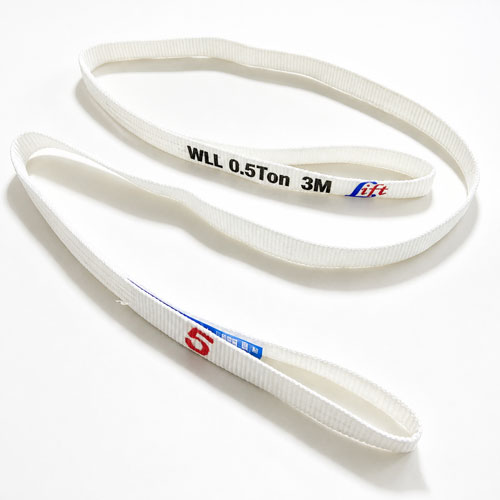
One way sling made for export packing and one-directional delivery: white flat woven webbing in the endless form, the working load limit printed on the band, and an orange label carrying the nine items DIN 60005 sets out - because white is not in the colour code, the tag is the identification. The standard fixes a 5:1 series and a sampling scheme for batches that run to tens of thousands. Ask for the form, the series and the batch test record. HS 630790. Phone 18066002268.
Hits: ℃
Release time:2026-09-19 11:13
Lift Sling Rigging Co., Ltd produce One Way Sling,One Way Round Sling,One Way Use Sling,Disposable Lifting Sling,Endless one way sling,Polyester one way sling.
One Way Sling — a White Band, an Orange Label, and the Standard Behind Both
A one way sling as the trade actually supplies it: white flat woven webbing in the endless form, the working load limit printed on the band, and green sleeving over the loop. There is no colour code in the band, and there cannot be one — see §4.
1. What a One Way Sling Is, and the Five Names Under One Word
The fastest way to see what is wrong with the phrase one way sling is to read the manufacturer's own listing line, which is the string this page is built from: One Way Sling, One Way Round Sling, One Way Use Sling, Disposable Lifting Sling, Endless one way sling, Polyester one way sling. Six entries, one product. The trade adds more — single use, one trip, white lifting sling, endless disposable — and a distributor will use whichever of them the buyer's paperwork happens to contain.
That would be harmless if the names were synonyms. They are not, quite. The word one way describes a commercial arrangement: the sling leaves with the load and is not brought back. The words endless and round describe a construction. The words polyester and polypropylene describe a fibre. And the word disposable describes what happens at the end of the journey. A single listing can therefore combine a commercial arrangement, a construction and a fibre — and two listings that share the first word may still be different articles. This is why the page separates the three questions rather than the six names: form, fibre, and the label.
What every one of these names does have in common is worth stating plainly, because it is what the buyer is actually paying for. The article is a flat woven webbing sling of a man-made fibre, supplied most often as an endless loop — a continuous band with no sewn ends — or as a sling with sewn eyes or loops at each end. It is made thinner and lighter than a general purpose sling of the same width, because it is not built to be returned, stored and inspected for years. It is supplied overwhelmingly in white, and its working load limit is printed on a label or directly onto the band.
| The name on the listing | Which question it answers | What it leaves open, and what to ask instead |
|---|---|---|
| one way one way use | The commercial arrangement: the sling travels with the load and is not recovered. Nothing about the sling itself. | Form, fibre and factor. Ask for all three by name, because the first word settles none of them. |
| endless one way one way round | The construction: a continuous loop, so the load can be carried in a basket or a choke and the band can be rotated to spread wear. | Whether the loop is sleeved or bare, and the effective length measured around the loop rather than along a straight band. |
| polyester one way | The fibre: high-tenacity polyester, which is what most published specifications for this article name as standard. | Whether polypropylene is being offered instead — it appears in the same listings and is a different fibre with a different chemical story. |
| disposable single use one trip | What happens at the end of the journey: the sling is finished with, withdrawn and destroyed rather than returned. | Not a statement about how many times the load may be picked up. The definition of the category is written on the single use page of this site. |
| white lifting sling | The colour the category is normally supplied in — a convention and, as §4 shows, not a capacity code. | Nothing at all about capacity. The capacity is on the label, and on a white sling the label is the only place it can be. |
The practical consequence is a single sentence long. An enquiry that says one way sling, 1 tonne, 3 metres has not yet described an article, because it has not said whether the loop is endless or sewn, which fibre the band is woven from, or which series the factor belongs to. Those three answers are what this page is for, and the next section explains why the third one is harder to give than it sounds.
2. Which Document Covers It: DIN 60005, and Why "One Way" Is Not in EN 1492-1
Here is the problem in the trade's own words. A manufacturer of exactly this article, writing about labelling practice, puts it this way: in many cases the labels specified in EN 1492-1 are used directly on disposable one way slings, and yet the EN 1492-1 standard does not clearly define the requirements for disposable one way slings. What that means for a buyer is narrow and important. EN 1492-1 is the standard behind the general purpose webbing sling — the one that is colour coded, marketed to a factor, and expected to be returned, stored and inspected. A disposable sling is not that article, and a label borrowed from that standard describes it only by analogy.
The document that does describe it is DIN 60005, the German national standard for single-use slings. Its scope is the disposable flat woven sling, and the manufacturers' published descriptions of it cover the things a buyer needs to see: what goes on the label and in what form (§3), how the label is coloured so the article can be told apart from a general purpose sling (§4), which factor series it fixes (§5), how a large batch is sampled and accepted (§6), and how the test is set up differently for an endless sling and for one with sewn eyes (§7).
There is a limit to this document that buyers discover late, usually after asking for a certificate and being handed something that does not say what they expected, and it is better stated early. A supplier of the article sets out the position directly: DIN 60005 is a German industry standard and not an EU harmonised standard, so it gives no presumption of conformity. It remains the accepted reference for this article in Germany and is widely specified by European buyers, but it does not, by itself, place a product on the European market. The CE marking that may sit on the same tag rests on Directive 2006/42/EC, declared by the manufacturer under that directive's own rules.
One further complication is worth naming, because it is visible in the catalogues rather than hidden in a clause. Suppliers of one way slings routinely list several standards together — one published specification names DIN 60005, ISO 4878, EN 1492-1 and BS 3481-3 on a single product page. That is not dishonesty; a manufacturer may well build to more than one document for different markets. But a list of four standards on a quotation tells the buyer nothing about which one the certificate will name, and which series the sling in the carton was actually made to. That question, which document and which series, is the one to put in writing before the order.
| The document | What it is | What it gives the buyer | What it does not give |
|---|---|---|---|
| EN 1492-1 | The European standard for flat woven webbing slings of man-made fibres for general purpose use. It fixes the colour code and the marking of that article. | A complete specification for a general purpose sling of this width and fibre, including the colour code the trade reads without a label. | A category for a disposable sling. Its requirements for the one way article are, in a manufacturer's own words, not clearly defined. |
| DIN 60005 | The German national standard for single-use slings, describing the label's content and form, the factor series, the sampling of large batches and the test set-up. | The document that actually describes this article: what the label must carry, what colour it must be, and how a batch is proved. | Any presumption of conformity in EU law. It is a national industry standard, not a harmonised one. |
| Directive 2006/42/EC | The Machinery Directive, under which lifting accessories are placed on the European market. | The legal basis under which the manufacturer declares the product and applies the CE mark. | Any statement about the factor series or the label content. Those come from the standard the sling is built to. |
| A list of four standards | What a quotation often shows: DIN 60005, ISO 4878, EN 1492-1 and BS 3481-3 named on one product page. | Evidence that the supplier builds to more than one document for more than one market — a real and ordinary practice. | Any indication of which document the certificate names, or which series the goods in the carton were made to. |
Two limits on this page should be stated, because they are limits and not modesty. DIN 60005 is a paid industry standard, so the description of it here is drawn from what manufacturers and distributors publish about it, and every figure in §3 to §7 is presented on that basis. Where the sources disagree, or where only one source states a figure, that is said where it happens rather than smoothed over. The second limit is that a standard's text and a supplier's practice can differ: the sampling scheme in §6 is what the standard is described as requiring, and the way to know which scheme your supplier follows is to read the report they send you.
3. The Label Is the Product: the Nine Things DIN 60005 Puts On It
On a general purpose sling the band does some of the work: its colour states the working load limit, so a handler who never finds the label can still see roughly what the sling is worth. On a one way sling that channel is closed. The article is white, white carries no capacity meaning, and everything a person needs to know has to arrive on one small piece of material sewn or printed onto the sling. That is why the label is described here before the fibre or the width: on this product the identification is not an accessory to the goods, it is the part that makes the goods usable.
The published description of DIN 60005 sets out nine items for the label. Each one is a question a buyer would otherwise have to take on trust, which is the reason to list them rather than summarise them.
The standard is also described as fixing the form of the label, not only its content, and those requirements are the ones that decide whether the label survives the journey it was bought for. It must be clearly and durably marked on the sling; the lettering must be at least 1.5 mm high; it must be fixed to the sling with part of the label placed under the seam, and that hidden part carries the same information for reference, so that if the exposed face is abraded away the identification still exists inside the joint; and the label for a disposable sling is to be orange, so that the article cannot be mistaken for a general purpose sling of the same appearance. The colour is not decoration — it is the mechanism, and §4 takes it apart.
| The item on the DIN 60005 label | The question it answers at the load | Why a buyer, and not only a rigger, needs it |
|---|---|---|
| Working load limit for straight lifting | How much this sling may carry in the simplest configuration, which is the number every other configuration is derated from. | It is the figure the load is planned against, and the figure an inspector will read first. Without it the sling cannot be used at all. |
| Webbing material | Which fibre the band is woven from — polyester, polyamide, polypropylene or another material. | The fibre decides what the sling must be kept away from. A substitution made silently at the factory is a change in what the sling may be exposed to. |
| A clear indication that it is a disposable sling | That this article is not a general purpose sling and is not to be returned to the rack. | This is the item that protects the buyer at the far end. A white sling with no statement on it looks exactly like a sling that may be kept. |
| Effective length in metres | Whether the sling that arrived is the sling that was ordered, measured the way the form is measured. | Length is the commonest commercial dispute on this article, because an endless loop and an eye sling are not measured the same way. |
| Manufacturer's name | Who is answerable for the article. | A disposable sling is still a product with a maker. Buying unattributable goods is how a batch problem becomes nobody's problem. |
| Traceability code | Which production batch, and therefore which test record, the sling belongs to. | This is the item that connects a sling in a carton to a sampling result in a file. Without it the test report in §6 cannot be used. |
| Standard number | Which document the sling was made to — the question §2 leaves open in a quotation that names four standards. | A single line on the label settles an argument that no amount of correspondence settles afterwards. |
| Year of manufacture | How long the sling has existed, and how long it has been in storage or transit. | A disposable article has no inspection history to speak of, so the date of manufacture is the only age evidence that exists. |
| CE marking, where the goods are for the EEA | That the manufacturer has declared the product against the directive named in §2. | Note what it does not say: it is not a statement that the sling meets DIN 60005, because that standard confers no presumption of conformity. |
Two practical notes follow from the list, and both are about what a buyer can actually check on arrival. The first is that seven of the nine items are readable from the label alone, so a goods-in check on this article is a matter of minutes: capacity, fibre, the disposable statement, length, maker, standard and year are all on the tag, and the traceability code is the string that lets you pull the test record. The second is a warning about making the check on price. The published description of this article is careful to say that the label requirements exist to ensure safe use and quality traceability, which is exactly the pair of things a supplier competing on paper cannot demonstrate: a label can be copied, but a traceability code either resolves to a batch record or it does not. A buyer who asks for one sling from a new supplier and follows its code to a dated sampling result has done more due diligence than a buyer who reads a page of claims.
4. Orange, Not Blue: the Label Colour Is the Signal, the Webbing Colour Is Not
Every general purpose webbing sling in Europe is supplied with a woven colour code, and the trade reads it without thinking: violet for one tonne, green for two, yellow for three, grey for four, red for five, brown for six, blue for eight, orange for ten and above. On a one way sling that habit produces a specific and dangerous error, because white is not in that table at all. A white band has no capacity meaning to read, and no amount of experience reading coloured slings will supply one.
What replaces the colour is the label — and the label has a colour of its own, which is the point most buyers have never had explained. The two documents point in different directions. A supplier's technical description of the general purpose article states that a polyester sling must carry a blue label with the statutory marking, the manufacturer's identity, the year, the material, the effective working length, the serial number, the standard number and the working load limit. The published description of DIN 60005 states that the label on a disposable one way sling must be orange, expressly so that it can be distinguished from other types of webbing sling. Two articles, two label colours, and the label colour is doing the job the band colour does on a general purpose sling.
That is corroborated where it matters most — in what manufacturers actually print. One European manufacturer's catalogue lists its one way range with the note that it is made to DIN 60005 and carries its label in the standard signal colour; another supplier's specification for its single-use sling offers label options of orange, blue or custom, which is the useful reminder that custom label colours exist and that colour is a convention rather than a guarantee. The same catalogue offers the sling itself in white as standard, with yellow, green, red, black or pink on request.
So the correct rule for this article is one sentence, and it is the opposite of the rule for every other sling on the site: do not read the band, read the tag. A supplier of the article states it as plainly as it can be stated — the colour on a single-use sling is not a working load limit indicator and the white webbing is a convention, not a colour code. The trade body that wrote the guidance on this category goes further in the other direction and says the article may come in any colour, including white, which means a coloured one way sling is entirely possible and carries no more capacity information than a white one.
| What you are looking at | What it tells you | What it does not tell you, whatever your experience says |
|---|---|---|
| A coloured band on a general purpose sling | The working load limit, straight from the colour code, with no label work needed. | Nothing about the condition of the sling, which is why the colour never replaces an inspection. |
| A white band on a one way sling | That the article is supplied in the colour the category is normally sold in — a convention of the trade, not a rating. | Any capacity at all. White is not in the colour code, so there is nothing to read off the band. |
| An orange label on a white band | That the maker intends the article to be recognised as a disposable one way sling, made to the series in §5. | That the goods conform to anything in EU law — see the limit set out in §2. |
| A blue label on a white band | That a general purpose label has been used on this article, which is a common practice and the exact problem the orange rule exists to prevent. | That the sling is a general purpose sling. The label colour is the seller's choice; the construction is not. |
| A yellow, green or pink one way sling | That custom colours are available on this article, which several suppliers offer. | Anything about capacity, and it must not be confused with the colour code of a general purpose sling, where those colours mean specific limits. |
| The striped band | On some ranges, a convention of one continuous black stripe per tonne of capacity — a useful habit that is not part of any standard. | Anything you may rely on. The convention is voluntary, and a one way sling may carry no stripe at all. |
The trade's own reading of the colour code, stripe by stripe and load by load, is set out on the single use page of this site, which carries the full table. The reason it is not repeated here is deliberate: the code belongs to the general purpose sling, and this page is about the article that sits outside it. What matters on this page is the consequence — that the moment the band stops being the source of the capacity, the label becomes the only source, which is why §3 lists the label's contents in full and why §8 deals with what should arrive in the carton beside it.
5. The Five-to-One Factor, and the Series a Buyer Should Name
A safety factor is the ratio between the load the sling is rated for and the load it is proved to take. On this article the number is not the seller's private choice in the way it may appear from a quotation, because the standard the sling is built to fixes a series. The published description of DIN 60005 names a 5:1 series — one supplier's specification states that the standard's 2018 edition covers the 5:1 series, and a European manufacturer lists its one way range as being made to DIN 60005 with a 5:1 safety factor and its label in the standard signal colour.
The proof behind the five is a test, and the test is specified too. According to the published description of the standard, a representative sling must withstand a force of at least five times its working load limit, using a tensile testing machine that meets the requirements of Class 1 of DIN EN ISO 7500-1, with the acceptance rule set out in §6. That is what the number on the label means: not a marketing round figure, but the outcome of a destructive test performed on a sample of the batch.
Where the market complicates this is by selling more than one series under the same name. Supplier specifications for one way and single-use slings routinely offer 4:1, 5:1, 6:1 and 7:1 as selectable options, and at least one distributor's range extends from 4:1 to 8:1 to customer requirement. None of those is a lie and none is illegal. But the consequence is that the phrase one way sling, 7:1 describes a different article from one way sling to DIN 60005, because the standard is described as covering the 5:1 series: the band has to be built heavier for the higher factor, which changes the weight of the consignment and the price of the piece. A buyer who wants the lighter, cheaper article should say so, and a buyer who needs the higher factor should say that instead — but in both cases the factor should be named on the order and checked on the label, because the two are not the same document.
There is one more reason to name the series rather than the factor. A quotation that says only 7:1 does not say which document fixes it, and §2 has already shown that a list of four standards on a page tells the buyer nothing about the certificate. The label item list in §3 includes the standard number for exactly this reason: it is the one line that lets a goods-in clerk confirm, without correspondence, which series arrived.
| What the quotation says | What sits behind the number | What it implies for the article | The question to ask before ordering |
|---|---|---|---|
| "one way sling, 5:1" | A series the standard is published as covering, with a test load of at least five times the working load limit behind it. | The ordinary article of this category, at the weight the category is designed around. | "Which standard number goes on the label?" The answer should be a document, not a list. |
| "one way sling, 7:1" | A higher series, offered by suppliers as an option but not the series the one way standard is described as covering. | A heavier band for the same working load limit, which is the point of the option — and a heavier consignment to freight. | "Made to which document, and tested at what multiple?" A factor without a document is a number without a test. |
| "4:1 or 6:1" | Intermediated options that appear in suppliers' published option lists alongside the 5:1 and 7:1 series. | An order-specific build. Fine as a specification, provided it is written down and appears on the label. | "Is the factor printed on the sling, or only on the invoice?" The load is planned from the sling, not from the file. |
| A factor with no document named | Nothing that can be checked, because the number cannot be tied to a test method or a sampling scheme. | An article whose paperwork will not survive a customer audit, whatever the goods are like. | "Send the type-test report." §6 explains what a competent one contains and what it does not. |
One clarification about the shape of the argument, because the wording of the two pages on this site could otherwise be confused. That the factor is a labelling decision rather than a material property — the observation that the same webbing can be sold as a heavier sling at a lower factor — is explained on the single use page, because it is the sentence that stops buyers assuming a number is intrinsic to the cloth. This page asks a narrower question: which series the one way standard fixes, and what test stands behind the figure. Both matter, and they are not the same question.
6. How a Batch of Twenty Thousand Is Proved: the Sampling Tables
This is the part of the article that no catalogue page explains, and it is the part that decides whether the goods in a container are safe. A general purpose sling is bought in tens and inspected one by one over its life. A one way sling is bought in tens of thousands, shipped to a destination where it will never be inspected again, and destroyed at the end of a single journey. Testing every piece is impossible and pointless, because the test is destructive. The standard's answer, as described by the manufacturers who work to it, is a sampling scheme: destroy a stated number of pieces out of a large batch, and let that sample stand for the batch.
Three things are fixed before the frequency is discussed, and they are the same for every batch. The test is carried out on a tensile testing machine meeting the requirements of Class 1 in DIN EN ISO 7500-1, with measuring tools of the appropriate range — vernier calipers or a rule — used where dimensions have to be checked. The test load is a minimum of five times the working load limit. And the test must be carried out by qualified personnel. The frequency is where the buyer's supplier becomes visible.
The published description of the standard sets two regimes, and the difference between them is the single most useful number on this page. Where the manufacturer has a documented quality assurance and documentation system — the standard names systems such as DIN EN ISO 9001 — the sampling rates are at their most economical. Where no such system exists, the same standard requires the manufacturer to destroy far more slings to say the same thing. In both regimes there is a floor clause: if the batch sizes below are not reached, the test is carried out at least once a year.
| The factory's situation | Working load limit | At least one sling must be tested out of every | What that rate tells a buyer |
|---|---|---|---|
| Documented quality assurance and documentation system | 3 t or less | 20,000 pieces | A factory whose records are trusted by the standard is allowed the lightest sampling. This is what the certificate system buys. |
| Documented quality assurance and documentation system | Above 3 t | 8,000 pieces | The heavier the sling, the more often it is destroyed, because a heavy failure costs more than a light one. |
| No such system | 3 t or less | 2,500 pieces | Eight times the destructive testing of the first row, for the same nominal assurance. This is the row that applies unless your supplier tells you otherwise. |
| No such system | Above 3 t | 1,250 pieces | The most frequent ratio in the scheme, and the one a buyer sees when a low-price quotation is being qualified. |
The arithmetic of the two columns is worth doing out loud, because it is the argument for paperwork made in numbers. At a working load limit of 3 t or less, a factory with a documented system destroys one sling in 20,000; a factory without one destroys one in 2,500 — eight times as many, out of the same batch, to reach the same claim. Above 3 t the ratio is one in 8,000 against one in 1,250, which is six and a half times. If the total order for a season is, say, 200,000 pieces at 2 t, the first regime destroys ten slings and the second destroys eighty. Neither figure is large beside a container of goods; the difference is that only one of the two factories can show a buyer a dated record of what happened when it did.
What happens to a sample that fails is specified as precisely as the frequency, and the rule is more forgiving than a buyer might expect. If the sample withstands a force equivalent to five times its working load limit, the test is passed and no test at a higher load is needed — the standard does not ask for the sling to be taken to destruction. If it fails below five times but the test load had reached at least 90% of that force, three further samples of the same type are tested. Only if any of those also fails below five times the working load limit does the type fail the standard. The results, including the accept-or-reject decision, must be recorded by the manufacturer in a test report.
| What the sample does | What the standard requires next | What a buyer should see in the file |
|---|---|---|
| Withstands five times the working load limit | Nothing further. The test is passed, and no higher load is applied. | The load reached, the date, the batch or traceability code, and the accept decision — on a report the manufacturer prepares and keeps. |
| Fails below five times, but the load had reached at least 90% of that force | Three further samples of the same type are tested before any judgement is made about the batch. | Whether the retest happened, and its result. A report that shows only a pass invites the question of what was tested. |
| Any of the three further samples fails below five times | The slings of that type do not meet the standard. The batch is a non-conforming batch, not a marginal one. | A reject decision in writing. It is the document a buyer needs if the goods have already shipped. |
| Fails well below 90% of five times | The retest route does not apply at all; the failure is outside the tolerance the rule was written to allow for. | The same reject decision, and a warning worth heeding: the 90% clause is not a general allowance for weak slings. |
Two clauses of this scheme are the ones a buyer can use immediately. The first is that the sampling rate is a question with a factual answer: ask a supplier how many pieces are destroyed out of every thousand, and which row of the table above they work to. A supplier with a documented system will answer with a number and a document; a supplier without one will answer with a factor. The second is that the traceability code on the label is the key to the report — §3 lists it among the nine items for exactly this reason. A test report that cannot be tied to the code on the goods is a statement about somebody's production in general, and the buyer has paid for goods in particular.
7. Testing Differs By Form: Endless Loop, or Sewn Eyes
The article is sold in two constructions under the same name, and the standard's published description does not give them the same test. That matters more than it sounds, because a type-test report is a statement about an article, and if the construction changes, the statement no longer describes what is in the carton.
For a disposable endless flat woven sling — the form both photographs on this page show — the representative sling is placed straight and without torsion between the test pins of the machine, and two set-up conditions are added: the connecting seam must not touch the test pins, and the diameter of the pins must not exceed 20% of the width of the webbing. Both conditions protect the same thing. An endless sling carries load through the woven loop and through a seam; if that seam is loaded across a hard pin, the test measures the seam rather than the band, and if the pins are too fat for the width of the band, the test measures the bend rather than the material.
For a disposable sling with eyes the set-up changes. The sample is again placed straight and without torsion between the pins, but here the pin diameter is chosen so that the angle between the slings is not less than 10° and not more than 20° — in other words, the geometry of the test is pinned to the eye-and-load angle rather than to a proportion of the band's width. A sewn eye is a folded and stitched section with less material in it than the running band, so the test is arranged around the eye instead of around the cloth.
The practical consequence is a sentence to put in the order. A certificate for an endless sling does not describe a sling with eyes, and the same is true in reverse, so when a buyer switches construction — because the load changed shape, or because a sleeved loop was specified, or because the length was specified along the band instead of around the loop — the type test behind the certificate has to be re-established for the new form. Suppliers of this article do distinguish the forms in their catalogues, listing the endless loop with reinforced sleeves as its own construction. That is a construction choice and not a standard requirement, but it changes the article, and it is the kind of change that quietly invalidates a document.
| The construction | How the sample is set into the machine | What the set-up is protecting | What the buyer should confirm |
|---|---|---|---|
| Endless loop | Straight, without torsion, between the pins; the connecting seam must not touch the pins; pin diameter not more than 20% of the webbing width. | The measurement of the band rather than the seam, and of the material rather than the bend imposed on it. | That the report names the endless form, and that the length on the label is the loop's effective length, not a straight-run figure. |
| Sewn eyes or loops | Straight, without torsion, between the pins; pin diameter chosen so the angle between the slings is not less than 10° and not more than 20°. | The eye itself, which is a folded and stitched section carrying less material than the band that runs between the two ends. | That the report names the eye form, and that the eye is the eye that was ordered — bare, or sleeved as in the second photograph on this page. |
| A change of form between order and delivery | No set-up at all, because the document on file refers to the other construction. | Nothing — this is the case the rule exists to prevent, and it is invisible until someone reads both the certificate and the goods. | Which form the certificate is for. If it does not say, the certificate does not cover the delivery. |
Read together with §6, the two sections describe a system rather than a promise. A batch is qualified by destroying a stated number of slings out of a stated total (§6); each sample is set into the machine in a way that is defined for the construction being tested, and for the seam and pin conditions that belong to it (§7); the result and the decision are recorded against a code that is printed on every sling (§3). None of that appears on a product page, and a buyer who has never asked for it will not miss it — until a customer audit arrives and asks which test stood behind the batch, and there is no answer that connects a sling in a carton to a number in a file.
8. What Should Arrive With the Shipment
A disposable article still arrives with paperwork, and the paperwork is not a courtesy. The trade body that wrote the guidance on this category is explicit about what a one trip sling must be supplied with: the sling must carry the appropriate conformity mark, which is found on the information tag, and it must be supplied with instructions for use and a manufacturer's certificate or, in the UK and EU, a declaration of conformity. The same guidance adds a condition that is easy to overlook when goods are being bought from a factory that writes in another language: any writing on the sling must be in the language of the user's location, or in English.
Suppliers of the article describe the same pack from the production side, listing what travels with a shipment: a batch material test certificate, proof-load reports and type-test documentation, with the CE marking resting on the directive named in §2. Read the two lists together and the buyer's requirement becomes concrete: the sling with its label and its traceability code, the instructions for use in a language the people at the far end can read, a certificate or declaration, and — on request, and this is the part most buyers never ask for — the batch test record described in §6 and the type-test documentation described in §7.
The distinction to hold on to is that these documents answer different questions, and a shipment that contains one of them is not covered by the others. An invoice states what was bought. A certificate or declaration states that the manufacturer has declared the product against a directive or a standard. A batch test record states what happened when a stated number of slings out of that production run were destroyed. A type-test document states how the construction behaves when it is set into a machine in the manner §7 describes. Only two of the four can be tied to the sling in your hand through its traceability code, and those two are the ones an audit will ask for.
| The document | What it proves | What it does not prove | Who needs to hold it |
|---|---|---|---|
| Instructions for use | That the maker has told the user what the article is and is not for, in the language of the place it is being used or in English. | Nothing about the goods themselves. It is a statement about information, not about product. | The consignee's yard or site, because the sling is used far from where it was bought. |
| Manufacturer's certificate or declaration of conformity | That a named manufacturer has declared the product, and against which document the declaration was made. | Any statement about this batch's test results, and — as §2 explains — any presumption of conformity from a national standard. | The importer or the buyer's own quality file, as the document that names the responsible party. |
| Batch test record | What happened when a stated number of slings out of that run were tested at five times the working load limit, with the accept or reject decision. | Anything about a sling from a different run. It is batch evidence, and it is only usable with the code from §3. | The buyer, at goods-in, matching the code on the label to the record. |
| Type-test documentation | How the construction behaves under the set-up for its form, including the seam and pin conditions of §7. | That the goods delivered match the type. It describes a design, not a shipment. | A customer running an audit of the supplier, or an engineer choosing between two constructions. |
| The label itself | The nine items of §3, on the article, in the format and colour the standard describes. | That the sling is undamaged on arrival, which is why it is read again before the lift. | Everyone who will touch the sling, which on this article is the point. |
The buyer's checklist is therefore four lines long, and it can be written into a purchase order without knowing anything about weaving. Instructions in a readable language; a certificate or declaration naming the manufacturer and the document; a batch test record that resolves through the label's traceability code; and a label carrying the nine items of §3, on an orange ground, in lettering at least 1.5 mm high, with part of it sewn under the seam. A supplier who finds any of those four questions unreasonable is telling the buyer something useful about the other three.
9. The Two Photographs, the Published Ranges, and Storage
The two photographs at the top of this page are the whole argument of §4 in visual form, so they are worth describing in the same detail a buyer would use at goods-in.
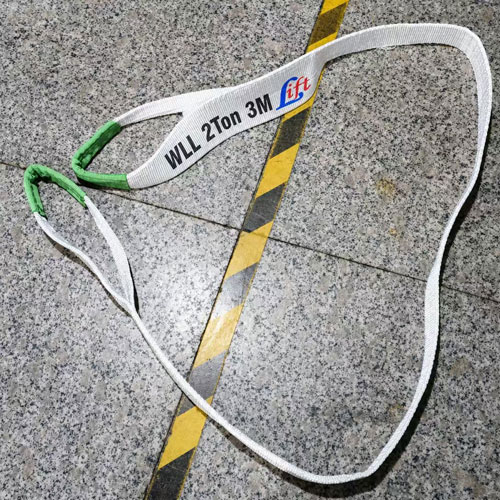
The first photograph shows a white flat woven webbing sling in the endless form — a continuous loop with no sewn ends — laid on a plain white ground. The working load limit is printed directly onto the band in black: WLL 0.5Ton 3M, with a small printed colour block beside it. The second photograph shows the same construction at a heavier rating: a white endless loop with green sleeving over the loop, printed WLL 2Ton 3M, photographed on a grey terrazzo floor beside a black and yellow hazard stripe. Look at the two together and the page's central point is visible without a word of argument. Both are white. Neither carries a capacity colour. The lighter sling will hold five hundred kilograms and the heavier two tonnes, and nothing on the band tells you which is which except the print. That is why §3 spends nine items on a label: on this article the identification is carried by the print and the tag, and by nothing else.
The construction choice behind the second photograph is worth one paragraph, because sleeving is the sort of detail that is quoted as a courtesy and specified as a necessity. The endless loop is offered by suppliers with reinforced sleeves over the loop, which is a construction option rather than a requirement of any standard. It matters because a light band is more easily cut than a heavy one: a supplier's own usage guidance for this article notes that the lightweight webbing is more cut-sensitive than reusable slings and tells the user to pad sharp load edges before lifting. On a sling bought in tens of thousands and used once, the sleeve is the cheapest insurance in the specification — but it is a change of article, and §7 has already explained what a change of form or construction does to a type-test document.
On the fibre and the range, the published specifications agree on the material and differ, honestly, on how heavy the article goes. High-tenacity polyester is named as the standard material for this category, with white as the standard colour and further colours available on request; polypropylene appears in the same listings as an alternative and is a different fibre with a different chemical story, which this site's polypropylene page covers on its own. The ratings quoted by suppliers run from about one tonne — one published specification gives a working load limit of up to 1,000 kg with custom capacities available — up to about five tonnes, with the same supplier advising that a heavier lift belongs to a reusable sling rather than a one way one. That upper end is a commercial boundary rather than a technical one, and it is the same boundary §11 comes back to: the category exists because the sling is not coming back, and a very heavy disposable sling is a contradiction in cost terms long before it is one in engineering terms.
Storage on this article is short and worth stating because there is no inspection programme to absorb a mistake. A supplier's usage guidance for the same product gives the practical rules: keep the slings sealed in their original packaging in a cool, dry place, away from sunlight, moisture and chemicals until the moment of the lift, because ultraviolet light degrades the webbing over time; keep polyester within roughly −40 °C to +100 °C and away from welding arcs and molten spatter; and inspect the sling before the lift even though it is new, because damage can have been done in storage or in transit before it ever reached the load. One rule from the same source is worth putting on the wall rather than in a file: single-use and reusable slings should not be mixed in the same set, because the two have different elongation, which changes how a multi-leg lift shares the load and can overload one sling. That is a rule about mixing, not about strength, and it is the kind of rule that only exists for this category — because only this category is bought in one kind and used beside another.
10. Where It Is Used, and What That Implies for the Order
The applications quoted by suppliers of this article are consistent and narrow, and they all share one property: the load is going somewhere the sling is not coming back from. Published application lists for one way slings name steel and pipe export, where pipes and structural steel are bundled for overseas shipment; machinery and equipment, lifted into export containers; wood and timber, long packages prepared for long-haul transport; and oil and gas, where hoses, valves and piping go out to rigs. The industry language for the situation is instructive: suppliers describe these as one-directional supply chains, and the same sources name the commercial benefit as the absence of return logistics — no recovery freight, no return paperwork, no reuse-inspection history to maintain.
One correction belongs in this section because it is the difference between a lift and a lashing, and the trade body guidance on this material states it directly: the article is for lifting only, and securing cargo while it is in transit is a job for lashing equipment rather than lifting slings. That distinction is not pedantry. The two products are rated under different systems, marked differently, and the site's own cargo pages state their figures in lashing capacity rather than in kilograms for exactly this reason. A one way sling that has been bought to hold a load down on a vehicle is being used outside its rating, whatever the supplier's application table appears to suggest.
| The application | What it sets in the specification | What it does not set, and where buyers get it wrong |
|---|---|---|
| Steel and pipe export | An endless loop or sleeved loop, because bundles and pipe ends are the surfaces the band meets; a length set by the bundle's circumference. | Nothing about how many slings per bundle — that is the lift plan, not the product. The common error is ordering by bundle count without checking the angle each band will run at. |
| Machinery into export containers | The heaviest ratings in the range, and a length that clears the machine's frame rather than the container's door. | Nothing about the corner protection on the machine. Light band, hard edges — the sleeve question from §9 is decided here. |
| Timber and long packages | Length, above all: long packages take long loops, and the label's effective length is the figure that decides whether the band reaches. | Nothing about whether the load is being lifted or held. Long timber is where lifting and lashing get confused most often. |
| Oil and gas, offshore delivery | Documentation more than construction: an offshore consignee will ask which batch was tested and where the record is. | Nothing about storage before use, which is where a sea voyage and a dock can damage a sling that has never been loaded. |
The order follows from the table, and it is shorter than buyers expect. Form is set by the load's surface and by whether the band has to run around something or lie against it. Length is set by the load's circumference, not by the crane's reach, and it is measured the way the form is measured — which is why §3 gives effective length its own line on the label. Quantity is set by the number of loads, because there is no second use to spread the cost over. And the label, the batch record and the test documentation are set by the fact that the sling will be used by people who never met the buyer, in a place where the sling cannot be replaced from stock. Everything in §3 to §8 exists for that last sentence.
11. The Three Mistakes Buyers Make With the Word "One Way"
There are three errors, they arrive in this order, and each one is caused by the previous section of this page being read alone.
The first is reading the word as a count of lifts. The vocabulary of this category describes the journey — a sling that accompanies one load to its destination and is finished when the load arrives — and not a limit on how many times the load may be picked up along the way. The full definition, together with what happens when the journey ends, is set out on the single use page of this site, and it is not repeated here because it belongs to that page. The practical note that does belong here is about colour: a buyer who has misread the word will also tend to misread the band, and the two errors reinforce each other.
The second is reading the band instead of the tag. This is the error §4 exists to stop. Every other sling a buyer handles carries its capacity in its colour, and the habit is strong enough that a white sling looks blank rather than unread. The consequence is not a wrong number; it is no number, because a handler who has been taught to read colour will read nothing and proceed. On this article the tag is the only source, which means a torn tag is not a cosmetic defect but the loss of the identification — and that is why the guidance on this category puts torn tags that make the working load limit unreadable at the top of the list of things to look for.
The third is buying a factor instead of a series. A quotation that says 5:1, or 7:1, has named a ratio without naming the document that fixes it, the test that proves it, or the sampling scheme that stands behind the batch. §5 shows why the ratio alone does not describe an article, and §6 shows what a buyer can ask for instead: which row of the sampling table the factory works to, and which standard number appears on the label.
Put the three mistakes together and the ordering instruction is a single sentence. Name the form, name the fibre, name the series and the document behind it, insist the label carries the nine items, and ask which sampling row applies. That sentence takes about a minute to write into a purchase order, and it is the difference between buying a white band and buying an identified product. A supplier who can answer all of it will answer it in writing, which is the only place it counts — because the sling is going to a destination where nobody can ask the buyer anything.
12. Frequently Asked Questions
Q1: What is a one way sling?
Q2: Is "one way" the same as "single use", "one trip" or "disposable"?
Q3: Which standard covers a one way sling?
Q4: What safety factor does a one way sling have?
Q5: Why is the label orange?
Q6: Why is the sling white, and can it be supplied in another colour?
Q7: May the same load be lifted more than once during the journey?
Q8: What documents should arrive with the order?
Q9: How is a large batch of one way slings tested?
Q10: What is the maximum capacity of a one way sling?
Contact
Lift Sling Rigging Co., Ltd manufactures one way slings in white high-tenacity polyester webbing, in the endless form or with eyes, with the working load limit printed on the band and an orange identification label carrying the nine items set out in §3. Tell us the form, the fibre, the working load limit, the effective length and the series you need, and we will confirm the label, the batch test record and the documentation that travels with the shipment.
Telephone and WeChat — 18066002268
E-mail — 702461526@qq.com
Address — Lifute Industrial Park, Taizhou City, Jiangsu Province, China
HS code — 630790
- Previous:Endless Sling
- Next:Single Use Lifting Sling