 Language
 简体中文

- On the 2018 National Day holiday, Lifet completed six 100 ton large tonnage lifting belts as a gift
- The role of suspension net in the transportation of goods turnover
- Cargo soft lifting net, lifting net, lifting net, lifting net, bag, climbing net
- Precautions for using Lifutiden elevator
- How to make circular lifting straps
Contact: Wang Lili
E-mail:18066002268
Phone:702461526@qq.com
Address: Lifute Industrial Park, Taizhou City, Jiangsu Province
Lifute Hoisting Co., Ltd. 18066002268 produces lifting belts, lifting nets, nylon ropes, soft ladders, steel wire rope rigging, paper ropes, safety belts, safety nets, lifting chains, steel coil hoists, crossbeam hoists, flat lifting belts, circular lifting belts, electric traction ropes, high-altitude safety belts, and anti fall safety nets
Hits: ℃
Release time:2026-09-17 15:07
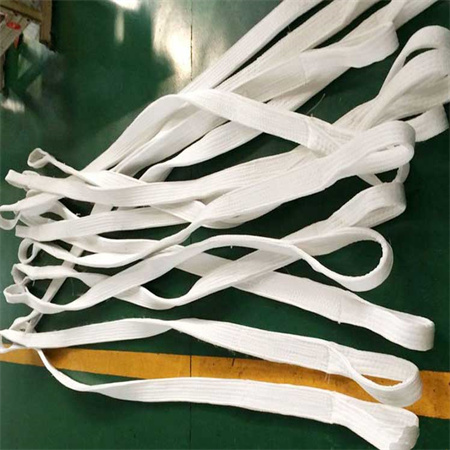
High strength polypropylene white flat sling lifting belt crane double buckle lifting rope sling
High Strength Polypropylene White Flat Sling for Crane Lifting

White polypropylene flat sling, sewn loop at each end. No metal hardware is part of this article.
1. What This Product Is, and What Each Word in the Name Means
The name of this page is a string of words that buyers search for, and the words do not all mean what they look like. The product itself is a flat woven webbing band, white, with the band folded back on itself at both ends and sewn into a loop. That is the whole article. Everything else in the name is either a description of that band, a statement about where it is used, or a word that the trade borrows from a different product.
The one word that misleads most often is double buckle. It does not describe a metal buckle. In this trade the Chinese term behind it is 两头扣, and the site's own product photograph of a white polypropylene flat sling carries that caption printed on the image: 两头扣(双环)丙纶扁平吊装带 — "two-end buckle, double ring, polypropylene flat lifting sling". The "ring" and the "buckle" are the same thing: the band doubled back and stitched. A buyer who reads the English phrase and expects hardware receives a sewn loop instead, and the safest thing this page can do is say so plainly rather than let the word ride.
| The word | What it means in this article | How to check whether that is what you need |
|---|---|---|
| high strength | An adjective, not a grade. No standard defines it and no label carries it (§3) | Ask for the working load limit and the safety factor instead, and compare those two numbers between the two slings you are choosing between |
| polypropylene | The fibre. The lightest of the three common webbing fibres, the one that absorbs almost no water, and the least strong of the three | Right when the duty is wet, light, or needs a clean white band; wrong when the same width has to carry what a polyester sling of that width carries |
| white | The natural colour of the band, left un-dyed. It is not a strength class and it is not a fibre code (§10) | If you need a colour that identifies capacity, that is a stripe system, not the band colour |
| flat sling, flat lifting belt | The same product under two trade names. Flat woven webbing, as against a round sling, which is a sleeve over a core | A flat sling spreads its load across the width of the band; if the load is a sharp edge or a machined surface, that is the reason to want one |
| crane | Where the lift happens, and it is not decoration: the crane, not the sling, decides the hook rules and the inspection interval (§2 and §7) | Have the hook's throat, section and latch condition checked against the figures in §2 before ordering more slings for the same crane |
| double buckle | A sewn loop at each end — the band doubled back and stitched. No metal (§4) | If you actually need a metal fitting in the end, that is a different order and a different rule (§4) |
| lifting rope sling | A loose trade phrase. This article is not a rope and not a wire rope sling | If the load or the environment calls for rope, a webbing sling is the wrong family and this page cannot help you choose one |
What the page does not re-open: the chemistry of this fibre belongs to the polypropylene flat sling page, why the band is white belongs to the white polypropylene lifting belt page, and the eye-to-eye form and its length datum belong to the acid-alkali flat double-ear lifting belt page. Each is linked once, here, and not repeated.
2. The Other Half of the Lift: What the Crane Hook Must Be First
A sling is rated for a load it never carries alone. It hands that load to a hook, and the hook has its own numbers, published by a different standard, inspected on a different schedule, and worn by a different mechanism. A plant can hold a shelf of perfectly marked slings and still be one deformed hook away from a dropped load.
The hook figures that matter are small. An increase in throat opening of 5 per cent, not to exceed 1/4 inch or 6 mm, is a removal criterion under ASME B30.10-1, and so is wear of more than 10 per cent of the original section dimension of the hook or its load pin. Any visibly apparent bend or twist from the plane of the unbent hook removes it under the same standard. OSHA's sling regulation sets a looser figure in the same territory — more than 15 per cent of normal throat opening, or more than 10 degrees of twist — so a hook can pass the regulation and still fail the standard. Where the two disagree, the tighter one is the one to work to, because a hook that passes ASME also passes OSHA and the reverse is not true.
| What is checked on the hook | The figure that governs | Why it matters to the sling on it |
|---|---|---|
| Throat opening | Increase of 5 per cent, not to exceed 1/4 inch or 6 mm, by ASME B30.10-1; more than 15 per cent by OSHA 1910.184(f)(6) | An opening throat lets the eye seat lower and off-centre, so the band loads on a smaller bearing area than it was rated for |
| Twist from the plane of the unbent hook | Any visibly apparent bend or twist by ASME B30.10-1; more than 10 degrees by OSHA | A twisted hook side-loads the eye and pulls the sling out of the bowl, which is the next row |
| Wear on the section | More than 10 per cent of the original section dimension of the hook or its load pin, by ASME B30.10-1 | A worn bowl presents a groove, and a groove concentrates the whole load on one line across the webbing |
| Seating | The load applied to the hook is to be centred in the base, the bowl, of the hook | Point loading on the hook is also point loading on the sling. The eye should sit in the bowl, not hang on the point |
| Cracks, nicks, gouges | Any visible crack removes the hook from service under ASME B30.10-1 | A hook that fails does not soften first; the load arrives with no warning at all |
| Latch | An inoperative latch where a latch is required is a removal criterion; see the note below on who requires one | The latch is what keeps the eye in the bowl when the line goes slack between picks |
| Heat history | Discolouration consistent with blueing or tempering means removal; consult the manufacturer before use above 400 °F (204 °C) | A hook that has been hot is a hook whose steel has changed, whatever it looks like afterwards |
Two more crane-side rules belong on this page because they are about the sling, not the load: a synthetic webbing sling is not to be used as a bridle on a suspended personnel platform, and where the load is not symmetrical across a multiple-leg sling the load on each leg has to be analysed rather than assumed to be equal.
3. High Strength Is Not a Number
The first two words of this product's name are the two that cannot be verified. High strength is not a grade in any sling standard. No label carries it, no test certifies it, and no inspection can confirm it. It is a comparative adjective with nothing to compare against, and it is used on this page's product name because buyers search for it, not because the article has it in any measured sense.
Polypropylene is also the wrong fibre to hang that phrase on. Of the three common webbing fibres it is the lightest, it absorbs almost no water and it floats, and it is the least strong of the three. That is not a defect; it is what the fibre is for. But it means a polypropylene sling carrying the words high strength is being measured against an idea, while the polyester sling on the same shelf is being measured against a number.
What can be verified is short, and it is worth asking for all four items.
| What the phrase suggests | What can actually be verified | What cannot |
|---|---|---|
| That the webbing is stronger than other webbing | The working load limit printed on the label for each type of hitch, which is the number the whole lift depends on | Any comparison that does not name the width, the ply and the fibre it is being compared with. A 50 mm two-ply band is not competing with a 25 mm single ply band |
| That the band will survive an overload | The safety factor the sling is built to. The ordinary belts on this site are organised to EN 1492-1 and its 7:1 factor, and a red core yarn that shows through if the sling has been overloaded (§9) | That a factor is a licence to overload. The factor is already spent in the rating; it is not spare capacity to be used on site |
| That the number came from a test | Which method the breaking strength and elongation were reported to. Webbing is commonly reported to ASTM D6775, and the certificate should name the method | That a figure quoted without a method is comparable with one quoted to a different method |
| That this is the right fibre for the job | The fibre's real advantages: water absorption near zero, so it does not gain weight or stiffen when wet, and it floats, which is why it is the one that turns up in wet and marine duty | That it is the right answer for a hot, sharp or heavy duty. Those are different fibre questions, and two sibling pages hold them |
4. The Double-Buckle End, and How It Is Actually Formed
The end of this sling is the part most often mis-bought, because the trade has several words for it and they are not interchangeable. On this article the end is a loop of the band itself, formed by folding the webbing back and sewing it. The site's own photograph of a white polypropylene flat sling carries the caption 两头扣(双环)丙纶扁平吊装带, in which both 扣 and 环 point at the same sewn loop: the band doubled back on itself at each end.
There is no metal in that. And it is not an economy measure: for this class of sling, stitching is not merely permitted, it is the required method. OSHA's sling regulation states that stitching shall be the only method used to attach end fittings to webbing and to form eyes, and that the thread shall be in an even pattern with enough stitches to develop the full breaking strength of the sling. An eye on a webbing sling is a stitched joint before it is anything else.
| The end you may be picturing | What it actually is | Is it this product |
|---|---|---|
| Double buckle, as in the product name | The webbing folded back and stitched into a loop at each end — 两头扣, doubled ring. Stitching is the only forming method OSHA allows here, and the stitch pattern carries the full breaking strength | Yes. This is the article on this page |
| A metal buckle or a metal end fitting | Hardware fitted to a webbing sling, where the metal becomes part of the load path | Not as standard. If you need it, say so at enquiry, because the rule changes: any fitting used with a synthetic web sling must have a minimum breaking strength at least equal to that of the sling itself, and a fitting weaker than the band moves the failure point instead of removing it |
| A return eye, or a folded eye | A loop formed by turning the end of the band back and securing it — structurally the same family as the loop on this sling, under another name | Effectively yes, and the sibling page that owns the eye-to-eye form and its length datum is the one to read for eye dimensions |
| An endless, or circular, sling | A closed loop of webbing with no ends at all, as against this article, which has two | No. A different article, with its own listing |
| A round sling | A sleeve over a wound core, where the load is carried by the core and not by a flat band | No. A flat sling and a round sling spread load differently, and the flat one is the one that shows damage on its face |
5. Fitting the Eye to the Hook
The two eyes of this sling have to sit on something, and if that something is the crane hook then the hook's width is part of the sling's rating whether or not it appears on the label. A hook that is too wide for the eye does not simply sit awkwardly: it makes the band bear on a narrow line across the eye, and the working load limit printed for that sling was not measured that way.
There is a published figure for this, and it is simpler than most buyers expect. Where a sling's eye goes over an object, the object should not be wider than one third of the length of the eye. That single sentence decides the eye length you need for the hook you have, and it is worth measuring the hook before ordering rather than after.
| On the hook | The rule | What to do before ordering |
|---|---|---|
| Hook width against the eye | The object in the eye should be no wider than one third of the length of the eye | Measure the hook across its seat and multiply by three. That is the minimum eye length, and longer is the safe direction |
| Where the eye sits | The load on the hook is to be centred in the base, the bowl, of the hook | Check the eye drops into the bowl and stays there when the line slackens, rather than riding the point |
| More than one sling on one hook | Each eye takes bearing area on the hook, and eyes stacked on a point stop seating in the bowl | If more than one sling must come from one hook, use a master link or a shackle so that each eye seats on its own surface, or ask us for a two-leg assembly instead |
| Hook condition | Throat opening, section wear, twist, cracks and latch condition, all per §2 | A sling bought to match a hook that is about to be condemned is a sling bought twice |
| Sling to sling | One sling against another, in place of a proper link | Not a connection. If the reach is short, order a longer sling rather than joining two |
Eye length is also a standard dimension in its own right, with a minimum set against the band width, and the sibling page that owns that calculation holds it: see the acid-alkali flat double-ear lifting belt page for the eye length datum and the length convention that goes with it.
6. One Leg or Two, and the Angle Between Them
A flat sling's working load limit is not one number. It is a table, and the crane operator's choice of hitch moves you up or down that table. The same white polypropylene band that lifts a tonne in two legs at a narrow angle lifts noticeably less in two legs spread wide, and less again if it is choked around the load. This is the single most common way a correctly marked sling is used outside its rating, and it happens because the label is read at one line while the lift is made at another.
The mechanism is simple. As the legs move away from vertical, each one has to carry more than its share of the load in order to produce the same upward force, so the tension in the band rises even though the load has not changed. The multiplication is published as a mode factor: the figure the working load limit is multiplied by for a given hitch. For two legs the pairs that matter in practice are 1.4 up to 45 degrees from vertical and 1.0 between 45 and 60 degrees, and a basket hitch taken round the load gives a factor of about 2.0 because two thicknesses of band carry it. Choking the band back on itself is the one that loses capacity rather than gaining it.
| The hitch | What it does to the rating | What to watch on a crane |
|---|---|---|
| Single leg, vertical | The base figure. The label's single-leg rating is the one everything else is derived from | A single leg has nothing to share with, so any swing puts the whole load on one band and one hook seat |
| Two legs, up to 45 degrees from vertical | Mode factor about 1.4 | Two eyes on one hook means neither sits in the bowl. Use a master link or a two-leg assembly |
| Two legs, 45 to 60 degrees from vertical | Mode factor about 1.0 — the gain over a single leg is gone | The band now pulls sideways on the hook as well as down, which is how hooks get twisted |
| Steeper than 60 degrees from vertical | Capacity keeps falling; horizontal angles below 30 degrees are not to be used except as the manufacturer recommends | This is where a longer sling is cheaper than the lift that goes wrong |
| Basket, band round the load | Mode factor about 2.0, because two thicknesses carry the load in the same plane | Only if the load cannot cut the band at the corners, and only if the two parts stay parallel |
| Choke, band through its own eye | The one hitch that reduces capacity; the band bears on itself at the choke point | A choked band is also the one most likely to be cut by a corner, because the load pulls the choke tight |
Where the load is not symmetrical, or where several legs share it, the load on each leg has to be worked out rather than divided by the number of legs. Equal division is an assumption, and it is the assumption that breaks on an off-centre load.
7. Duty Class: Why the Crane Sets the Inspection Interval
A sling in a warehouse that lifts twice an hour and a sling in a scrap yard that lifts twenty times an hour are the same article and are not the same inspection problem. The difference is written into the crane's duty classification, and the classification is what sets how often the sling and the hook are looked at properly, with records.
The baseline is a periodic inspection at intervals of no more than 12 months, recorded in writing, with frequent visual checks by a designated person before each shift. That baseline is the floor, and severe service pushes it down hard: heavy and severe duty classes — bucket and magnet work, scrap yards, cement mills running twenty or more lifts an hour — are expected to receive quarterly to semi-annual periodic re-inspection instead. Two plants, two identical slings, two very different service lives, and the only thing that distinguishes them is a classification the sling supplier never sees.
| Duty the crane is in | Frequent check | Periodic check, with records | What that means for the sling |
|---|---|---|---|
| Standby and light service | Monthly, plus before each use by the operator | Annual | A sling can reasonably live to the end of its rated life if it is stored off the floor and out of sunlight |
| Heavy service | Weekly to monthly | Quarterly to semi-annual | Keep a small spare set on the shelf; a sling found damaged mid-shift must not be put back because the shift needs it |
| Severe service — bucket, magnet, scrap, 20 or more lifts per hour | Daily visual, plus pre-shift | Quarterly to semi-annual, and the periodic check should reach the stitching and the label, not just the band face | White webbing shows soiling and abrasion early, which is an advantage here: the band that has to be looked at daily is the band that shows its history |
| Continuous severe service | Each shift | Quarterly, and consider a written retirement life rather than inspection alone | At this rate the sling is a consumable, and the honest advice is to buy it as one |
8. What the Two Kinds of Inspection Are Looking For
The frequent check and the periodic check are not the same check done more often. The frequent one is a visual survey that can be done at the hook in under a minute by the person about to make the lift. The periodic one is a documented examination by a designated or qualified person, at a bench, with the stitching and the label reached and the findings written down against the sling's identification.
| Item | Frequent check, at the hook | Periodic check, at the bench |
|---|---|---|
| Identification | Label present and readable at a glance | Recorded against the sling's number; a missing or illegible identification is itself a removal criterion, because an unmarked sling has no rating |
| The band face | Cuts, snags, holes, tears, and anything that looks like melting or charring | Excessive abrasive wear, measured rather than judged; stiffness or a change of colour, which can mean chemical or ultraviolet damage rather than mechanical damage |
| The stitching | Anything obviously loose at the loop the hook is in | Broken or worn stitching, in the load bearing splices especially. The stitching is the end fitting, so worn stitches are structural damage, not cosmetic wear |
| Knots | Any knot in any part of the sling | A knot is a removal criterion in its own right. It also means someone has been improvising, which is worth following up |
| Chemical and heat history | Burns, discolouration, a smell, a patch that has gone stiff | Acid or caustic burns and any melting or charring remove the sling; if the duty involves chemicals, treat the sling as a consumable with a life set by the chemicals, not by the calendar |
| The core yarn | Look for red showing through the weave at any point | See §9. A visible red core is an overload indicator and removes the sling |
| The hook being used with it | Throat, twist, latch, seating, per §2 | Measured against original dimensions on the hook's own schedule. The sling is only ever as good as the hook it is on |
| The record | Not required for the frequent check | Inspector, date, sling number, findings, and the signature that puts it back — or does not |
9. Removal Criteria for a White Polypropylene Webbing Sling
This section is the one that gets used. A white band has one real operational advantage in a crane shop and it is not cosmetic: soiling, abrasion and contamination show on it early, so the frequent visual check has something to see. But the criteria that decide whether a sling stays in service are specific, and most of them are conditions rather than degrees — they are not thresholds to be negotiated, they are answers.
| What is found | Why it is treated as it is | Decision |
|---|---|---|
| Missing or illegible identification | An unmarked sling has no rating, and a sling whose rating cannot be read is unmarked in practice | Remove from service |
| Acid or caustic burns | Chemical damage does not recover and does not show as a cut. It appears later as a failure | Remove from service |
| Melting or charring of any part | A melted patch is a patch of molten fibre. The strength there is not reduced, it is gone | Remove from service, including from weld spatter |
| Holes, tears, cuts or snags | Load is carried by the whole width of the band, so a cut removes a share of the capacity and concentrates stress at its ends | Remove from service |
| Broken or worn stitching | The stitching is the end fitting. Worn stitches in a load bearing splice are structural, not cosmetic | Remove from service |
| Excessive abrasive wear | Wear thins the band. On a white band it is visible as fuzz or polish before it is visible as thinning | Remove from service |
| A knot in any part of the sling | A knot forces the load into a short length of band and can halve what it will hold | Remove from service |
| Discolouration, or areas gone brittle or stiff | Both are the signature of chemical or ultraviolet damage, which is exactly the sort of damage a visual check cannot size | Remove from service |
| Fittings pitted, corroded, bent, twisted, gouged or broken | Where there is no metal in the sling, this is about whatever it is connected to, and it still takes the sling out of service | Remove from service |
| Red core yarn visible anywhere | A sling carrying a red core yarn is built so that overload and severe wear expose it. It is a fuse, not a decoration | Remove from service |
| Damage present, red core not exposed | The core yarn is evidence, not the test. Its absence does not cancel damage that is there | Remove from service anyway |
| Anything else that raises doubt | Every standard consulted for this page ends its removal list with a clause like this, and it is not filler | Remove from service pending assessment by a qualified person |
A sling that has been in a fire, or that has been dragged out of a pickling line or a plating tank, cannot be assessed by eye at all and should be treated as damaged. Two sibling pages deal with those environments and are the right places to look: the white acid-resistant and alkali-resistant sling for chemical duty, and the reinforced and sheathed lifting straps when the wear is coming from the load's edges rather than from the air.
10. White Webbing, Marking, and Where the Standards Sit
White is the band's natural colour. It is not a fibre code, not a capacity class and not a statement about strength; a white band can be polypropylene, polyester or nylon, and the colour that identifies capacity on most industrial slings is a stripe system keyed to the working load limit, not the colour of the tape. The full argument for a white band and what it is worth in a factory belongs to the white polypropylene lifting belt page and is not repeated here.
What this article does need to carry is marking. A synthetic web sling is to be marked or coded so that its rated capacity for each type of hitch and the synthetic material it is made from can be read off it. Practically that means the label states the working load limit for the hitches you will actually use — vertical, choked, basket, and the leg angles if it is one leg of an assembly — together with the fibre. A sling bought without those numbers marked on it is a sling whose rating exists only in a delivery note.
On standards, the ordinary flat belts here are organised to EN 1492-1 and its 7:1 safety factor, with the EN colour code where the duty is ordinary; the JB/T 8521 series is the domestic standard the workshop works to as well, which is what keeps an inspection argument from starting over the words on the label. This is a flat woven webbing sling, so EN 1492-1 is the part of the family that applies to it.
The one thing this page would change first if the site's policy allowed it: the page carries no tags at all, so it is invisible in the site's own tag navigation, and its keywords field is empty. Both are supplied with this delivery and the tag question is raised again in the notes that come with the document.
11. Packing, HS Code and How to Order
The article ships coiled and tied, in the length it was sewn to, and it is made to order rather than cut from stock, because the length and the loop ends are set at sewing. To quote accurately the first time, the following is what we need. Everything after the length is optional and everything is confirmed back to you before the sling is made.
- Band width and ply — 25 mm to 150 mm; single ply or duplex. Width is what sets the bearing area on the load, so it is worth more thought than the strength figure on a crane job.
- Working load limit and the hitch — tell us the load and how it will be hitched, not just a tone figure. A two-leg basket and a single choked leg are different slings at the same width.
- Length, and where it is measured — the loop-to-loop length, being the distance between the two bearing points with the sling laid out flat and unstretched. Say so if you need it measured another way; the sibling page that owns the length convention holds the datum.
- Eye length, set against the hook — the hook's seat width multiplied by three, per §5, and the hook's condition per §2.
- Quantity and any spare — on heavy or severe duty, one spare per crane is cheaper than one stopped shift.
- Marking and any certificate — the hitches the label should carry, and whether you need the breaking strength and elongation reported to ASTM D6775 rather than a bare working load limit.
- Anything on the band itself — the edge protection question from the sheathed sibling page, and whether the crane lifts anything with a corner on it.
HS code 630790. Lead time and price follow the length, the width and the ply; the telephone number below reaches the workshop rather than a call centre, which is the reason the answer to a technical question usually comes back the same day.
12. Frequently Asked Questions
Q1: What is a high strength polypropylene white flat sling?
Q2: Does double buckle mean there is a metal buckle in the end?
Q3: Is polypropylene strong enough for a crane?
Q4: How do I choose the eye length for my crane hook?
Q5: What should I check on the crane hook before using the sling?
Q6: Does my hook have to have a latch?
Q7: How often must this sling be inspected?
Q8: What takes a white polypropylene sling out of service?
Q9: Is white a colour code for capacity?
Q10: What do you need from me to quote?
Contact
This sling is made to order, in the length and the end form agreed with you, and the technical questions on this page are answered by the workshop rather than by a call centre. Send the band width, the load, the hitch and the length, and we will confirm the working load limit at that width and hitch before anything is sewn. If the lift is on a crane whose hook you have never measured, measure the hook first: it takes a minute and it decides the eye length.
- Telephone and WeChat — 18066002268
- E-mail — 702461526@qq.com
- Address — Lifute Industrial Park, Taizhou City, Jiangsu Province, China
- HS code — 630790
- Previous:Double buckle flat wear-resistant sling | Double buckle flat wear-resistant lifting strap
- Next:High temperature resistant ring eye type lifting belt, doubl
-
Drone Anti-collision Net
-
Extra Large Capacity Cargo Net
-
Cargo Webbing Net
-

Color changing nylon double buckle loop nylon braided rope
-

Two end buckle lifting rope, double buckle round lifting rope, double fork nylon lifting rope, non jointed nylon lifting rope
-

Emergency escape lifeline, fire escape rope, fire safety escape emergency rope, steel wire core fire rope

