 Language
 简体中文

- On the 2018 National Day holiday, Lifet completed six 100 ton large tonnage lifting belts as a gift
- The role of suspension net in the transportation of goods turnover
- Cargo soft lifting net, lifting net, lifting net, lifting net, bag, climbing net
- Precautions for using Lifutiden elevator
- How to make circular lifting straps
Contact: Wang Lili
E-mail:18066002268
Phone:702461526@qq.com
Address: Lifute Industrial Park, Taizhou City, Jiangsu Province
Lifute Hoisting Co., Ltd. 18066002268 produces lifting belts, lifting nets, nylon ropes, soft ladders, steel wire rope rigging, paper ropes, safety belts, safety nets, lifting chains, steel coil hoists, crossbeam hoists, flat lifting belts, circular lifting belts, electric traction ropes, high-altitude safety belts, and anti fall safety nets
Hits: ℃
Release time:2026-09-17 15:32
Lift Sling Rigging Co., Ltd. +8618066002268 produce Double buckle flat wear-resistant sling | Double buckle flat wear-resistant lifting strap
Double Buckle Flat Wear-Resistant Sling

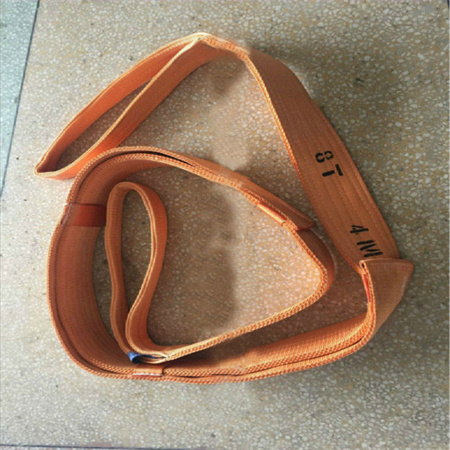
The double-buckle return eye at each end. The band is marked 8T 4M and carries a sewn label; there is no metal anywhere in the article.
1. What This Sling Is, and What Each Word Can Carry
The article is simple and worth stating in full before the words are argued about. A flat woven webbing band, with both ends turned back and sewn into a loop. That is the whole of it. The page's own photograph shows the form plainly: orange webbing, a folded return eye at each end, the band printed 8T 4M, and a sewn label. No metal fitting, no ring, no buckle in the hardware sense.
Four of the words in the name do real work, and one of them does almost none.
| The word | What it means on this article | What to check before you buy |
|---|---|---|
| double buckle | The band folded back and sewn into a return loop at each end. In this trade the Chinese behind the phrase is 两头扣, two-end buckle, and the loop and the ring are the same thing. No metal | If you were expecting hardware, say so at enquiry. Where a fitting is fitted, it must have a minimum breaking strength at least equal to that of the sling |
| flat | Flat woven webbing, as against a round sling, which is a sleeve over a wound core | A flat band spreads load across its width and shows damage on its face. That is the reason to want one on an abrasive duty |
| wear-resistant | A comparative claim about woven textile on a laboratory rig. It is not a grade, not a rating, and not printed on any tag (§5) | Ask instead what the weave and ply are, what the edge finish is, and whether a protective sleeve is available for your contact points |
| sling, lifting strap | The same article under two trade names. Note that a sling is rated for lifting; a lashing is not, and the two are governed differently | Say whether the job is lifting or securing. The sibling page that owns that distinction holds the detail |
| the fibre, which the name does not say | This article is woven in polyester, nylon or polypropylene, and the fibre is a separate choice from the form | Choose the fibre for the environment and the wear duty together. Each fibre's own page is linked once at the end of this section |
The chemicals, the heat and the fibre question are not re-opened here, because each already has a page: the polypropylene flat sling page for the acid side of the fibre question and the white acid-resistant and alkali-resistant sling page for the alkali side, with temperature held by the high temperature resistant ring eye type lifting belt page. This page stays on wear.
2. Where a Flat Sling Actually Wears: Four Contact Points
A webbing sling has no moving parts and no bearings. It wears in exactly the places where something rubs against it, and there are only four of those. Naming them is the whole of the engineering, because it separates what the mill can improve from what only the user can.
The mill controls the band: the weave, the ply, the width, the edge finish and the stitching. The mill does not control the concrete, the steel corner, the floor of the truck or the grit on the shop floor. A sling advertised in the abstract as wear-resistant is making a claim about the one contact point its maker can influence and staying silent about the three that usually decide the outcome.
| Contact point | What is doing the rubbing | Who can improve it |
|---|---|---|
| The load's surface and edges | Rough or sharp material: concrete, stone, glass, machined steel, casting flash, and any edge the band is asked to bend around under tension | The user, by choosing the hitch and fitting protection. Standards are explicit that slings are to be protected from being cut by corners, edges, protrusions and abrasive surfaces |
| The hook, shackle or pin it sits on | The bearing surface itself, and any roughness, wear groove or damaged mouth on it | Partly the user, who owns the hardware. A worn or grooved seat concentrates the whole load on one line across the band |
| The sling against itself | In a choke or a choke through the sling's own eye, the band slides across itself under full tension and rubs its own weave | The user, by the choice of hitch and by keeping the choke on the webbing. This is the one contact point the maker's choice of weave does not help at all (§3) |
| The floor, the truck, the drawer | Dragging, being driven over, being walked on, and the grit that comes with any of them | The user entirely. This contact point produces some of the worst damage a sling ever receives, and none of it happens while the sling is lifting |
3. Why the Double-Buckle End Is Where It Concentrates
The eye of a webbing sling is normally its strongest part, and not by a small margin. Formed by doubling the band back and sewing it, the eye is two thicknesses of webbing working in the same plane, which is why riggers describe it as a small basket. Break a new sling and it does not fail in the eye: it fails in the body, just below the splice. The eye is what holds.
That fact is what makes the double-buckle form interesting on a wear duty, because two things are true at once. The eye is the strongest part of the sling, and the eye is where the sling touches everything — the hook it hangs on, the load it wraps, and, in a choke, its own band. So the strongest part of the sling is also the most exposed, and when it is damaged the sling loses the reserve that was designed into the other end. Section 4 puts a number on exactly that case.
Two published rules apply directly to this form and are worth quoting, because both are about keeping load away from the places that cannot take it.
The first concerns the choke. Where a sling with fittings is used as a choker, it is to be long enough that the choking action is on the webbing and never on the fitting. The same principle governs the return eye: the choke should close on the band, not on the stitched fold, because the fold is the part carrying the whole of the eye's strength.
The second concerns where stitching may sit. A stitch pattern is not to be placed where it will bear on a sharp corner, on a hook, or on a choking point. Stitching is where the thread is; abrasion attacks thread faster than it attacks a tightly woven band, and a worn stitch line under a bearing point is the least visible and most expensive kind of wear on this article.
| Point on the return-eye form | Why it is exposed | What protects it |
|---|---|---|
| The outside of the eye where it bends over the hook or pin | It is the smallest radius the band ever has to take, and it takes it under full tension every lift | A hook seat that is smooth and undamaged, and an eye long enough that the hook does not fill it |
| The inside of the eye where the load passes through | It touches the load directly, and on an abrasive load that surface is grinding against the fold | A sleeve or pad at that point, and a hitch that keeps the rubbing surface away from the fold |
| The stitch line on the fold | Abrasion attacks thread faster than a tight weave, and a worn stitch line is hard to see from outside | Keep stitching away from bearing points and corners, and inspect the fold itself rather than only the outer band |
| The band as it passes through its own eye in a choke | Under load the band slides across itself; this is self-inflicted abrasion and no choice of weave prevents it | The right hitch for the load, and enough length that the choke closes where the band is single and clean |
| The tail of the band hanging past the choke | It is unloaded, so nobody looks at it, and it is the part that meets the floor, the truck tailgate and the corner | Lift it clear. Nothing else on the sling is looked after less and damaged more |
4. What Wear Costs, Measured in Pounds
This is the section that answers the word in the product name. A rigging company pulled slings out of service in the field, put them on a test bed, and pulled them to destruction alongside a record of what was wrong with each one. The slings were two-inch, two-ply flat webbing slings with a 6,400 lb vertical working load limit, and one three-inch sling at 9,400 lb.
A sound sling of that size is built with a design factor, and the presenters state their own figure as 5:1 — so a new 6,400 lb sling should reach roughly 32,000 lb before it parts. That is the number to hold in mind, because every result below is a fraction of it.
| Condition of the sling | Working load limit | Broke at | As a multiple of the working load limit | As a share of a sound sling's breaking load |
|---|---|---|---|---|
| Cut and abraded in the eye, cutting on both sides | 6,400 lb | 7,300 lb | 1.1 times | About 23 per cent. The lowest failure of the day, and it failed in the eye — the part that is normally the strongest |
| Severe melting and burns on the fibres | 6,400 lb | 7,800 lb | 1.2 times | About 24 per cent |
| Greyed out and stiffened by ultraviolet exposure | 6,400 lb | Barely above proof load, in the splice | About 2 times | About 40 per cent |
| Tied into a knot | 6,400 lb | About 15,000 to 16,000 lb, in the knot | About 2.4 times | About 47 per cent, and it failed at the knot with friction burns |
| Weld splatter and slag in the eye | 9,400 lb | About 33,000 lb, in the eye | 3.5 times | About 70 per cent, the best result of the day |
Read the first row again, because it is the argument of this page. A sling with a visibly cut and abraded eye still lifted its rated load. It broke at 7,300 lb against a 6,400 lb working load limit, so on paper it passed. What it had lost was everything behind the rating: the design factor that exists to absorb a shock, a snatch, a swing or an off-centre pick. The presenters say it in one sentence worth quoting — even though it made its working load, how long could it sustain it, and if there were any drop in the load or a sudden shock, that sling would have failed before it reached working load at all.
One difference between those tests and our own product is worth stating plainly rather than glossing over. The slings broken in that demonstration carried a 5:1 design factor, which is common in that market; the ordinary belts on this site are organised to EN 1492-1 and its 7:1 factor. A 7:1 sling starts with more reserve, so the same amount of wear takes longer to eat it. It does not change the shape of the finding: the reserve is what wear consumes, and a 7:1 sling whose eye is abraded is a sling with no reserve, however much it started with.
5. Why Wear-Resistant Is Not a Rating
The phrase is used everywhere and certified nowhere, and this is the reason. Abrasion resistance of woven textiles is measured in laboratories, on machines built for upholstery and apparel, using abradants that have nothing to do with your load. The results are reported in cycles, and the industry bodies that publish the methods say plainly that the results do not transfer.
Three published statements are worth putting side by side, because together they close the question.
First, on the two main methods: there is no correlation between Wyzenbeek and Martindale results. Two standard rigs, two numbers for the same fabric, and no conversion between them.
Second, on repeatability: studies by the same body found that results of multiple abrasion tests performed on some woven fabric structures may vary significantly, as much as 60 per cent or more. That is the spread between runs on one piece of cloth.
Third, on prediction: abrasion results are not necessarily a reliable indicator of fabric lifespan, comparative laboratory results on the same textiles frequently differ, and the methods do not necessarily correlate well with the variables encountered in actual use.
Add the obvious point and the circle closes: none of these rigs rubs your sling against concrete, grit, glass or steel swarf. They rub it against cotton duck, worsted wool or an abrasive wheel, under a fixed pressure, in a laboratory.
| Method | What it rubs with | What it counts | Does it predict your duty |
|---|---|---|---|
| ASTM D4157, Wyzenbeek, oscillating cylinder | A standard cotton duck, at about 3 lbf pressure and 4 lbf tension | Double rubs until two yarns break or noticeable wear appears | No. It is a rig for upholstery fabric, and the result does not correlate with the other standard method |
| ASTM D4966, Martindale | Worsted wool cloth, at about 12 kPa | Cycles until the appearance changes objectionably | No, and there is no conversion from it to the Wyzenbeek figure |
| ASTM D3389, Taber | Rotary abrasive wheels, around 250 g head weight | Change of appearance after a set number of revolutions, used for print retention on coated fabric | No. It is aimed at surface appearance, not at load-bearing capacity |
| Any of them, on a sling | A laboratory abradant. Note that some rigs switch to a wire screen for low-melting fibres, which shows how method-dependent the figure is | Cycles, which is not a load and cannot be converted into one | No, and no sling standard turns any of these figures into a sling rating. There is no wear rating for a lifting sling |
6. Abrasive Loads: Concrete, Grit, Glass and Swarf
Not every rough load damages a sling in the same way, and the most common one — set concrete — has an answer that is not yes or no. Hardened concrete on a sling is judged by what it did to the webbing, not by the fact that it is there. The inspection question is whether the concrete has cut the band, made holes, abraded the surface, or damaged the stitches. A splash that dried on a clean band and can be picked off has done none of those. Concrete that set inside the weave, or set across a fold so that the band cannot lie flat, has.
The distinction matters because one widely used summary of the removal criteria adds embedded particles to the list of holes, tears, cuts and snags. Grit that has worked into the weave is not just dirt sitting on a sling: while the sling is in use, it is an abrasive held against the fibres by the same load that is tensioning them. The sling is then grinding itself from the inside, and no amount of careful handling at the hook will prevent it.
Glass, swarf and casting sand are worse than concrete in one specific way: they are sharp rather than merely hard, and they cut rather than polish. A band abraded by concrete goes fuzzy and thins. A band cut by glass or swarf develops a notch, and a notch is where the load concentrates.
| The load | What it does to webbing | What to specify for it |
|---|---|---|
| Set concrete, dry | Judged by effect: cutting, holes, abrasion, damaged stitches, or particles embedded in the weave. A dried splash alone is not automatically a removal | Judge it in person and examine the fold, not just the flat face. If concrete splatter is routine, the better answer is a construction with a jacket, where the abrasive meets a cover rather than the load-carrying fibres |
| Grit, sand, casting sand | Works into the weave and abrades from inside under load. Becomes embedded particles, which is itself a removal condition | A sleeve or pad at the contact point, and a wash-and-inspect routine rather than a wipe. Once grit is inside the weave it cannot be removed without damaging fibres |
| Glass, sheet metal, machined edges | Cuts rather than polishes. Produces a notch, and a notch concentrates load at its ends | Edge protection at the corner in addition to any band protection; a cut is not a wear problem and a tougher weave is not the fix |
| Steel swarf and turnings | Sharp, and often oily, so it also carries contamination into the weave | Protection at the contact point plus a check of the whole band, since swarf travels. Treat a polluted sling as a candidate for retirement rather than for cleaning with solvent |
| Rough castings and forgings | Flash and parting lines act as a file along the whole contact length | A wider band to spread the contact, and a hitch that puts the smooth face on the load |
One general principle is worth more than any specific product recommendation. Where a load is abrasive, the useful engineering move is to give the abrasion something it can destroy without destroying capacity. A jacket or sleeve is exactly that: it carries no load, and it is expected to be the part that wears through. The load-bearing fibres sit behind it, untouched. A jacket does not raise the working load limit by a single kilo, and it is not meant to; its whole contribution is to be the thing that fails first.
7. Handling Rules That Decide Wear More Than the Webbing Does
The published operating rules for synthetic web slings read like a list of small housekeeping notes, and almost every one of them is a wear rule in disguise. They are worth reading again in that light, because the cost of breaking them is not a fine — it is the difference between the eye surviving five years and surviving one.
| The rule | Why it is a wear rule | What it costs to ignore |
|---|---|---|
| Do not drag a sling on the floor or over an abrasive surface | Dragging is abrasion at zero load, which is the cheapest possible way to remove fibre: nothing is being lifted and nothing is gained | Surface fibre is removed along the whole length, including the part that never touches the load |
| Do not pull a sling from under a load resting on it | This is dragging with the full weight on the band, and the band is dragged across whatever the load is sitting on | The worst single incident a sling can have outside a lift. Lift the load clear first |
| Do not set loads down on top of slings | Crushing damages fibres in a way inspection finds hard to judge, and it flattens the weave so that embedded grit cannot be seen | Damage that passes a visual check and then behaves unpredictably under load |
| Do not drive over or walk on slings | It presses the sling into the ground, and the ground is full of grit | Grit driven into the weave to stay, which is embedded particles and a removal condition |
| Do not shorten a sling with a knot or by twisting | A knot forces the entire load through a short length of band, and the knot works against itself under tension, which generates friction and heat | Measured: a knotted 6,400 lb sling failed at about 15,000 to 16,000 lb, with friction burns at the knot and the band cut through (§4) |
| Keep the choking action on the webbing, never on the fitting | The fold and any hardware are the parts least able to take a tight radius under load | A choke that bites into the stitch line, which is the failure point that is hardest to see |
| Avoid twisting and kinking, and never drop a sling with metal fittings | A twisted band carries the load unevenly, edge against edge, and a dropped fitting damages whatever it lands on | Uneven loading that cannot be seen and a band that wears on one edge first |
| Protect the sling from corners, edges, protrusions and abrasive surfaces | This is the rule that all the others are really about, and it applies whichever end of the lift you are looking at | Cutting is the failure mode that gives no warning at all, because a cut band looks almost intact until it parts |
8. Judging Wear: Agreeing What Excessive Means, Before You Need To
The standards are deliberately unspecific here, and it is worth being honest about why. The removal list for synthetic webbing includes excessive abrasive wear and, at the end, a catch-all for other conditions, including visible damage, that cause doubt as to the continued use of the sling. There is no number. There is no instrument. There is no gauge you can lay against a band and read.
That is not a gap in the standard; it is a transfer of responsibility. Because the criterion is judgement, the useful thing a plant can do is decide in advance what "excessive" means for its own lifts, write it down, and train the people who will have to make the call at the hook. A criterion invented after the damage is a criterion invented to justify a decision that has already been made.
Four practical checks do most of the work. Look at the surface: frayed fibres, an uneven or disoriented yarn surface and general fuzz are the visible signature of abrasion, and they appear before the band measurably thins. Compare the eye against the body, since on this form the eye is where wear concentrates and the two should not look like different slings. Feel for stiffness or brittleness, which points at chemistry, heat or ultraviolet rather than rubbing. And measure the length: a sling that has become shorter than it was has been overloaded, and that is a different finding from wear with the same consequence.
One further indicator belongs here because it is the clearest one on the article. If the sling carries a warning yarn in a contrasting colour and you can see it, the damage has already passed the point where the outer weave was protecting the core, and the sling comes out of service. The full removal list, including what to do when damage is present but the warning yarn is not exposed, is on the high strength polypropylene white flat sling page, which owns that subject; this page does not repeat it.
| What you see | What it indicates | What to write down |
|---|---|---|
| Fuzzy surface, disoriented yarn | Abrasion in progress. Surface fibre has gone and the load is being carried by what is left | Where on the sling, and how long it is. A patch at one contact point is a rigging problem; fuzz along the whole length is a handling problem |
| The eye looks worse than the body | Expected on this form, and the reason the eye is the place to look first. Remember what is at stake: the eye is normally the strongest part and it is where the measured failures happen | Which eye, and whether the stitch line is affected as well as the outer band |
| Grit or concrete set into the weave | Embedded particles. The sling will abrade itself from inside on every future lift | Which load it came from, because the answer is a change of practice, not a change of sling |
| Stiff, stiffening or darkened areas | Chemical, heat or ultraviolet damage rather than rubbing. Faded colour on a sling that lives outdoors or in a truck is the classic ultraviolet case | Where it is stored, because the fix is storage rather than the sling |
| The sling is shorter than its marked length | Overload history. The fibres have taken a permanent set, which is not wear but has the same effect on capacity | The measured length against the delivered length, and the lift that did it |
| The warning yarn is visible | Damage has reached the core. Out of service | The date and the lift. And check the rest of the set, because a sling that got there did not do it alone |
| Anything that raises doubt | The standards end their list with exactly this clause, and it is written for the case where an inspector cannot articulate the problem | The finding, the inspector, the date and the removal. An unexplained doubt that is recorded can be investigated; one that is not becomes a dropped load with no history |
9. The Label, the Band Marking, and Why a Faded Tag Removes a Sling
Every synthetic web sling has to be marked, so that its rated capacity for each type of hitch and the synthetic material it is made from can be read off the article itself. That marking is not paperwork; it is part of the product, and losing it removes the sling from service exactly as a cut does. A sling whose rating cannot be read is, in practice, an unrated sling.
This page's own photograph makes the point in the most ordinary way possible. The band is printed 8T 4M — eight tonnes, four metres — and there is a sewn label alongside it. Both are doing the same job from opposite ends of the article: the label is the formal record, and the band marking is what the rigger actually reads when the sling is in the lift and the label is facing the wrong way.
On any other duty that is a neat system. On an abrasive duty it is a design weakness, because a tag is a loose flap of material hanging exactly where the band is working, and it abrades faster than the band it describes. The sequence is predictable: the band survives, the tag fades or tears off, and a perfectly sound sling becomes unusable. That is a wear problem, and it is worth planning for before it happens.
| What is marked | Why it wears on an abrasive duty | What to do about it |
|---|---|---|
| The sewn identification label | It hangs free, so it meets concrete, grit and the load's edges before the band does | Treat a faded or missing tag as a removal condition, and consider a band marking as the primary identification on abrasive duty |
| The band marking, such as 8T 4M | Printed or woven into the band, so it abrades with it. A band that has gone fuzzy may still be strong while its marking is no longer legible | Have the capacity printed at more than one point along the band, so that losing it in one place does not lose it entirely |
| The rated capacity for each hitch | Nothing wears this off except the tag, but it is the number a rigger needs at the moment of the lift, not later | Have the hitches you actually use marked, including the choke, rather than only the vertical figure |
| The material and the length | Length is your overload indicator: a sling that has become shorter has been overloaded (§8), and you cannot measure that without knowing what it was | Record the delivered length at commissioning, against the sling's own number, so the measurement has a baseline |
| The sling's own identity | Without a number there is no inspection history, and on an abrasive duty history is the only way to see wear as a rate rather than as an event | Give every sling a number at commissioning and inspect against it. Two inspections six months apart tell you far more than one |
10. Storage, Sunlight, and the Wear Nobody Blames on Storage
There is a second form of wear that has nothing to do with rubbing, arrives with no visible friction, and is measured in the same tests. Exposure to sunlight and ultraviolet light degrades the strength of synthetic webbing, and this is stated in so many words in the sling standards rather than left to inference.
The test-bed evidence is unusually clear. A sling that had been left in the sun long enough to fade was broken alongside the others, and it failed in the splice having barely exceeded proof load — roughly 40 per cent of what a sound sling of its size should reach. The detail the presenters keep returning to is the colour: what had been a vibrant orange band was grey and dull, and the fibres could be heard breaking as the load came on, well before the working load limit was reached. The damage was visible to anyone who looked, and it had been happening for months without a single lift going wrong.
So storage is not housekeeping on this article; it is the other half of wear control. Webbing is to be stored cool, dry and dark, off the ground, and away from the place slings actually get left. Not the back of a truck, where the sun works on it all day and the grit works on it every time something is thrown in beside it. Not on a dashboard. Not on the floor of a workshop where carts and boots will find it. And never cleaned in a solvent tank, which is a chemical exposure with the same outcome as an acid burn.
11. Ordering a Double-Buckle Sling for an Abrasive Duty
This article is made to order, because both the length and the return loops are set at sewing rather than cut from stock. To quote it properly the first time, the following is what we need. Everything after the length is optional, and every point is confirmed back to you before the band is sewn.
Width and ply — 25 mm to 150 mm, single ply or duplex. On an abrasive duty width is doing more work than strength, because a wider band spreads the same load over more contact area.
Working load limit and the hitch — give us the load and how it will be hitched, not just a tonnage. A two-leg basket and a single choked leg are different slings at the same width, and the choking factor runs the other way from the basket.
Length, and the datum it is measured on — the loop-to-loop length between the two bearing points, with the sling laid out flat and unstretched. Say so if you need it measured another way.
What the eye has to go over — the width of the hook, shackle or pin, so the eye length can be set against it rather than guessed.
The load itself, described — concrete, glass, steel swarf, a rough casting or a clean machined face. This is the single most useful sentence on an enquiry, because it decides whether the answer is a tougher band, a wider band, a sleeve, or a different construction altogether.
Edge finish and any sleeve — whether the contact points need a pad, and whether the sleeve needs to be fixed or can be movable. A movable sleeve slides out of position in a tight gap, which is worth knowing before you specify one.
Marking and any certificate — the hitches the label should carry, whether you want the capacity printed at more than one point on the band, and whether you need the breaking strength and elongation reported to a named test method rather than a bare working load limit.
A spare — on an abrasive duty the sling is a consumable, and one spare on the shelf is cheaper than one stopped shift.
HS code 630790. Price and lead time follow the length, the width, the ply and the sleeves. The number below reaches the workshop rather than a call centre, which is why a technical question usually comes back the same day.
12. Frequently Asked Questions
Q1: What does wear-resistant actually mean on a webbing sling?
Q2: Does double buckle mean there is a metal buckle in the end?
Q3: Where does a flat sling wear most?
Q4: How much strength does abrasion actually take off?
Q5: If the sling still lifts its rated load, why is it unsafe?
Q6: Does dried concrete on a sling mean I must scrap it?
Q7: For an abrasive load, is a tougher band better than a sleeve?
Q8: How do I decide when abrasion is excessive?
Q9: Does an abrasive duty change how I store the sling?
Q10: What do you need from me to quote?
Contact
This sling is made to order, in the length and the return-loop form agreed with you, and the technical questions on this page are answered by the workshop rather than by a call centre. Send the width, the load, the hitch and the length, and tell us in one sentence what the sling will be rubbing against — that last part decides more of the answer than anything else on the list. Every point is confirmed back to you before the band is sewn.
Telephone and WeChat — 18066002268
E-mail — 702461526@qq.com
Address — Lifute Industrial Park, Taizhou City, Jiangsu Province, China
HS code — 630790
- Previous:Wear Protection lifting sling_ Sleeve Wear Pad flat web sling
- Next:High strength polypropylene white flat sling lifting belt cr
-
Drone Anti-collision Net
-
Extra Large Capacity Cargo Net
-
Cargo Webbing Net
-

Color changing nylon double buckle loop nylon braided rope
-

Two end buckle lifting rope, double buckle round lifting rope, double fork nylon lifting rope, non jointed nylon lifting rope
-

Emergency escape lifeline, fire escape rope, fire safety escape emergency rope, steel wire core fire rope

