 Language
 简体中文
简体中文
- On the 2018 National Day holiday, Lifet completed six 100 ton large tonnage lifting belts as a gift
- The role of suspension net in the transportation of goods turnover
- Cargo soft lifting net, lifting net, lifting net, lifting net, bag, climbing net
- Precautions for using Lifutiden elevator
- How to make circular lifting straps
Contact: Wang Lili
E-mail:18066002268
Phone:702461526@qq.com
Address: Lifute Industrial Park, Taizhou City, Jiangsu Province
Lifute Hoisting Co., Ltd. 18066002268 produces lifting belts, lifting nets, nylon ropes, soft ladders, steel wire rope rigging, paper ropes, safety belts, safety nets, lifting chains, steel coil hoists, crossbeam hoists, flat lifting belts, circular lifting belts, electric traction ropesA double ring disposable lifting strap is a flat woven band with a formed loop at each end, bought to make one journey and not come back, and the three phrases in this page‘s name describe that one article at its ends: a double buckle disposable sling, or a with buckle disposable sling, is the same band under the catalogue‘s other word for the same two loops.
Hits: ℃
Release time:2026-09-27 14:09
Lift Sling Rigging Co., Ltd manufactures Double buckle disposable sling
Double Ring Disposable Lifting Strap, Double Buckle Disposable Sling and With Bu
3. The Parameter Table on This Page, Column by Column
The table below is this page's own parameter table. It was published on the page before this text was written, in Chinese, under the caption Parameters of circular eye flat sling. Its figures are r eproduced here unchanged and in English, because a table of dimensions that a buyer cannot read is not an asset. Every number in it is the maker's own published figure; nothing has been rounded, corre cted or filled in.
| Working load limit | Thickness | Approximate width, 5:1 | Approximate width, 6:1 | Approximate width, 7:1 | Minimum breaking force | Minimum length | Maximum length | Eye length | Weight per metre, 5:1 | Weight per metre, 6:1 | Weight per metre, 7:1 |
|---|---|---|---|---|---|---|---|---|---|---|---|
| 1 t | 7.5 | 25 mm | 25 mm | 30 mm | 6 t | 1.1 m | 100 m | 300 mm | 0.19 | 0.20 | 0.22 |
| 2 t | 7.5 | 50 mm | 50 mm | 60 mm | 12 t | 1.2 m | 100 m | 300 mm | 0.36 | 0.41 | 0.45 |
| 3 t | 7.5 | 75 mm | 75 mm | 90 mm | 18 t | 1.3 m | 100 m | 350 mm | 0.56 | 0.60 | 0.71 |
| 4 t | 7.5 | 100 mm | 100 mm | 120 mm | 24 t | 1.4 m | 100 m | 500 mm | 0.61 | 0.75 | 1.02 |
| 5 t | 7.5 | 125 mm | 125 mm | 150 mm | 30 t | 2.0 m | 100 m | 550 mm | 0.89 | 1.02 | 1.21 |
| 6 t | 7.5 | 150 mm | 150 mm | 180 mm | 36 t | 2.0 m | 100 m | 600 mm | 0.98 | 1.26 | 1.42 |
| 8 t | 7.5 | 200 mm | 200 mm | 240 mm | 48 t | 2.0 m | 100 m | 700 mm | 1.36 | 1.69 | 1.89 |
| 10 t | 7.5 | 250 mm | 250 mm | 300 mm | 60 t | 3.0 m | 100 m | 800 mm | 1.68 | 2.07 | 2.34 |
| 12 t | 7.5 | 300 mm | 300 mm | 300 mm | 72 t | 3.0 m | 100 m | 900 mm | 1.95 | 2.37 | 2.98 |
The first column is the working load limit, one tonne to twelve tonnes in nine steps. It is the column a buyer chooses from, and it is not the same figure as the load: the limit is th e figure for a particular hitch and a particular factor. The column does not by itself say which.
The three width columns are the most informative part of the table and the reason it runs to twelve columns rather than four. A tonne is not a width. The same one-tonne band is publis hed as approximately 25 mm wide at a factor of 5:1, 25 mm at 6:1 and 30 mm at 7:1; at twelve tonnes it is 300 mm at all three. The pattern is consistent all the way down: to carry the same load at a h igher factor, the band has to be wider, and the gap between the columns closes as the sizes get large because the difference is absorbed by a band that was already wide. This is the table telling a bu yer something a capacity figure never can, which is that the webbing you receive is decided by two numbers and not one.
The breaking force column is exactly six times the first column at every size: 1 t and 6 t, 2 t and 12 t, 3 t and 18 t, up to 12 t and 72 t. It is the table's own arithmetic and it is worth noticing, because it means a buyer can read the effective factor off the published sheet instead of assuming it. It also means the column carries no independent information: it is the first col umn multiplied by six.
The thickness column carries the same figure, 7.5, at every size from one tonne to twelve. A figure that does not change across a twelve-fold range of capacity is not doing the work t hat a dimension usually does, and it should not be relied on to choose between two sizes. Treat it as a nominal figure and ask us to confirm the actual band for the article you are ordering. The same caution applies to the weight columns, whose heading is printed on the page as kh per metre; that is a typing error for kilograms per metre, and the figures themselves are the ones we work to.
4. The Eye Length Column: the One Figure You Cannot Trade
Of the twelve columns, eleven describe the article as a whole. One describes the ends, and it is the only figure on the table that a buyer cannot move by ordering differently. The eye length column runs 300 mm at one tonne, 300 mm at two tonnes, 350 mm at three, 500 mm at four, 550 mm at five, 600 mm at six, 700 mm at eight, 800 mm at ten and 900 mm at twelve.
The reason it behaves this way is in the construction. A flat eye is not an extra piece sewn onto the band: it is the band turned back on itself and stitched, so a longer eye means more band consum ed inside the loop, more plies of fabric stacked at the point where the load enters, and a longer run of stitching to develop the strength. Those scale with the size of the article, not with the lengt h a customer orders. A one-tonne strap ordered at one hundred metres has the same 300 mm eye as a one-tonne strap ordered at 1.2 m. The length column moves; the eye length column does not.
That single fact is responsible for a large share of the enquiries that go wrong in this family, and the error is always the same shape. A buyer has a piece of hardware in mind — a hook, a shackle, a beam lug, a master link — and orders the length they need with the capacity they need, without ever converting the hardware into a figure. The hardware is not in the table. The only defence is to m easure it: the width of the body the loop has to pass over, and the diameter of the section it will bear on, are what decide whether a 300 mm eye is generous or useless.
There is a second-order point about the same column. Because the eye length increases with the size, a buyer who needs a big eye and a small capacity cannot have one by choosing a small article, an d a buyer who needs a small eye on a large capacity will not get one either. The two cannot be traded against each other on this form. Where the fit is tight, the practical options are to change the h ardware, to change the form to an endless band with no eyes at all, or to take the article to the next size up and accept a heavier band. The first of those is usually the cheapest, and the last is us ually what happens by accident.
The loop also has to seat properly, not merely fit. An eye that goes over the hardware but rides up onto the point of a hook instead of sitting in the load-bearing bowl is doing something the eye w as not built for. Some of that is the hook's business rather than the strap's, and the page on this site that deals with hooks and their own removal criteria is the white flat sling for crane duty, li nked above.
5. The Minimum Length, the Maximum Length, and a Convention Nobody Writes Down
Two further columns of the table are ranges rather than figures, and both of them say something about the article that is not obvious. The minimum length runs from 1.1 m at one tonne to 3.0 m at te n and twelve tonnes. The maximum length is 100 m at every size, from the smallest to the largest.
The minimum is the more interesting of the two, because it is nearly all end. At one tonne the two eyes account for 600 mm of a 1,100 mm article, which leaves roughly half a metre of band between t hem; at two tonnes the same 600 mm sits inside 1,200 mm. Read the other way round, the shortest article in the table is the one in which the ends are the largest share of the whole, and the shortest a rticle is therefore the one where it matters most that the eyes are right. A buyer who wants a one-tonne strap for a short, tight pick is buying an article that is almost entirely loop, and the loop i s what they will be handling.
The maximum is uniform, and it is worth converting once so that the figure stops being abstract. At one tonne the table gives 0.22 kilograms per metre at a factor of 7:1, so a hundred metres is abo ut twenty-two kilograms of band. At twelve tonnes the same hundred metres is 2.98 kilograms per metre, or close to three hundred kilograms. Both are real orders, and they are three hundred kilograms o f webbing with a 900 mm eye at each end, which is a load in its own right before it has been asked to carry anything. The weight per metre columns exist for exactly this kind of arithmetic: they turn a length into a shipping figure, and they turn a length into the answer to whether the article can be handled by the number of people who will be present when it arrives.
The convention is the part nobody writes down. The length of an article with a formed end at each end can be measured more than one way — between the two loops, from the outside of one loop to the outside of the other, or along the whole band including what is folded into the loops. The standard knows this, and it deals with it by saying which measurement it means for each construction: for Typ e III, eye and eye with flat eyes, its own description of the type gives the length as measured between lap and eye. Two suppliers can therefore both quote two metres and deliver articles that differ by the length of an eye, and on the twelve-tonne size that is a difference of 1.8 m. There is no way to resolve it after the fact. The order has to carry the convention, in words, on the same line as the figure.
A range also tells a buyer something about how the article is bought. Because the table publishes from 1.1 m to 100 m at nine capacities and three factors, a length is a line on an order rather tha n a stocked size in a bin. That is normal for this family and it is why the lead time conversation belongs at the point of enquiry rather than after the specification is fixed.
6. What a Single-Trip Article Changes, and What It Leaves Alone
The word disposable is used in this trade as though it described a grade of article, and it does not. It describes a journey. The article on this page is a rated article bought for one trip, and th e trip does not exempt it from anything: it has rated capacities for each hitch, it is marked with them, and the fibre it is made from is marked too, because that is what the standard requires of ever y synthetic web sling rather than only of the ones that are expected to survive (the page on disposable slings makes this argument at length and is linked rather than repeated here).
What the single trip does change is the inspection schedule. The standard requires that each day before being used the sling and all fastenings and attachments be inspected for damage or defects by a competent person designated by the employer, and that additional inspections be performed during use where service conditions warrant; damaged or defective slings are to be removed from service imm ediately. On an article in daily use, that requirement produces a rhythm: an inspection before each shift, a person who knows the article, and a store to draw a replacement from when something is foun d. On an article bought for one journey, the whole of that rhythm collapses into a single event. There is one inspection, before the only use, performed by whoever is at the load. There is no second m orning, no additional inspection during service, and no store to draw from: a fault found at the destination becomes a factory order, not a replacement from a shelf.
Three practical consequences follow, and they are the reason this page spends its middle on the ends rather than on the fibre.
The first is that the single inspection has to be sufficient on its own. There is no accumulated acquaintance between the article and the person using it. On a recurring article, small changes are noticed because they are changes. On a single-trip article, everything that would have been noticed as a change has to be judged as a state, by somebody seeing the article for the first and only time.
The second is that the article is despatched in quantity and used at a distance. That means the decision to accept or reject a whole order has to be taken before despatch, because the cost of a fau lt is not a replacement but a lift that cannot happen. It also means the thing that travels with the article has to be sufficient: the standard requires that slings not be used without affixed and leg ible identification markings, and that the employer not load a sling beyond the safe working load given by the manufacturer's permanently affixed marking. A single-trip article with an illegible marki ng is therefore not an article with a cosmetic defect.
The third is arithmetic rather than procedural. Because the count is the order, the buyer of a single-trip article is buying the number of lifts they expect to make, which is why this article is no rmally bought against a job rather than against a store level. Everything that is decided for the article — the capacity, the factor, the width, the length, the eye length, the fibre — is decided once and multiplied. A mistake in any of those lines is therefore not a mistake in one article.

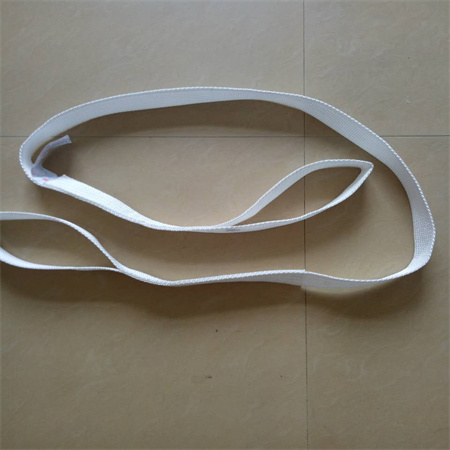
A quantity of white flat woven straps together on a works floor, and the picture a single-trip order makes when it is being coun ted rather than selected. Each band in the heap has a formed loop at its end, and the loops are the part that can be looked at in a heap. The band is un-dyed, which is what makes a dark mark on it wor th a second look. When the count is the order, a heap like this is the unit of purchase, and any fault in it will be found either now, in the factory, or at the far end of a journey where nothing can be done about it.
7. The Two Ends Are the Whole Inspection Surface of This Article
Imagine the inspection the standard asks for, performed on this article at the point of use. A person is standing at the load with no tools, a minute or two of time, and a band in their hands. On t he eye-and-eye form the band runs from one formed loop to the other, and on the largest sizes that band may be a hundred metres long. The loops are where the article will be lifted from and where the load will enter it. They are also the only part of it that can be looked at without walking its whole length.
That is what the phrase the whole inspection surface means, and it is a property of this form rather than of this article in particular. An endless band offers no such place: it has no ends, which is why the page on the disposal circular sling on this site describes that form as having no eyes and no fittings to inspect. A round sling with a sleeve over a core has the same problem from the othe r direction, because the load-bearing core is hidden inside the sleeve. The eye-and-eye flat form puts its construction on the outside, at two places, and that is the practical advantage a single-trip buyer is often not told about.
| What to look at | How a fault presents itself | Why it is decisive on this form |
|---|---|---|
| The run of stitching | A thread broken anywhere along the run, or a run that has worn thin where the loop has rubbed. Broken or worn stitches are one of the conditions the standard lists as grounds for removing a synthetic web sling from service. | The stitching is what makes the loop an eye, so the stitching is part of the load path rather than a seam that holds a shape.< /td> |
| The inside of the loop | A cut, a nick or a snag on the face of the band where the loop bears on hardware. Snags, punctures, tears and cuts appear on t he standard's removal list alongside acid or caustic burns and melting or charring. | The inside of the loop is the surface that touches whatever it is hung from, so it collects the damage that the lift itself ca uses. |
| The band at the mouth of the loop | A crease, a hard fold, or fabric that has stiffened or discoloured. On a white band a mark is visible in a way it is not on a dyed one. | This is where the band is asked to change direction under load, and it is within arm's reach of the person doing the inspectio n. |
| The printed capacity | A figure that cannot be read, or cannot be read at arm's length on a wet and gritty surface. | A rated capacity that cannot be read at the point of use is not a rated capacity. On a heap of identical articles the print is also what tells one capacity from another. |
| Anything hooked under the loop | A bolt, a shackle pin, a piece of bar, a makeshift fastener of any kind. Shortening a sling with knots or bolts or other makes hift devices is prohibited outright. | Anything inside the loop that was not meant to be there is bearing directly on the stitching run. |
Five conditions, and four of them live at the ends. The fifth is the one that is absent from this article altogether: distortion of fittings. The standard's list of conditions that remove a synthet ic web sling from service includes distortion of fittings, and on a plain eye-and-eye strap there are no fittings to distort. That is not a loophole, it is a difference in construction, and it is the clearest single statement of what a buyer gets when they order this form: one of the standard's five removal triggers cannot occur, because the part it refers to has been deliberately left off.
What the two ends do not cover is the rest of the band, and on a hundred-metre article that is most of it. A single-trip strap is not exempt from the requirement that defective slings not be used, and a fault in the middle of a long band is a fault. In practice the middle of a band is protected by exactly the things that protect it on a recurring article: the load is not supposed to be slung ov er a sharp edge without protection, edges are to be padded, loads are not to be dragged, and a sling is not to be pulled from under a load that is resting on it. None of that changes because the artic le is going to be abandoned at the end of the trip.
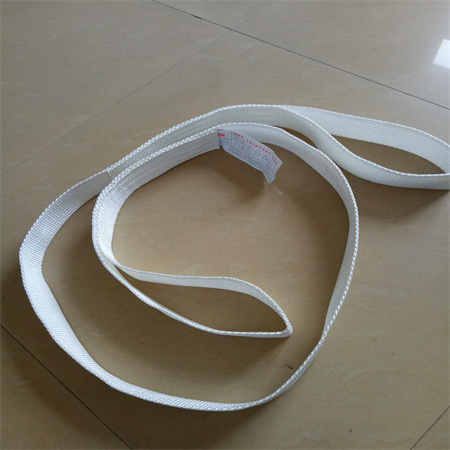
The same article with its identification visible: a white flat woven band, a formed eye at each end, and a printed label sewn in to the face of the band rather than threaded onto it. A label sewn into the band cannot be transferred to another article, which is the only property a marking needs in order to be worth anything. Rea d together with the photograph of the heap above, this is the difference between a pile of identical straps and a pile in which each article carries its own capacity, length and fibre.
8. What Ends This Article Before It Leaves the Yard
A single-trip article is bought in a quantity, despatched in one movement, and used somewhere the factory has never seen. That changes the economics of finding a fault. On a recurring article, a fa ult found at the works is an inconvenience; on this one, a fault that leaves the factory is a lift that cannot be made at the destination, by people who have no alternative but to make it anyway. So t he checks that matter most on this article are the ones that can be settled on a bench before despatch, by somebody who is not under time pressure and does have the second article to compare against.< /p>
Three of them are decidable in that way. The first is the run of stitching: a broken thread is one of the standard's removal conditions, and a broken thread in a loop that will be inspected once, a t arm's length, by a stranger, is not going to be found at the far end. The second is the inside of the loop: a cut or a nick in the fabric where the eye bears is visible on a new article, because the fabric inside a formed eye is smooth and unbroken when it is new. The third is the printed figure. This is the one that gets least attention and causes the most trouble, because identification is not decoration: the rated capacity is usable only when it can be read, and the standard requires both that the marking be affixed and legible and that the employer not use a sling without it. A figure pr inted directly on the band survives a works surface in a way that a loose tag does not, and it is why the graded articles elsewhere on this site are photographed with their working load limit printed across the webbing rather than only on a card.
The fourth check is the one that cannot be made at all, and the honest response is to say so. Whether the eye will pass over the hardware at the far end is not a question the factory can answer, be cause the factory has not seen the hardware. Nobody in this trade can tell a buyer whether the eye of a strap will fit a hook, a shackle or a beam lug that has never been described. The only defence i s to put the hardware into the enquiry, in figures, and the ordering section below sets out the lines that carry it.
There is one further point about the ends that is administrative rather than mechanical, and it follows from the article being single-trip. If the strap is expected to be thrown away at the far end of the journey, then the last question about it is where it goes. That is a subject of its own, and the page on this site that deals with the consumable side of the family — the single use endless webbing sling — takes it up properly: how a consumable is stored, counted, issued and reconciled. It is linked rather t han repeated here because that page addresses the endless form, and this page is about the form with two ends.
On this article, though, one thing about that question is certain rather than arguable. There is no ferrous part in the strap and no plated metal on it, because the ends are stitching. The article is therefore a single material. Nothing has to be separated from it before it is discarded; there is no mild steel to pull out, no zinc plated component to classify, and no mixed material to explain. A buyer comparing this form with a version that carries hardware is comparing two articles whose ends are worth the same amount mechanically and something quite different administratively.

A longer article of the same form, and a fair illustration of the limitation described above. The two ends are in the frame and can be examined; the whole band is not, and on the hundred-metre sizes it could not be. A single filament is visible standing off the face of the band in the middle of the picture. The point of the ph otograph is not that the article is faulty — the eye cannot settle that, and neither can a caption — but that a strap of this length has more surface than the person doing the inspection has time to c over, which is why the ends have to be right on their own.
9. The Version With Real Hardware on It
Everything above describes an article whose ends are stitching. If a fitting is genuinely wanted — a metal buckle, a D-ring, a thimble, a snap hook — then the article is an assembly rather than a b and with two folded ends, and the requirements that apply to it are not the same. The standard sets two of them out in a single short paragraph: fittings are to be of a minimum breaking strength equal to that of the sling, and they are to be free of all sharp edges that could in any way damage the webbing.
Both halves of that sentence are about the same idea, which is that a fitting is never a neutral addition. It has to be as strong as the band it is attached to, so that the band remains the weakest link rather than being quietly replaced by a weaker one. And it has to be incapable of injuring the band, which is an admission that metal next to webbing is a hazard the standard expects to be manag ed rather than a detail of finish.
There is a third point that the standard does not address and the trade does, because it is about the goods rather than about the sling: a metal surface in contact with a finished load. A zinc plat ed fitting, a nickel or chrome finish, a mild steel bar or a bare coated metal edge is, in each case, a hard object with an edge, pressed against a painted, powder coated, electrophoretically coated o r polished surface by the weight of the load. The fitting is not carrying the load — it is the webbing that is the rated part — so the risk of marking the goods is taken for no mechanical gain at all. That is the reason this form exists with no metal in it, and the reason a single-trip strap specified for coated pipe, machined components or finished fabrications is normally ordered with stitched l oops and nothing else.
There is a fourth point, and it is about time rather than about strength. On an article that is expected to be abandoned at the far end of one journey, a plated metal component outlives the article it is fitted to. The webbing is the rated part and the fitting is a sub component of a different lifespan, and when the strap is discarded the two go into the same place having had two different live s. Taken together, these four points are why the position taken on this site is consistent: if a metal buckle is what a buyer wants, they are buying a different product with a different rule, and the page on this site that says so in those words is the white flat sling for crane duty. A fitting is not refused; it is specified, with its own mat erial and its own minimum breaking strength declared as part of the assembly.
If the difficulty is not the fitting but the loop, there are three other ways out, and each of them is a different article on this site rather than a variation of this one. An endless band removes the problem by removing the ends, and has nothing at an end to inspect — the endless webbing sling is that article. A return eye , which the standard lists as a construction in its own right, presents a longer and slimmer loop than a flat eye. And the eye itself can be covered, which changes what touches the load without changi ng what the loop is.
An order for this article is seven lines. Each of them exists because there is a specific way the article goes wrong without it, and the last three are the ones that are most often left out.
| The line | What to write | What it prevents |
|---|---|---|
| 1. The form | Eye and eye with flat eyes, or return eye. Add a sentence if an endless band is what you actually want, because that is a diff erent article and a different page. | A strap that cannot be hung the way the lift needs, or that cannot be passed around the load at all. |
| 2. The capacity and the factor | The working load limit per hitch that will actually be used, and the factor you want it at. Both are needed, because the width follows from the pair rather than from the tonne alone. | A band that is the right capacity and the wrong width, which is the commonest of the silent mistakes on this family. |
| 3. The length, and how it is measured | The figure, plus the words between the eyes or overall. If the two ends of the strap will be attached to different things, say what they are. | An article that is correct by one convention and short by an eye length under the other. |
| 4. The eye, and the hardware it must pass over | The eye length you need, and the dimensions of the hook, shackle, lug or bar the eye will go over. | A loop that is generous on the drawing and impossible on the site. This is the line that cannot be checked by the factory on y our behalf. |
| 5. The fibre, and where the article will be used | The fibre you want, named, so that it can be marked on the article. Add the temperature of the place the strap will work in, a nd anything chemically present. | An article that is right in every mechanical respect and wrong in the environment. The standard gives ceilings of 180 degrees F for polyester and nylon and 200 degrees F for polypropylene, and it prohibits nylon where acids or phenolics are present and polyester and polypropylene where caustics are. |
| 6. The quantity, and the packing | The number of articles, which is the same as the number of lifts expected. Say how they will be counted at the receiving end, and how they will be handed out. | A shortfall discovered at the far end, where nothing can be done about it, and a heap in which nobody can tell one capacity fr om another. |
| 7. Plain ends, or an assembly with fittings | Whether the ends are to be stitched loops and nothing else, or whether a fitting is to be part of the assembly. If a fitting i s wanted, name its material. | A fitting being assumed by one party and not quoted by the other, and a metal part arriving on a job where the whole point of the article was that it carried none. |
The three lines that are most often missing are the second, the third and the fourth: the factor, the measurement convention, and the hardware the eye has to go over. They are missing because each of them seems to the buyer to be obvious, and none of them is written on the drawing they are working from. If a buyer has the nine capacities in front of them and does not know which factor applies, the useful thing to send is the load and the hitch rather than a guess at the factor, because from those two we can put the three width columns side by side and show which one the job is asking for.
11. Where Each Question Goes on This Site
This article sits in a family, and most of the questions a buyer has about it are answered in more detail somewhere else on this site. This table is the map.
| The question | Where it is answered | Why it is not repeated here |
|---|---|---|
| What does double buckle mean, and is it hardware? | Double buckle flat wear-resistant sling, and high strength polypropylene white flat sling | Both pages argue the naming out in full, from a wear-resistant article and from crane duty respectively. This page takes the a nswer as settled. |
| What if I really want metal on the ends? | High strength polypropylene white flat sling | That page states the position: a metal buckle means a different product under a different rule. The fittings requirements are quoted on this page and the argument is not. |
| What about a form with no ends at all? | Endless webbing sling, and the disposal circular sling | This page is about the form with two ends. The endless forms, and the consequences of having no eyes and no fittings to inspec t, belong to those pages. |
| Is disposable a grade of article? | Disposable sling | That page deals with the word itself, and with the difference between a disposable article and an unrated one. |
| What has to be marked on a single-trip article? | Single use lifting sling | The items a marking has to carry, and how a single-trip article is identified in an order, are dealt with there. |
| Where do the factors and the tolerances come from? | One way sling | The factor system, the marking tolerances and the way the one-way family is organised are the subject of that page. |
| The eye form in a fibre for acid and alkali sites | Acid-alkali flat double-ear lifting belt | The same end form built for a chemical environment, argued as its own article. |
| The eye form as an article for years of use | Eye and eye sling | Everything about the form as a durable article, including what changes when it is not thrown away. |
| What the absence of dye buys you | White disposable lifting ring and white flat sling | The white article, and the two engineering consequences of an un-dyed band, are that page's subject. |
| Storing, counting and issuing a consumable | Single use endless webbing sling | The consumable side of the family, taken up as a subject of its own. |
| Slinging something that is already packaged | Disposable pre-slung cargo sling | The article fitted at the packing station rather than at the load, which changes when the ends are decided. |
| The rest of the article's life when nothing is being lifted | Large tonnage circular lifting belt | Goods-in, identification, storage, issue and the retirement route, argued for a large article and general in method. |
12. Frequently Asked Questions
Q1: What is a double ring disposable lifting strap?
Q2: Does double buckle mean there is a buckle in the end?
Q3: Is a with buckle disposable sling a different product?
Q4: Can I have a longer eye on a smaller sling?
Q5: How is the length measured?
Q6: What is the shortest and the longest you make?
Q7: Why are there three width columns in the table?
Q8: What does the breaking force column tell me?
Q9: What is the thickness and the weight column for?
Q10: Is a single-trip strap exempt from inspection?
Q11: Where is this article recognised in the standards?
Contact
Lift Sling Rigging Co., Ltd makes the article on this page: flat woven straps with a formed loop at each end, in the width, length, eye length and fibre the load needs, and in quantities bought for a single journey. If you are comparing two suppliers' figures for the same strap, send both the figure and the way you are measuring it, and we will tell you which of them solves your lift.
Telephone and WeChat: 18066002268
E-mail: 702461526@qq.com
Address: Lifute Industrial Park, Taizhou City, Jiangsu Province, China
HS code: 630790
- Previous:Circular disposable sling, circular disposable lifting belt, circular disposable lifting rope
- Next:Export steel pipe sling, export steel pipe supporting liftin
-
Drone Anti-collision Net
-
Extra Large Capacity Cargo Net
-
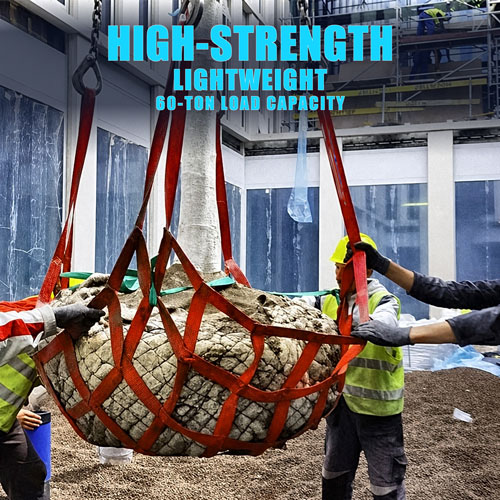
Cargo Webbing Net
-

Color changing nylon double buckle loop nylon braided rope
-

Two end buckle lifting rope, double buckle round lifting rope, double fork nylon lifting rope, non jointed nylon lifting rope
-

Emergency escape lifeline, fire escape rope, fire safety escape emergency rope, steel wire core fire rope

