 Language
 简体中文
简体中文
- On the 2018 National Day holiday, Lifet completed six 100 ton large tonnage lifting belts as a gift
- The role of suspension net in the transportation of goods turnover
- Cargo soft lifting net, lifting net, lifting net, lifting net, bag, climbing net
- Precautions for using Lifutiden elevator
- How to make circular lifting straps
Contact: Wang Lili
E-mail:18066002268
Phone:702461526@qq.com
Address: Lifute Industrial Park, Taizhou City, Jiangsu Province
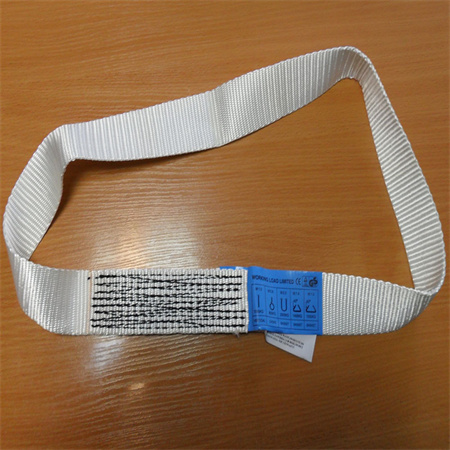
Lifute Hoisting Co., Ltd. 18066002268 produces lifting belts, lifting nets, nylon ropes, soft ladders, steel wire rope rigging, paper ropes, safety belts, safety nets, lifting chains, steel coil hoists, crossbeam hoists, flat lifting belts, circular lifting belts, electric tracAn export steel pipe sling is rarely one article. A pipe is long, round and heavy, and the job is done by three pieces bought together: the export steel pipe sling that lifts, the export steel pipe supporting lifting strap that bears the pipe while nothing is being lifted, and the export steel pipe special lifting rope that steadies it, draws a band under it, guides it into position or reaches a hook it cannot be brought to. This page is written around the second and third of those, because they are the two buyers specify last and regret first: a supporting strap is not a sling, and a rope is not a sling either. The pipe‘s own length sets the two pick positions, and those set the sling‘s length, the support‘s duty and the rope‘s job.tion ropes, high-altitude safety belts, and anti fall safety nets
Hits: ℃
Release time:2026-09-27 11:48
Lift Sling Rigging Co., Ltd manufactures Export steel pipe sling, steel pipe export special lifting strap
Export Steel Pipe Sling, Supporting Lifting Strap and Special Lifting Rope — One Lift, Three Pieces of Kit
An export steel pipe sling is rarely one piece of kit. A pipe is long, round and heavy, and the job of getting it off a rack, across a yard and into a hold is done by three things that are bought together and behave completely differently from one another. The sling lifts it. The supporting lifting strap bears it — while it is standing, stacked , being fitted up or waiting on a trestle, when nothing is being lifted at all. And the special lifting rope controls it and reaches it: the line that steadies a pipe as it swings, dr aws a band under a pipe that cannot be got at, guides a pipe into a rack or a hold, or reaches a hook that cannot come to the pipe.
Two of those three are the reason this page exists, because they are the two pieces of kit that buyers specify last and regret first. A supporting strap is not a sling: it is loaded when nothing is happening, it is fixed rather than hung, and the moment somebody treats it as a lifting point the whole arrangement has changed. A rope is not a sling either, whatever the shape of its load, and the four jobs a rope does on a pipe lift each ask for a different rope. Both are covered here; the sling itself is covered here only in the narrow respect that the pipe's own length decides its geometry, because the pipe as a load of steel and steel tube, and the choice of end configuration for pipe, tube and timber, are pages of their own and are linked rather than repe ated.
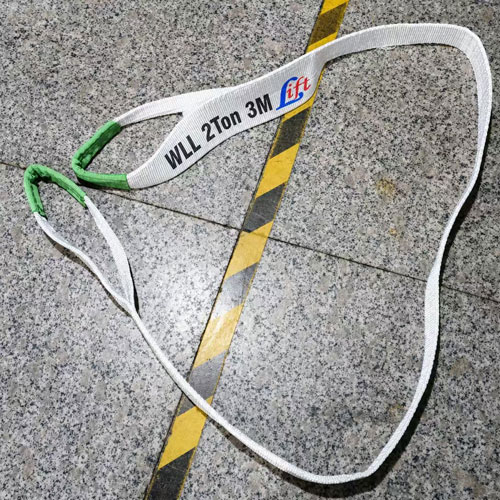
One of the three pieces, photographed on a works floor. This is a flat woven band with its own two figures printed on it and its ends finished in a green sleeve, which is the piece of kit that lifts. Read the photograph as the starting point for the next three sections: what is on the floor here is one of three things that hav e to arrive together, and the other two are not made of the same material or specified on the same lines, which is the whole difficulty this page addresses.
1. The Three Phrases in the Name: One Lift, Three Pieces of Kit
The name of this page is three phrases — export steel pipe sling, export steel pipe supporting lifting strap, export steel pipe special lifting rope — and they are not three ways of describing one product. They are three functions, and the reason they are worth separating is that each of them fails in a different way and is ordered on a different sheet. A buyer who collapses them into one line on an enquiry will receive one article and discover at the load that he needed two more.
The sling is the piece that carries the load between the pipe and the hook, and it is the only one of the three whose rating is a lifting rating. The supporting strapis the piece that carries the pipe when the pipe is not being lifted: standing in a rack, lying on a trestle, waiting on a bolster for a fit-up, sitting across a stillage in a yard, or nested in a barge's saddle for a voyage. It is loaded continuously and quietly rather than briefly and visibly, and that is the whole reason it must not be confused with the sling. The rope is t he piece that does everything a sling cannot: it steadies, draws, guides and reaches, and in none of those jobs is it asked to carry the pipe.
Two neighbouring pages on this site deal with the same material from different directions, and it is worth being clear about the difference so that the three pages help each other rather than compe te. This site's export steel and steel tube page decomposes the job by cargo: what a s teel pipe is as a unit load, how a bundle is closed, how a consignment is packed for a voyage and what documents travel with it. This site's disposable cargo sling page decomposes it by journey: a band and its rope bought as a pair and followed through the hand-over points along a transport chain. This page decomposes the sam e job by function: what lifts, what bears, what controls. Three decompositions, three pages, and a buyer who has one of the other two questions should follow the link.
| The piece | What it is asked to do | How it fails, and when the failure is noticed |
|---|---|---|
| The sling | Carries the pipe's mass between the load and the hook, for the length of one lift and one journey. | At the load, visibly, in front of the rigger. Its failure mode is the one everybody designs against. |
| The supporting strap | Bears the pipe while nothing is being lifted: at rest, in storage, in transit, during a fit-up or a coating repair. | Quietly, over weeks, and often out of sight. Nobody inspects a strap that is holding a pipe up while the pipe is waiting. |
| The rope | Steadies the pipe, draws a band under it, guides it into position, or reaches a hook the pipe cannot be brought to. | Only when it is asked to do a fifth job — carrying load — for which it was never specified. §9. |
| All three together | Get a pipe out of a yard and onto a vessel with nobody standing under it and nothing marked that should not be. | In the compatibility: a rope that will not reach, a support at the wrong height, a strap left in the lift. |
| The pipe itself | Supplies the geometry that decides all three: its length sets the pick spacing, its mass sets the figure, its surface sets the contact. | Not a failure of the pipe but of the paperwork: a pipe measured after the order was placed. |
2. The Sling, and the Arithmetic of a Long Pipe
A pipe is not lifted like a box, and the difference is arithmetic rather than strength. A twelve metre length of line pipe is a beam, and a beam picked at one point in the middle will hinge and swi ng; picked at two points it can be carried level if the two points are placed where the pipe's own balance allows. So the first figure on a pipe lift is not the working load limit, it is the s pacing of the two pick positions, and everything else about the sling follows from it. The spacing decides where the bands sit, the bands' positions decide how much band has to reach round th e pipe at each one, and that decides the length.
Three cases recur and each of them changes the arithmetic. A single joint of pipe is picked near its ends, so the two positions are far apart and the bands are long. A doub
le joint, two lengths welded or coupled together before shipment, is heavier and longer and is still picked at two positions, so each position carries more and the spacing is wider. And a
The second consequence of the pipe's length is that the sling is doing two jobs at once on a round load, and both of them are decided by its length rather than its rating. It carries the pipe's mas s downwards, and it holds the pipe inwards so that it cannot roll out of its own band. A band that is too long for the pipe it goes round makes a loose wrap, and a loose wrap on a round load is a load that can shift inside its own sling on the way up. That is why the length line on the enquiry for a pipe lift is not a matter of convenience, and why the convention the length is quoted in has to be named: the two conventions for a closed article differ by about a factor of two, and the page that owns them is the endless sling page.< /p>
| Feature of the pipe | What it changes about the sling | What has to be written on the order |
|---|---|---|
| Length of the joint | Sets the spacing of the two positions and therefore the reach of each band. | The two positions, as distances from an end, rather than a single length for the whole pipe. |
| A double joint or a coupled length | More mass per position, and a wider spacing, so the bands are both longer and loaded harder. | The mass of the joint as it will travel, not the mass of one pipe. |
| Outside diameter and wall | Set the circumference the band has to reach round, and therefore the effective length. | The diameter, or the measured circumference at the pick position. |
| A coated or wrapped surface | Decides the width of the band, because a wider band spreads the same force over more of the coating. | That the surface is coated, and whether a witness mark on it is a rejection. |
| A bevelled, threaded or capped end | Moves the pick positions inboard, so the two positions are further from the ends than they would otherwise be. | Where the pick positions must not be, as well as where they should be. |
| A pipe that will be re-slung at the far end | Nothing about the band; everything about who will choose it, and what they will have to go on. | Whether the bands are to be fitted before shipment, which is the route on the pre-slung cargo page. |
3. The Supporting Strap: the Piece of Kit That Is Not Lifting Anything
An export steel pipe supporting lifting strap is the phrase in the name that a buyer is least likely to have specified before, and the one that causes the most trouble afterwards, because a support ing strap spends its life doing something no lifting article is designed for: it holds a load up while nothing is happening. It is the strap that a pipe lies in, or stands on, at every moment between lifts — on a trestle in a fabrication shop while a joint is being fitted up, across a pair of bolsters in a yard while a stack is being built, on a stillage in a paint bay, in the saddle of a barge or the cradle of a trailer for a voyage. In each of those positions the strap is under load continuously, and in none of them is anybody watching it.
That single difference — continuous, unwatched load — is what makes a supporting strap a separate article from a sling, and it has three consequences the buyer has to accept rather than engineer ar ound. The first is that a supporting strap must be specified for a load that never ends, and the behaviour of a woven synthetic band under a load that is never taken off is a property of its material, not of this page: the pages that own that question are the fibre pages, and the polypropylene flat strap page deals with it for the fibre most often used in a support. The second is that a supporting strap is fixed rather than hung: it is tied, bolted, looped round a bolster or pinned at both ends, and every one of those fixings is a place where a band can be cut, crushed or worn without anybody noticing. The third is the rule that carries the safety of the whole arrangement: a supporting s trap is never a lifting point. The moment a crane takes the pipe, the load path must be the sling, and a strap that is still under the pipe must be either part of the lift deliberately or out of the way entirely; a strap left in position across a lift is a load path nobody has rated.
The practical discipline that follows is worth writing into a method statement because it costs nothing. Support a pipe on a strap that is visibly a different article from the sling — a different c olour is enough, and a permanent one is better. Mark the support positions on the pipe or on the rack, so that the two positions that carry the pipe at rest are known and can be checked against the tw o positions the lift uses. Inspect the supports as a separate item from the slings, on their own interval, because they are loaded when nothing else is. And when a support is retired, retire it out of the store entirely rather than into the sling rack, because the one thing a support must never become is a sling.
| Where the support sits | What it is asked to do | What the order has to fix |
|---|---|---|
| Under a pipe at a trestle in a fabrication bay | Holds the pipe at a working height while a joint is aligned, welded or coated, for hours at a time. | The support height, the pipe's diameter, and whether the strap may touch a prepared end or a wet coating. |
| Between bolsters in a pipe rack | Carries the bottom layer of a stack and separates it from steel, so that the pipe is not bearing on a hard edge. | How many layers, what the bottom layer weighs, and whether the strap is fixed to the rack or free. |
| On a stillage or a paint-bay cradle | Holds a finished or part-finished pipe off the ground and clear of other work while it dries or waits. | The surface condition, since a support is the article most likely to mark a new coating. |
| In a trailer cradle or a barge saddle | Carries the pipe for the whole of a road leg or a voyage, under movement as well as under mass. | Whether the support travels with the consignment or stays with the vehicle, which decides who owns it afterwards. |
| Across a trench or a lay-down area | Holds a pipe clear of the ground at a height and a span that keep it straight and keep it clean. | The span between supports, which decides how much of the pipe's mass each one carries. |
| Anywhere a support becomes a lifting point | Nothing. This is the case the whole section exists to prevent. | A rule, in writing, that the lift goes on the sling and the support comes out first. |
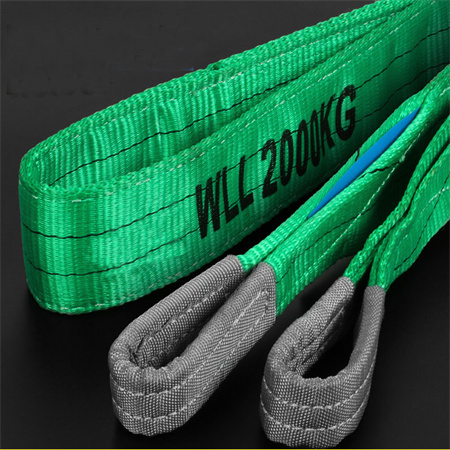
The band family a supporting strap is made from, and the reason the photograph is here rather than a photograph of a support in service: this site's library contains no picture of a pipe resting in a supporting strap, and a caption should not pretend otherwise. What the photograph does show is the two features that matter when a band is asked to bear rather than to lift — a finished loop at each end, which is what a support is fixed by, and a printed figure, which is the only thing that tells a support apart from a sling o nce both are lying in the same rack. A photograph of a real support position is the one picture this page would most like to be able to show, and it is the first one to take the next time a pipe is se t down in a yard.
4. Support Points and the Pipe's Own Weight: What a Supporting Strap Is Actually Carrying
A supporting strap is specified from two numbers that nobody writes down because both are thought to be obvious: the pipe's mass per unit of length, and the distance between the supports. Their pro duct is what any one support is carrying, and on a long pipe both of them are larger than they look. A line pipe of modest diameter is heavy per metre, and a stack of them on two bolsters puts the who le of the bottom layer into two narrow bands. The buyer who wants a support that does its job without being over-specified needs those two numbers on the enquiry, in the same way that a sling needs th e mass of the lift.
The span is the number that surprises people, because it is chosen for reasons that have nothing to do with the strap: a pipe is supported at a spacing that keeps it straight, clears the ground, an d leaves room for whatever is happening underneath it. That spacing may be set by the pipe's own straightness requirement, by the height of a weld position, or by the reach of a machine. What matters here is only that the span is a decision somebody made, that it decides what each support carries, and that changing it later — moving a bolster to make room for a truck, for example — changes the loa d in a strap that nobody re-specified. A support position should therefore be marked, and the mark should stay with the rack rather than with the pipe.
There is one further difference between a support and a sling that is worth stating plainly because it explains why the two articles are inspected differently. A sling's load is short, known and vi sible: mass, geometry, an angle between legs, and a figure on a band that somebody can compare against a plan. A support's load is none of those things. It is the pipe's own weight, applied through a contact that nobody measured, for a period that nobody has defined, in a place where nobody looks. The practical answer is not to develop a calculation — that belongs to the structural side of the job — but to make the support visible and to give it its own place in the inspection round, which is the same discipline that the store-side page applies to consumable bands from the other direction.
| The number | Why it matters to the support | Who has it |
|---|---|---|
| Mass per metre of the pipe | Multiplied by the span, it is the load in one support while the pipe is at rest. | The mill or the supplier, from the pipe's nominal size and wall. |
| The span between supports | Decides how the pipe's mass is shared, and changes silently when a bolster is moved. | Whoever laid out the rack, the bay or the trailer; it should be marked and kept. |
| The support height | Decides the drop the pipe would take if a support failed, which is the reason the failure matters. | The same person; it is a working-height decision rather than a strap decision. |
| The contact the strap makes | A support touches a pipe in one line, and on a coated or finished pipe that line is the whole risk. | The buyer, who should say whether a witness mark on the surface is a rejection. |
| How the support is fixed | Tied, looped, pinned or laid: each fixing concentrates force somewhere different on the band. | The works, from the drawing of the rack or the cradle; it is usually left to habit. |
| How long the pipe will sit there | A support is loaded for a shift, a month or a voyage, and the duration is what makes it different from a sling. | Nobody, unless the buyer writes it down. Write it down. |
| Whether it travels or stays | Decides whether the article is consumed with the journey or remains the works' own equipment. | The buyer, at the enquiry; it is the line that settles who pays for it. |
5. The Special Lifting Rope: Four Jobs on a Pipe Lift, and Four Different Ropes
The export steel pipe special lifting rope is the third phrase in the name, and it is the one that gets least attention and does the most work, because a rope on a pipe lift is doing jobs that no s ling can do. Four of them recur, and they are worth separating because each asks for a different rope and each has its own limit. The first is the steadying line: a pipe that has been picked at two points still swings as it comes off the ground, and a line held by somebody on the ground is what stops it turning into the crane's structure or into a person. The second is the drawing line: a band that has to pass under a pipe lying flat in a rack cannot be got at by hand, and a rope is what draws it through and back up.
The third is the guide line: a pipe being lowered into a rack, a trench, a cradle or a hold is being placed at a distance from the operator's eye, and a line from the pipe to a per son on the ground is what turns "a little to the left" from a shout into a control. The fourth is the reaching line: where the hook cannot be brought to the pipe — inside a stack, und er a deck, beyond a wall — a rope is what takes the band's eye out to somewhere the hook can reach. All four have one thing in common and one thing that separates them: they are all handled by a perso n rather than by a machine, and none of them is asked to carry the pipe's mass — which is exactly the assumption that has to be protected, because the moment a rope becomes a load path it has stopped being specified by anybody.
The rope itself is a separate article with its own maker's figures, and this site makes ropes and rope-adjacent articles on their own pages: the circular sling page and the cable sling page both deal with rope and cable duty in their own terms, including the case where a rope goes r ound something with a bend radius. The line to hold on to for a pipe lift is simpler than any of that. A steadying line, a drawing line and a guide line are hand tools: they are speci fied for length, for a comfortable diameter in a gloved hand, and for an end that can be held or tied. A reaching line is not a hand tool at all, because it takes the band's own load as soon as the ho ok lifts, and it is therefore part of the rigging and has to be rated, marked and inspected like any other part of it. Getting those two categories the right way round is the whole of the rope questio n.

Rope as this site makes it, and the thing to look at before ordering a line for a pipe: a braided rope with a formed end rather than a cut end. On a steadying or drawing line the end is what the person on the ground holds, ties or passes through, and a finished end is what makes the line usable at both ends instead of at one. The section above separates the four rope jobs by whether a person or the load is at the other end of the line, and the photograph is the reminder that the rope's own end is a specification line rathe r than a detail.
6. What "Special" Means on an Order
The word in the client's own phrase — a special lifting rope — is doing the work of a specification, and it is worth unpacking because the word by itself tells a supplier nothing. A rope is special in this context when it has been made for one job on one site: a length that reaches from a hook to a band in a particular position, an end that suits a particular fixing, a diameter that a particular gloved hand can hold for an hour, and a working load that matches what the job asks of it and nothing more. That last line is the one that turns a rope into a rated article, and it is the line most often missing, because a buyer who has never seen a rope fail does not think of a rope as something that has a figure.
Four lines therefore belong on the enquiry for a rope, and a fifth belongs on it for the rope that is going to be part of the rigging. The four are the job — steadying, drawing, gu iding or reaching — the length, which is measured from where it will be held to where it has to arrive, the diameter, which is a handling decision as much as a streng th one, and the ends. The fifth is the figure, and it applies only to the reaching line, because that is the only one of the four that will ever have the pipe's mass at the other end of it. On the other three a figure is not required and asking for one only invites a heavier rope than a person can use, which is its own kind of hazard.
| The line on the enquiry | What it fixes about the rope | What it does not fix |
|---|---|---|
| The job: steady, draw, guide or reach | Whether the rope is a hand tool or part of the rigging, which is the decision that changes everything else. | Nothing about the pipe; the job is the buyer's to state and the supplier cannot infer it. |
| Length | Reach, from the point of control to the point of attachment, with enough slack to be useful and not enough to be a trip hazard . | Anything about strength; a long rope is not a strong rope, and a short one is not a weak one. |
| Diameter | How the rope sits in a gloved hand and how it behaves when it is wet, which decides whether it is used properly. | Nothing about the fibre; that is the maker's line and the rope pages' subject. |
| The ends | Whether the line can be held, tied or passed through, and whether it can be attached at both ends. | Nothing about length; a finished end shortens the usable length of a line and should be allowed for. |
| The figure — reaching lines only | That the rope which takes the band's eye out to the hook is a rated article with a mark and a record. | Not the sling's figure, and not the load's: the reaching line has to be rated for what it carries, which is the whole lift. |
| Nothing at all | The commonest enquiry: "a rope for pipe work". | Everything. Four jobs with four answers cannot be met by one unnamed line. |
7. The Export Half: What Changes When the Pipe Is Going Abroad
Everything above is written for a pipe that is being moved. The name of this page says the pipe is being exported, and that adds three conditions to each of the three pieces of kit rather than one condition to the set. The first is that the destination is far away and the consignee is unknown: the pipe will be re-slung by people this side will never meet, using whatever is at h and, so the pick positions must be marked on the pipe, the band must be legible, and the supporting strap must be either supplied with the consignment or specified as staying behind. The second is tha t the pipe is probably finished by the time it is shipped: coated, wrapped, lined or end-capped, and every one of the three pieces touches it. The third is that the journey in cludes time — days or weeks in a yard, a quay, a hold or a deck — which is the condition under which a supporting strap stops being a convenience and becomes a design decision.
Three consequences follow that are worth writing into an export method rather than a general note. Because the consignee is unknown, the sling should be the article that does not need to be chosen at the far end, which is the argument for fitting the bands before shipment and the reason that page exists. Because the pipe is finished, the contact matters on all three pieces at once and the widest reasonable band is usually the right one. And because the journey includes time, the supporting strap is the piece whose specification most needs to be written down, since it is the one that will be loaded longest and watched least. What travels with the load as paperwork — the packing list, the certificates and t he shipping documents — belongs to the export steel page, and it is not repeated here.
| What export adds | What it changes about the sling | What it changes about the other two pieces |
|---|---|---|
| An unknown consignee | The band must be usable without a choice being made at the far end, and readable in the condition it arrives in. | The support and the rope must be either supplied with the load or written out of the method explicitly. |
| A finished pipe | Width is the sling's protection measure, and it is the line that is most often omitted. | A support touching a new coating is the likeliest source of a claim in the whole arrangement. |
| Time in a yard and at the water | Nothing directly, except that a band left on a pipe for weeks is being aged before it is used. | Everything: the support carries the pipe through that time, and it is the piece under load the longest. |
| A voyage by sea | The band's own packing and humidity are the shipment's problem, and are covered on the export page. | The support becomes a sea fixture for the duration, with movement as well as mass to carry. |
| Re-slinging at the far end | A band already fitted, or marks on the pipe, or both: the two devices that survive a hand-over. | Nothing, unless the receiving site is asked to keep the supports; then it is a written instruction. |
| A claim on arrival | A band whose contact left a mark is the first thing photographed on a finished pipe, whatever the paperwork says. | Two more things photographed with it, unless the support and the rope were chosen with the same care. |
8. Where Each Piece Is Left: Three Different Lifecycles in One Yard
The three pieces of kit are bought together and they do not die together, and the discipline of a pipe yard is largely the discipline of keeping their endings apart. The sling leav es with the consignment, on the pipe, and is written off against the job; it will not come back and nobody expects it to. The supporting strap usually stays: it belongs to the rack, t he trestle or the cradle, and it is loaded again the next morning; on an export job it may be asked to travel, which is a commercial decision rather than a technical one, and either answer is defensib le as long as somebody chose it. The rope stays with the people who use it, because a steadying line is a hand tool and hand tools belong to the crew.
The trouble comes from two of those endings being able to look like the third. A support that has been taken off a rack and laid on the ground beside a pipe looks exactly like a sling waiting to be used, and a sling that has come back off a load — or never went — looks exactly like a support. The distinguishing feature is the printed figure, which is why a support should carry the figure that t ells the truth about what it is, or carry no figure at all and be visibly a different article. What must never happen is a support acquiring the appearance of a sling, because then the next person to arrive at the rack will use it as one.
The rope has one ending of its own that is worth naming. A line that has been used as a reaching line — the one case in which a rope is part of the rigging — must be treated as rigging for the rest of its life, even if it is subsequently used for steadying. The reverse is not true: a line that has only ever been held in a hand does not become rated by being asked to take a load once. Both direc tions of that mistake are common in yards, and both of them are settled by keeping the two categories of line physically apart, in the same way that the support and the sling are kept apart.

A quantity of one of the three pieces, and the picture to keep in mind when reading the section above. Every band in that pile i s the same article, and the pile works because the group shares a specification and a job. Put a supporting strap into the same pile and the group stops being trustworthy, because the one thing that d istinguishes the pieces from each other is no longer visible in the hand: on a pile like this, the paperwork is what keeps the three lifecycles apart.
9. What the Three Pieces Are Not
Five refusals cover the whole arrangement, and each of them has been the cause of an accident somewhere rather than being a theoretical caution. The first: a supporting strap is not a lifti ng point. It carries a pipe at rest; the moment a crane takes the pipe, the load path must be the sling. The second: a rope is not a sling. No line specified for holding, dra wing, guiding or reaching becomes a lifting line by being used as one, and the reaching line is the single special case in which a rope is rigging — because it was specified, rated and marked as riggi ng from the start. The third: a tag line is not a substitute for a pick plan. A line controls a pipe that has been picked correctly; it does not make a bad pick safe, and a load that needs a line to stay level was picked in the wrong places.
The fourth and fifth refusals belong to the export half. A support is not packing material. A strap that bears a pipe for a voyage is doing a structural job, and a strap that merel y stops the pipe touching something is a packing detail; the two get confused because they are often the same band. And none of the three is a substitute for the fourth thing this arrangement needs, which is not a purchase at all: a person who decides where the two pick positions go and writes them down. Every failure mode in this page comes back to that one, and it is the reason section 10 exists.
| The refusal | Why it is refused | What to do instead |
|---|---|---|
| Using a supporting strap as a lifting point | It was specified for a load at rest and is not rated for a lift; a strap left under a pipe across a lift is a load path nobody has rated. | Take the support out before the lift, or give it its own rated lift as part of the method. |
| Using any rope as a sling | A line selected for handling has no lifting figure, no mark and no record, and none of those arrive by being used. | Order the reaching line as rigging, with a figure; keep the hand lines as hand lines. |
| Relying on a tag line to make a pick safe | A line controls rotation and position; it cannot compensate for two pick positions in the wrong places. | Move the pick positions, which is a length and a mark rather than a rope. |
| Treating a support as packing | A support carries load for a period; packing holds a load in place. The two are specified from different starting points. | Decide which the article is and put it on the order as that; a band cannot be both by accident. |
| Buying the three pieces without a pick plan | Every figure in the three specifications follows from where the two pick positions are, and nobody has decided that. | Write the positions down and mark them on the pipe, then order the kit to fit them. |
| Leaving the support to the yard to choose | The article loaded longest and watched least is the one most often bought from whatever is on the shelf. | Put it on the order with the sling, where somebody is already thinking about the same pipe. |
10. The Three Lines That Specify All Three Pieces
A buyer who wants the arrangement to work does not need a document, a calculation or a specialist. He needs three short specifications written against one pipe, and the discipline of writing them i n the right order. The order matters because the first line decides the next two: the pipe's own geometry fixes the pick positions, the pick positions fix the sling, and only then do the support and t he rope have anything to be specified against.
The first line is therefore the pipe and the pick: length, diameter, mass as it will travel, surface, and the two positions measured from an end. The second line i s the sling: the figure for the mass each position carries, the length with its convention named, the width the surface calls for, and the form — which is a question this page links rather than answer s, because the end configuration for pipe and tube is its own subject. The third line is the other two pieces together, because they share one requirement: the support must be specified for the pipe's mass at rest and for the span it will be used at, and th e rope must be specified for one of the four jobs and for nothing else. A fourth line, in the margin, is the one that keeps the arrangement safe after it leaves the office: the support comes out b efore the lift.
| What to write | What it settles | What goes wrong without it |
|---|---|---|
| The pipe and the two pick positions, measured from an end | The geometry of the whole arrangement, and the thing the far end will re-use. | A band that fits a pipe picked somewhere else; a pipe that arrives with its pick marks in the wrong places. |
| The mass each position carries | The figure on the sling, and the width that goes with the surface. | A sling chosen from the pipe's total mass, which is twice what either position sees. |
| The length and its convention | That the band reaches round the pipe with enough left for the legs to work at a sensible angle. | The commonest dispute on a closed article, and the one that is entirely avoidable. |
| The support: span, height and what it sits on | What the strap is asked to carry at rest, and the contact it makes on a finished surface. | A support bought from the shelf and loaded by a span nobody re-checked. §4. |
| The rope: which of the four jobs | Whether the line is a hand tool or part of the rigging, and therefore whether it needs a figure at all. | A hand line used as a load path; a rated line so heavy that nobody wants to hold it. §5. |
| The rule: support out before the lift | The one safety line that no specification carries, because it is an instruction rather than an article. | A strap loaded across a lift by somebody who was never told it mattered. |
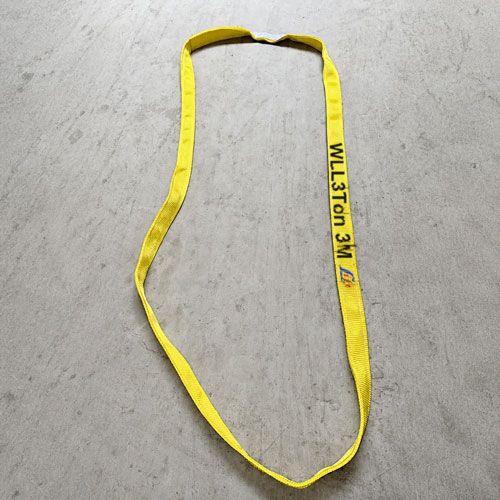
The sling end of the specification, and the two figures that have to come out of the first line of the enquiry. The photograph i s of the simplest possible answer to a pipe lift: one closed band, one printed figure, one printed length, and nothing else on the article to decide. What the first line has to produce is the pair of positions that makes this the right band, and what the second line has to produce is the length that lets it reach round the pipe at those positions and still leave the legs somewhere useful.
The same article with its identification on it, which is what makes the difference between a band on a pile and a band that can be issued against a job. On a pipe going abroad, the identification is what lets the receiving site tie a band back to a batch and a specification at all, and the marking is the second thing this page would ask for on a photograph of a real support — because it is the marking that tells the three pieces of kit apart once they are all lying in the same yard.
11. Where Each of the Three Is Explained on This Site
This page decomposes the job by function. Two other pages on this site decompose the same job by cargo and by journey, and several pages own the individual articles. The table below is the map, so that a reader with a question about one of the pieces can reach the page that owns it instead of reading this one carefully and finding that the answer is elsewhere.
| Page | The question it answers | Go there when |
|---|---|---|
| This page | The three functions inside one pipe lift: what lifts, what bears at rest, and what steadies, draws, guides or reaches. | The question is which piece of kit you actually need, or what to write for the two that are not the sling. |
| Export steel and steel tube | The same job decomposed by cargo: what steel and steel tube are as a unit load, how a bundle is closed, how a consignment is p acked and documented. | The load is already a packed unit and the question is the load rather than the kit. |
| Disposable cargo sling | The same job decomposed by journey: a band and its rope bought as a pair and followed through the hand-over points. | The question is the journey and the hand-overs rather than the functions inside one lift. |
| Single eyes for steel pipe and tube | The end configuration: one eye, two eyes or none, and which the pipe duty calls for. | The form of the sling is the open question rather than its place in the method. |
| Disposable pre-slung cargo sling | Fitting the band before the pipe is placed, so the receiving end never has to choose one. | The receiver will have to lift the pipe without a rigger or a plan. |
| Polypropylene flat lifting strap | The flat band itself: yarn, weave, width and ply, what it does on a round load, and its behaviour under a load that is left on . | The question is the band's material rather than its role. |
| Cable sling and circular sling | Rope and cable duty in their own terms, including the case where a line goes round something with a bend radius. | The question is the rope as an article rather than the rope as one of three functions. |
| Endless sling | The closed band's arrangements, and the two ways its length can be stated. | The length convention is the open question. §2. |
| Single use lifting sling and one way sling | The one-trip category itself, and the paper on the band. | The question is the category or the marking rather than the method. |
| Cargo lashing belt | Holding a load down rather than lifting it, which is the nearest neighbour to the supporting function and a different job. | The question is restraint in transit rather than support at rest. |
12. Frequently Asked Questions
Q1: What is an export steel pipe sling, and why three pieces of kit?A pipe is long, round and heavy, and one article cannot do all the jobs it needs. The sling carries the pipe between the load and
the hook. The supporting lifting strap bears the pipe while nothing is being lifted, at a trestle, in a rack, in a cradle or on a quay for as long as the pipe is waiting. And the special lifting rope
does the jobs that have nothing to do with carrying load: steadying a pipe as it swings, drawing a band under a pipe that cannot be got at, guiding a pipe into position, or reaching a hook the pipe ca
nnot be brought to. This page is written around the second and third of those, because they are the two that buyers specify last.
Q2: Can a supporting strap be used as a lifting point?
Q3: How many pick positions does a pipe lift need, and where do they go?Two, for a single joint, placed so that the pipe can be carried level rather than hinging; a double joint or a coupled length is h
eavier and longer and still uses two, with a wider spacing and more load in each. Where exactly they go is a decision rather than a formula, because it depends on the pipe's own balance, on what is at
its ends — a bevel, a thread, a cap — and on whether the pipe will be fitted to something at the far end. What matters commercially is that the positions are measured from an end, written on the orde
r, and marked on the pipe, because the pipe will be re-slung by somebody else at the other end of the journey.
Q4: Why does the length of the sling matter more on a pipe than on a box?Because on a round load a band does two jobs at once: it carries the pipe's mass downwards and it holds the pipe inwards so that i
t cannot roll out of its own wrap. A band that is too long for the pipe it goes round makes a loose wrap, and a loose wrap on a round load is a load that can shift inside its sling on the way up. So t
he length has to reach round the pipe at the pick position with enough left for the legs to work at a sensible angle, and the convention the length is quoted in has to be named on the order, since the
two conventions for a closed article differ by about a factor of two. The endless sling page owns that question.
Q5: What is a special lifting rope actually special about?
Q6: Which of the four rope jobs needs a rated rope?
Q7: What has to be on the order for a supporting strap?
Q8: Does export change the specification of the three pieces?
Q9: What is the most common mistake with an arrangement like this?Buying the three pieces without deciding where the two pick positions go. Every figure in the three specifications follows from th
at one decision: the sling's length follows from the spacing and the pipe's diameter, the support's duty follows from the mass per metre and the span, and the rope's job follows from what the pick lea
ves awkward. A buyer who orders kit first and works out the pick afterwards will receive three articles that are individually correct and collectively wrong, and the correction will be a second order
for a length that should have been specified the first time.
Q10: Which page in this cluster should I be reading?
Contact
Lift Sling Rigging Co., Ltd makes the three pieces this page describes: flat woven slings for pipe duty in the width, length and form the load needs; supporting straps for the rack, the trestle and the trailer; and purpose-made ropes for steadying, drawing, guiding and reaching. For a pipe export, send the pipe's own numbers and the two pick positions first, and we will confirm the three specif ications against them before anything is cut or woven.
Telephone and WeChat: 18066002268
E-mail: 702461526@qq.com
Address: Lifute Industrial Park, Taizhou City, Jiangsu Province, China
HS code: 630790
- Previous:Double ring disposable lifting strap, double buckle disposable sling, with buckle disposable sling
- Next:White disposable lifting ring, disposable white flat lifting
-
Drone Anti-collision Net
-
Extra Large Capacity Cargo Net
-
Cargo Webbing Net
-

Color changing nylon double buckle loop nylon braided rope
-

Two end buckle lifting rope, double buckle round lifting rope, double fork nylon lifting rope, non jointed nylon lifting rope
-

Emergency escape lifeline, fire escape rope, fire safety escape emergency rope, steel wire core fire rope

