 Language
 简体中文

- On the 2018 National Day holiday, Lifet completed six 100 ton large tonnage lifting belts as a gift
- The role of suspension net in the transportation of goods turnover
- Cargo soft lifting net, lifting net, lifting net, lifting net, bag, climbing net
- Precautions for using Lifutiden elevator
- How to make circular lifting straps
Contact: Wang Lili
E-mail:18066002268
Phone:702461526@qq.com
Address: Lifute Industrial Park, Taizhou City, Jiangsu Province
Lifute Hoisting Co., Ltd. 18066002268 produces lifting belts, lifting nets, nylon ropes, soft ladders, steel wire rope rigging, paper ropes, safety belts, safety nets, lifting chains, steel coil hoists, crossbeam hoists, flat lifting belts, circular lifting belts, electric traction ropes, high-altitude safety belts, and anti fall safety nets
Hits: ℃
Release time:2026-09-21 10:50
Lift Sling Rigging Co., Ltd produce Web Sling Bridle Assembly,Four Leg Bridle Web Sling,4 Leg sling assembly,Flat Webbing Sling Assembly,Combination flat lifting belt,flat lifting belt complete set of rigging,
Web Sling Bridle Assembly — One Rated Unit, Not a Bag of Parts
1. Six Names, One Assembly: What Comes in the Box
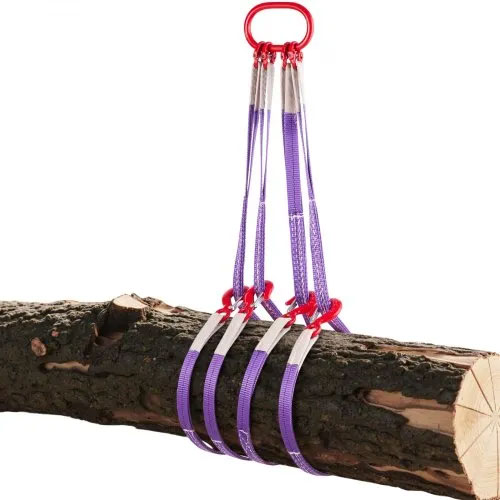
This article is listed under six names — Web Sling Bridle Assembly, Four Leg Bridle Web Sling, 4 Leg sling assembly, Flat Webbing Sling Assembly, Combination flat lifting belt and flat lifting belt complete set of rigging. They describe one article, and the words divide usefully: the first three name the assembly and its leg count, and the last three name what it is made of — flat woven webbing, combined into a set.
What makes this article different from every other sling on this site is that it is not a sling. It is a small system, and a buyer is choosing the whole of it at once. There are four component groups, and each one has its own requirement:
| Component | What it does in the assembly | What is required of it |
|---|---|---|
| Master link or master ring | Takes the whole load from the crane hook and distributes it to every leg | Rated for the total, compatible in material, and of the shape and size that seats properly in the hook (§4) |
| The legs | Share the load between the pick-up points; two, three or four of them | Matched to each other, and rated as an assembly rather than as individuals (§3, §5) |
| The end fittings | Connect each leg to the load, and to the master link at the top | Rated at least equal to the sling, twice the rated load without permanent deformation, no sharp edges (§4) |
| The assembly tag | States what the whole assembly will carry, and in which configuration | Rated load for each type of hitch and the material type — the assembly is marked as a unit (§7) |
The legs themselves are flat woven webbing, which is worth naming because it places the assembly in one of this site's two textile families. The flat woven family is built to EN 1492-1, with stitched eyes and a defined width; the sleeved round form is a different construction under EN 1492-2, documented on the endless round sling page, with the loop-eye variant on the eye type round sling page. A bridle assembly is built from the flat family, and the sewing that forms each leg's eye is part of what the inspection criteria look at (§8).
One practical note before anything else, because it is the reason this page exists. A customer who buys four legs and a master link separately, and assembles them on site, has built something whose capacity nobody has stated. The published guidance is explicit that for configurations not shown, the rated loads are those provided by the sling manufacturer or a qualified person — which is the position a home-made assembly leaves the user in. Ordering the assembly as one article is not a convenience; it is the difference between having a rating and having a guess (§11).
2. The Assembly Has a Rating of Its Own, and It Rests on Six Things
The published tables do not simply list slings and leave the assemblies to arithmetic. Capacities are tabulated for single-leg vertical, choker and basket hitches, and two-leg bridle slings, and the bridle appears as a named configuration with its own columns at its own angles. That is the structural fact that makes a bridle assembly an article rather than a sum: its figure is published as an assembly figure.
The basis of a rated load is set out in the same guidance as six items — material strength, design factor, type of hitch, angle of loading, diameter of curvature over which the sling is used, and fabrication efficiency. Five of those six will be familiar to anyone who has read about slings. The sixth is the one that belongs to assemblies, because it is about how the article was made rather than what it is made of: the quality of the connection between the legs and the master link, and the consistency with which the assembly converts one hook load into several leg loads. Two assemblies can be built from identical webbing and identical fittings and still not be equally efficient. That is why the figure comes from the maker.
| What a rated load rests on | What it means for an assembly |
|---|---|
| Material strength | The webbing of every leg, and it matters that all the legs are the same material (§5) |
| Design factor | The margin between the working load and the break, commonly 7:1 in this family |
| Type of hitch | A bridle is one of the hitch types the tables name, at the assembly level |
| Angle of loading | The horizontal angle between the leg and the horizontal plane; it sets which column applies (§6) |
| Diameter of curvature | How tightly each leg bends — around the master link at the top and around the load fittings at the bottom |
| Fabrication efficiency | How well the assembly as built turns one hook load into several equal leg loads. This is the assembly's own factor, and the reason the maker states the figure |
3. Legs Are Not Additive: Why Four Is Not Four Times One
This is the arithmetic that surprises buyers, and it is worth stating once here plainly. In the published tables, a single leg is tabulated at a vertical angle and the multi-leg families at horizontal angles of 60, 45 and 30 degrees. Read across: a single leg gives 28,300 lb; a triple and quadruple leg bridle at a horizontal angle of 30 degrees gives 42,400 lb. Four legs, at the shallowest angle the standards permit, deliver about one and a half times one leg — not four times.
The reason is that a bridle's legs do not all pull straight up. As the legs open out from the vertical, each one carries its share at an angle, and the horizontal component of each leg's pull works against the others instead of lifting the load. The load path through the assembly is therefore nothing like the sum of its legs, and it is why the tables publish bridle columns at all rather than leaving buyers to multiply.
Two design consequences follow, and they are the reason this section is on a product page rather than a textbook. First, an assembly is designed to the assembly figure — the assembly rating is what must be compared with the load, and the leg ratings are inputs to it, not a substitute for it. Second, the master link must be able to take the total, which is the fitting rule in §4. And the arithmetic of the angle itself — how the figure falls from 60 degrees to 45 to 30, and why the tables stop at 30 — is worked through on the 30 ton flexible lifting belt page, which takes the angle as its own subject and shows the published values side by side.
| Configuration, as the published table prints it | Published figure | What the ratio tells a buyer |
|---|---|---|
| Single leg, vertical | 28,300 lb | The baseline every multi-leg figure is compared against |
| Triple and quadruple leg bridle, horizontal angle 60 degrees | 73,500 lb | About two and a half times one leg — the best case for the family |
| Triple and quadruple leg bridle, horizontal angle 45 degrees | 60,000 lb | Adding legs without holding the angle gives away capacity that was paid for |
| Triple and quadruple leg bridle, horizontal angle 30 degrees | 42,400 lb | Four legs doing the work of one and a half; the tables do not go below this angle |
| Any configuration outside the tables | Use the next lower angle, or a qualified person's calculation | The rule that leaves a home-assembled bridle without a rating at all (§1) |
4. The Master Link and the Fittings: Where an Assembly Is Won or Lost
The published requirement for mechanical fittings used in this family is short and it is doing a lot of work. Fittings must have materials compatible with the mechanical and environmental requirements of the sling; a rated load at least the same as the synthetic webbing sling; sufficient strength to sustain twice the rated load of the sling without visible permanent deformation; and surfaces that are clean, with sharp edges removed.
Read that list with an assembly in mind and it becomes a specification for the master link. The master link carries every leg's load combined, so a fitting whose rating merely equals one leg is not compliant for the assembly — the rating that has to be matched is the assembly's. The twice-the-rated-load requirement is a deformation test rather than a strength test: it exists so that a fitting which has been overloaded bends visibly instead of failing quietly, and a bent master link is a finding rather than a surprise. And the sharp-edge clause is the same one that governs the contact point on the leg — hardware is inside the wear problem, not outside it, which is why the test for when an edge has to be protected is set out on the circular lifting straps page.
One further requirement belongs to the hook rather than the fitting but is checked the same way: the fitting must be the proper shape and size to be seated properly in the hook or lifting device. A master link on a hook that is too small sits on the point instead of in the bowl, and the load arrives at a place the fitting was never designed to take it. It is an assembly-level error with a fitting-level symptom.
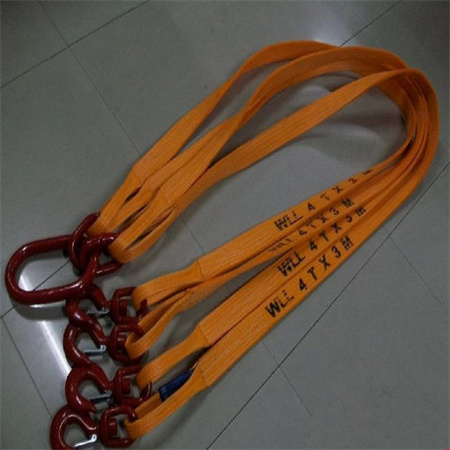
The assembly is a system of four component groups, and the rating belongs to the whole of it: the master link takes the total, the legs share it, the fittings connect it, and the tag states it (§1, §2, §7).
| Requirement | What it says | What it means on a bridle |
|---|---|---|
| Material compatibility | Compatible with the mechanical and environmental requirements of the sling | The fitting is inside the environment, not outside it — caustics in particular (§10) |
| Rated load at least equal to the sling | The fitting may not be the weak link | For the master link this means the assembly's figure, because it takes the total |
| Twice the rated load without visible permanent deformation | A deformation test, not a breaking test | Overload shows as a bend, which inspection can find (§8); a straight link after an incident is no evidence of anything |
| Clean surfaces, sharp edges removed | No edge that could damage the webbing | A burr on any of the six or twelve contact points in the assembly is a cutting site |
| Proper shape and size for the hook | Seated properly in the hook or lifting device | An assembly error that presents as a fitting problem; check the pair, not the part |
5. Legs Must Match, and Nonsymmetrical Loads Need an Analysis
An assembly shares load between its legs on one assumption: that the legs are alike. The published guidance turns that assumption into an instruction for the cases where it fails — for multiple-leg slings used with nonsymmetrical loads, an analysis by a qualified person must be performed to prevent overloading of any leg.
Nonsymmetrical does not mean exotic. It covers the ordinary case of a load whose pick-up points are not equally spaced, or whose centre of gravity sits closer to one leg, or a lift where one leg is shorter than the others because of how it was hitched. In every one of those cases the load no longer divides evenly, one leg takes more than its share, and nothing about the assembly's appearance tells you which one. The published figure assumes a symmetrical arrangement; using an assembly outside that assumption moves the lift into the hands of a qualified person rather than into a table.
Three things make the symmetrical case hold, and all three are properties of how the assembly was supplied rather than how it was used. The legs should be the same length — equal legs mean equal angles, and equal angles are what the tabulated figures rest on. They should be the same material and the same rated webbing, because a mixed set has no single figure and, in an environment, no single set of exclusions. And they should carry matching identification, so that a leg replaced during service is known to match the others rather than assumed to — the identification requirement is set out in §7.
| The assumption | What breaks it | What to do instead |
|---|---|---|
| The load divides evenly between the legs | Pick-up points unevenly spaced, or a centre of gravity off to one side | An analysis by a qualified person to prevent overloading of any leg |
| The legs make equal angles | Legs of different length in one assembly, or one leg hitched shorter | Keep the legs matched, and never adjust a sling by knotting or twisting it |
| Every leg has the same rating | Mixed webbing, or a leg replaced from another set during service | Match material and rating, and verify it from the identification rather than from memory |
| The assembly will be used at the angles the table lists | An angle between the tabulated ones, or outside the range | Use the next lower angle, or the qualified person's calculation (§6) |
| The fitting suits the hook | A master link too large or too small for the hook it will be presented to | Check the pair before the lift; the published requirement is proper shape and size (§4) |
6. The Angle Belongs to the Assembly, Not to the Legs
Because the bridle is tabulated as its own configuration, the horizontal angle is a property of the assembly. It is defined as the angle formed between the inclined leg and the horizontal plane — not the angle between two legs, which is the picture most people have in mind. A leg at 90 degrees to the horizontal is vertical and doing its most useful work; as the angle closes towards 30 degrees the legs pull increasingly against one another.
Two rules follow directly and both are published. Angles not shown in the tables are handled by using the next lower angle, or by a qualified person's calculation — a conservative answer rather than an interpolated one. And horizontal angles below 30 degrees are not to be used except as recommended by the sling manufacturer or a qualified person. That floor is not arbitrary: at 30 degrees the arithmetic has already given away most of the benefit of multiple legs (§3), and below it the arrangement is closer to a tug-of-war than a lift.
There is also a mechanical rule that bites hardest on an assembly, because an assembly has more bends than a single sling: the diameter of curvature over which the sling is used is one of the six things a rated load rests on (§2). Every leg bends around the master link at the top and around its fitting at the bottom, and each of those bends is a point where the load concentrates. This is the mechanism that the contact-point rules on the circular lifting straps page address in full.
| The angle question | The published answer |
|---|---|
| What is the horizontal angle? | The angle formed between the inclined leg and the horizontal plane — not the angle between the legs |
| The lift is at an angle between two tabulated values | Use the next lower angle, or a qualified person's calculation. Do not interpolate a benefit |
| Can the legs be opened out further? | Not below a horizontal angle of 30 degrees, except as recommended by the manufacturer or a qualified person |
| Where does curvature matter on an assembly? | At every bend: around the master link above and around each end fitting below |
| Who decides when the geometry is unusual? | A qualified person, and for configurations not shown the manufacturer's rated loads govern |
7. The Assembly Is Marked as a Unit
A single sling's identification describes one article. An assembly's identification has to describe a relationship, and the published marking rule is built for that: new slings are marked to show the rated load for each type of hitch and the type of synthetic web material, and may additionally show the manufacturer's code or stock number and the manufacturer's name or trademark.
On an assembly, each of those items does more work than it does on a single leg. The rated load for each type of hitch is what tells a rigger how the assembly itself is rated — not what one leg will take. The material type is what decides whether the assembly may be used in the environment it is going into, and it has to be read as applying to every leg. The manufacturer's code or stock number is what makes a matched set traceable, so that a leg returned for replacement can be matched to the others rather than guessed at.
The practical discipline is simple and worth stating: the tag on the assembly governs the lift, and the tags on the legs do not override it. A rigger who reads 5 tonnes on a leg's tag and multiplies by four has done arithmetic the published tables do not authorise (§3). The number that matters is the one on the assembly.
| Marked item | What it settles on an assembly |
|---|---|
| Rated load for each type of hitch | The figure for the whole assembly in the configuration being used — the one number compared with the load |
| Type of synthetic web material | Whether the assembly may be used in the environment, read as applying to every leg (§10) |
| Manufacturer's code or stock number | Traceability, and the ability to match a replacement leg to the set it belongs to (§5) |
| Name or trademark of the manufacturer | Who to ask about the assembly's rating, its repair and its inspection history |
| Identification of a repaired assembly | Who made the repair — required after any repair, and part of the record the proof test sits in (§9) |
8. Inspecting an Assembly: More Parts, More Places to Look
The inspection regime for this family is the one already described elsewhere on this site, and on an assembly it is applied to more components. A qualified person inspects the sling and its attachments each day before use, and periodic inspections are made at intervals no greater than 12 months — yearly for normal service, monthly to quarterly where service is severe, and at a qualified person's recommendation for special or infrequent use.
What changes at the assembly level is the length of the list, because an assembly has more connect points than a sling. The published criteria to look for are missing or illegible sling identification, acid or caustic burns, melting or charring of any part of the sling, holes, tears, cuts or snags, broken or worn stitching in load bearing splices, excessive abrasive wear, knots in any part of the sling, discolouration and brittle or stiff areas, and pitted, corroded, cracked, bent, twisted, gouged or broken fittings. Where any such damage is present, the sling or attachment is removed from service immediately.
Three of those items are worth a sentence on an assembly. Identification comes first, and on an assembly it has to identify the assembly rather than a leg, or the rating cannot be established (§7). Fittings are inspected as part of the sling — the wording covers the attachment as well as the webbing, which on an assembly means the master link and every end fitting, each of them examined for the deformation that the twice-rated-load requirement is designed to produce visibly (§4). And abrasion is judged against excessive rather than present, because a working lift always leaves marks; the criterion is wear that has gone beyond the surface, and the wear resistant flat sling page sets out where a woven sling wears and what retires it.
| Criterion | What it looks like on an assembly | Action |
|---|---|---|
| Missing or illegible identification | The assembly tag is gone or unreadable, so the assembly figure cannot be established | Remove from service; leg tags do not replace the assembly's tag (§7) |
| Broken or worn stitching in load bearing splices | Disturbed thread where a leg's eye is formed — and this family's eyes exist only by stitching | Remove from service; load-bearing splices may not be repaired (§9) |
| Pitted, corroded, cracked, bent, twisted, gouged or broken fittings | Any of it on the master link or an end fitting — including a bend, which is the designed signal of overload | Remove the attachment from service immediately; repairs to fittings have their own requirements (§9) |
| Excessive abrasive wear | Wear past the surface on any leg, most likely where a leg crosses a load edge | Remove from service; check whether the same load will do it again on the replacement |
| Knots in any part of the sling | A knot used to equalise leg lengths, which looks like a solution and is a defect | Remove from service; adjust only by approved methods (§5) |
9. Repair and Proof Test: the Rules an Assembly Must Satisfy Before It Goes Back
An assembly is expensive enough that repair is worth asking about, and the published rules answer clearly. Damaged slings may be used again only after they are repaired, reconditioned and proof tested by the sling manufacturer or a qualified person. The specific prohibitions are that repairs must be performed by the manufacturer or a qualified person; that cracked, broken, melted or damaged webbing material may not be repaired; that load-bearing splices may not be repaired; and that no temporary repairs of webbing or fittings may be made at all. Repaired slings must be marked to identify who made the repair.
Fittings have their own route to compliance: repairs of hooks and fittings must meet the applicable mechanical standards for those components, which is a different discipline from repairing webbing. That split is worth knowing before sending an assembly away, because the answer for a bent master link and the answer for a cut leg are not the same answer.
The proof test is the step most often skipped in practice and the one most clearly specified. Before initial use, all synthetic webbing slings incorporating previously used or welded fittings, and all repaired slings, must be proof tested by the manufacturer or a qualified person. New slings with new fittings need not be proof tested, although an employer may require it in the purchase specification. And there is a record-keeping requirement attached: certificates of proof test are to be retained and made available for examination.
For an assembly this has a specific consequence worth stating plainly. An assembly built up on site from a used master link and new legs falls squarely into the proof-test requirement, and so does any assembly that has been repaired. Where the assembly was supplied complete and new, the proof test is not required — which is a second reason, after the rating itself (§1), for buying the assembly as one article rather than assembling it from parts.
| Situation | The published position |
|---|---|
| Damaged webbing | Cracked, broken, melted or damaged webbing material may not be repaired |
| Stitching in a load-bearing splice | May not be repaired at all; the eye is where the leg's load is transferred |
| A damaged or bent fitting | Repairs of hooks and fittings must meet the applicable component standards, performed by the manufacturer or a qualified person |
| Any temporary repair | Prohibited, on webbing and on fittings alike |
| After a repair, or with previously used or welded fittings | Proof tested by the manufacturer or a qualified person before initial use; the assembly must be marked to show who repaired it |
| The record | Certificates of proof test retained and made available for examination |
10. What an Assembly May Not Do, and What It May Not Meet
Two published prohibitions are worth naming on a bridle page specifically. The first is direct and unusually blunt: do not use synthetic webbing slings as bridles on suspended personnel platforms. Every other rule in this family is about protecting a load and a sling; this one is about people, and it is the only place the word bridle appears in the prohibition list. It is not a capacity question and no rating answers it.
The second is about where the assembly is used rather than what it does. Because the material type governs the environment (§7), the environment has to be checked against every leg and against the fittings. Nylon web slings may not be used where fumes, vapours, sprays, mists or liquids of acids or phenolics are present; polyester and polypropylene web slings may not be used where caustics are present, and web slings with aluminium fittings may not be used where caustics are present either. On an assembly the fitting clause matters as much as the webbing clause, because the master link is a fitting and it sits in the same atmosphere as the legs.
On temperature, the two published sources give figures that differ, and the honest thing is to say so. The regulation for this family sets the limit for polyester and nylon webbing at 180 °F and for polypropylene at 200 °F, while the guidance document for synthetic web slings states 194 °F (90 °C) for nylon and polyester, with a lower bound of minus 40 °F (minus 40 °C). Where two published figures apply to the same article, work to the lower one — and note that the four degrees between them is not the interesting part. The interesting part is that heat, like chemistry and sunlight, degrades a sling without producing the wear an inspector is looking for, so storage matters as much as use: slings are to be stored where they will not be subjected to mechanical, chemical or ultraviolet damage, or to extreme temperatures.
Personnel practice belongs with these rules on a multi-leg assembly, because an assembly puts more legs in more places. Personnel are to be kept away from the areas between the sling and the load and between the sling and the hook; no one is to stand in line with or next to the legs of a sling under tension; and no one is to stand or pass under a suspended load.
11. Ordering an Assembly as One Article
The enquiry for a bridle assembly is a short specification, and every line in it exists because it changes either what is supplied or whether the assembly can be used. The list below is the one worth working through before the enquiry goes out; it is deliberately written in the order that the decisions depend on each other.
Start with the load and its pick-up points: how heavy, how many points, and whether they are symmetrical. The symmetry answer decides whether a tabulated figure applies at all, or whether the lift needs a qualified person's analysis (§5). Then the horizontal angle the legs will make in service, because that is what selects the column of the table the assembly will be rated against (§6) and it is the figure most often left out of an enquiry. Then how many legs, remembering that the fourth leg buys less than the third (§3). Then the length of the legs, which must match each other. Then the master link and the end fitting types, including the hook they will be presented to, since the fitting has to seat properly in it (§4). Then the environment — chemistry, temperature and sunlight — which selects the material for the webbing and the fitting alike (§10). And finally the documentation and marking your site has to hold: the rated load for each type of hitch, the material type, the manufacturer's code, and the proof test certificate where the assembly includes previously used or welded fittings or has been repaired (§7, §9).
| What to state | What it decides |
|---|---|
| Load weight, number of pick-up points, and whether they are symmetrical | Whether a tabulated bridle figure applies, or whether the lift needs an analysis by a qualified person (§5) |
| The horizontal angle in service | Which column of the tables the assembly is rated against, and whether the 30 degree floor is respected (§6) |
| Leg count | The assembly figure, which is not proportional to the count (§3) |
| Leg length, and whether the legs must be matched as a set | Equal angles, which is the assumption the tabulated figures rest on (§5) |
| Master link and end fitting types, and the hook they meet | Whether the fittings match the assembly rating and seat properly in the lifting device (§4) |
| Chemistry, temperature and sunlight | The webbing material and the fitting material, and whether either is excluded outright (§10) |
| Marking and documents your site must hold | The tag content, the assembly's traceable code, and whether a proof test certificate is required (§7, §9) |
12. Frequently Asked Questions
Q1: What exactly is a web sling bridle assembly?
Q2: If I buy four legs of five tonnes each, do I have a twenty tonne assembly?
Q3: What is a rated load based on?
Q4: How strong does the master link have to be?
Q5: Why is the twice-the-rated-load requirement described as a deformation test?
Q6: My pick-up points are not evenly spaced. What changes?
Q7: What is the horizontal angle, and what is the limit?
Q8: What has to be marked on the assembly?
Q9: Can a damaged assembly be repaired and returned to service?
Q10: Is there anything a webbing bridle specifically may not be used for?
Contact
Send the load, the number of pick-up points, whether they are symmetrical, and the horizontal angle the legs will make — and we will come back with the assembly, the master link, the legs and the marking that has to travel with it.
Telephone and WeChat — 18066002268
E-mail — 702461526@qq.com
Address — Lifute Industrial Park, Taizhou City, Jiangsu Province, China
- Previous:Circular flat lifting belt, circular flat sling, circular flat lifting belt, circular flat lifting rope
- Next:Wear resistant flat lifting belt sling
-
Drone Anti-collision Net
-
Extra Large Capacity Cargo Net
-
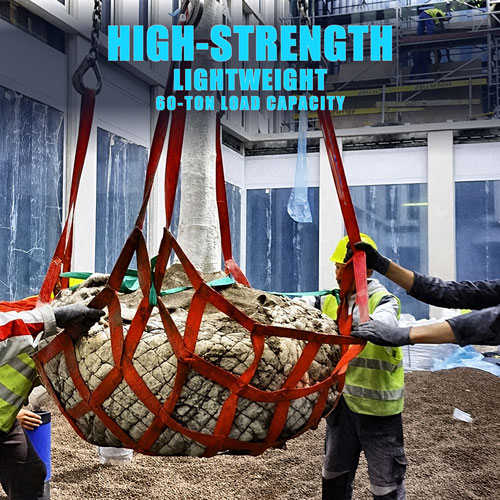
Cargo Webbing Net
-

Color changing nylon double buckle loop nylon braided rope
-

Two end buckle lifting rope, double buckle round lifting rope, double fork nylon lifting rope, non jointed nylon lifting rope
-

Emergency escape lifeline, fire escape rope, fire safety escape emergency rope, steel wire core fire rope

