Language
 简体中文

- On the 2018 National Day holiday, Lifet completed six 100 ton large tonnage lifting belts as a gift
- The role of suspension net in the transportation of goods turnover
- Cargo soft lifting net, lifting net, lifting net, lifting net, bag, climbing net
- Precautions for using Lifutiden elevator
- How to make circular lifting straps
Contact: Wang Lili
E-mail:18066002268
Phone:702461526@qq.com
Address: Lifute Industrial Park, Taizhou City, Jiangsu Province
Lifute Hoisting Co., Ltd. 18066002268 produces lifting belts, lifting nets, nylon ropes, soft ladders, steel wire rope rigging, paper ropes, safety belts, safety nets, lifting chains, steel coil hoists, crossbeam hoists, flat lifting belts, circular lifting belts, electric traction ropes, high-altitude safety belts, and anti fall safety nets
Hits: ℃
Release time:2026-09-23 09:29
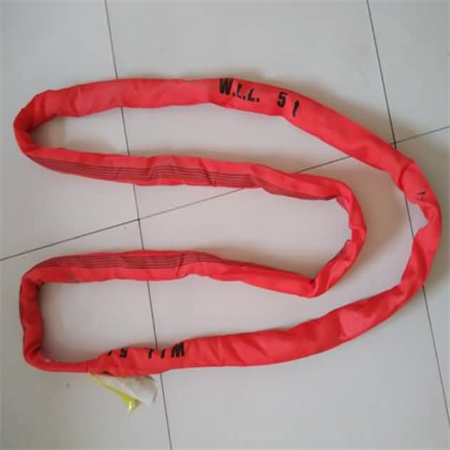
Lift Sling Rigging Co., Ltd manufa cture Circular lifting belt, flexible sling, flexible circular lifting belt.
Circular lifting belt — Three Words, One Article, and the Sheet Behind Them
Two things are worth knowing before the sheet on this page is used. The first is that the three words in the name are not synonyms: a sling is an assembly that connects a load to the handling equipment, a lashing restrains a load in tension, and a belt is a form word that says nothing about either - and a buyer who orders one and receives another has bought the wrong duty, not the wrong article. The second is that the sheet's last two columns are a purchase decision rather than a description: the same capacity is offered at a 6 to 1 and a 7 to 1 safety factor, and the article is heavier at the higher one. HS code 630790; telephone 18066002268.
1. Belt, Sling and Lashing: Three Words, Only One of Them a Lifting Device
The trade uses the three words as though they were interchangeable, and they are not. The difference is not stylistic: it decides which duty the article has been rated for, which standard it was made against, and what it may lawfully be used for.
| The word | What it describes | What it is rated for | What it must not be used for |
|---|---|---|---|
| Sling | An assembly that connects the load to the handling equipment | A rated capacity for each type of hitch, marked on the article | Anything beyond the rated capacity, or a hitch or angle it was not rated for |
| Lashing | An article that restrains a load in tension, holding it down or together | A lashing capacity in tension, for restraint | Suspending a load: a lashing is not a lifting device, whatever it looks like |
| Belt | A woven band, a form word | Nothing by itself: the rating depends on what it was made and marked as | Being used for any duty until its marking says which one it was rated for |
The practical consequence is short. A woven band is only a sling once it has been made and marked as one, and the label is where that is decided. Slings without affixed and legible identification are not to be used at all - so an article whose marking cannot be read is not a belt that might be a sling, it is an article that may not be used.
2. The Specification Sheet on This Page, Column by Column
极限工作力 | 厚度 | 近似宽度 | 长度 | 近似重量(kh/m) | ||
最小长度 | 最大长度 | 6;1 | 7:1 | |||
1t | 6mm | 40mm | 0.5m | 80m | 0.30 | 0.35 |
2t | 7mm | 50mm | 0.5m | 80m | 0.44 | 0.52 |
3t | 8mm | 60mm | 0.5m | 80m | 0.65 | 0.74 |
4t | 9mm | 70mm | 0.5m | 80m | 0.83 | 0.91 |
5t | 11mm | 75mm | 0.5m | 80m | 1.01 | 1.29 |
6t | 12mm | 80mm | 1.0m | 80m | 1.19 | 1.39 |
8t | 13mm | 90mm | 1.0m | 80m | 1.50 | 1.75 |
10t | 15mm | 100mm | 2.0m | 80m | 1.95 | 2.28 |
12t | 16mm | 110mm | 2.0m | 80m | 2.46 | 2.87 |
| 15t | 18mm | 125mm | 2.0m | 80m | 2.97 | 3.47 |
| 20t | 20mm | 150mm | 2.5m | 80m | 4.66 | 5.44 |
| 25t | 24mm | 180mm | 2.5m | 80m | 5.84 | 6.82 |
| 30t | 32mm | 200mm | 2.5m | 80m | 9.23 | 10.8 |
| 40t | 40mm | 200mm | 2.5m | 80m | 12.1 | 14.2 |
| 50t | 45mm | 220mm | 2.5m | 80m | 14.1 | 16.3 |
| 60t | 65mm | 240mm | 4.0m | 80m | 17.3 | 20.2 |
| 80t | 70mm | 260mm | 4.0m | 80m | 22.2 | 25.9 |
| 100t | 80mm | 290mm | 4.0m | 80m | 26.0 | 30.3 |
| 200t | 120mm | 450mm | 5.0m | 80m | 64.0 | 74.6 |
| 300t | 160mm | 525mm | 5.0m | 80m | 79.0 | 92.2 |
| 400t | 200mm | 670mm | 5.0m | 80m | 98.4 | 114.8 |
| 500t | 220mm | 750mm | 8.0m | 80m | 121.2 | 141.4 |
| 600t | 240mm | 820mm | 8.0m | 80m | 145.0 | 169.2 |
| 700t | 260mm | 870mm | 8.0m | 80m | 168.0 | 196.0 |
| 800t | 280mm | 930mm | 9.0m | 80m | 192.0 | 224.0 |
| 900t | 300mm | 990mm | 9.0m | 80m | 215.0 | 250.1 |
1000t | 320mm | 1050mm | 9.0m | 80m | 238.0 | 277.7 |
The sheet is the factory's own, and it is arranged by capacity rather than by size: every row is one working load limit, from 1 tonne to 1000 tonnes, and the rest of the row describes the article that reaches it. The headings are bilingual on the original sheet; the table below gives them in English and says how each one is used.
| Column | What it is | How to use it |
|---|---|---|
| Working load limit | The rated load of the row, in tonnes | The figure the lift is planned from, for the vertical case; for a hitch or an angle, the figure comes from the configuration, not from this column alone |
| Thickness | The thickness of the article, in millimetres | Decides how the article sits on a small radius and how much room it takes in the store |
| Approximate width | The width of the article, in millimetres | Decides the contact with the load, and whether the article fits the hardware it must pass through |
| Minimum length | The shortest length the article is made in for that capacity, in metres | A real constraint: the heavy rows start at several metres and cannot be ordered shorter |
| Maximum length | The longest length offered, in metres | Sets the limit for long lifts and for wrapping large loads |
| Mass per metre at 6 to 1 | The mass of the article per metre at a safety factor of six to one, in kilograms | The lighter of the two articles at the same capacity |
| Mass per metre at 7 to 1 | The mass of the article per metre at a safety factor of seven to one, in kilograms | The heavier of the two articles at the same capacity: this is what the higher factor costs |
3. The Last Two Columns Are a Purchase Decision, Not a Description
Most columns on a specification sheet describe the article. The last two describe a choice, because they are the same capacity offered at two safety factors, and the article is heavier at the higher one. A buyer who reads only the capacity column has not yet chosen the article.
| The capacity | Mass at 6 to 1 (kg/m) | Mass at 7 to 1 (kg/m) | What the difference is |
|---|---|---|---|
| 1 tonne | 0.30 | 0.35 | The lighter article, for handling that does not have to be bought at the higher factor |
| 5 tonnes | 1.01 | 1.29 | The difference widens as the construction changes, which is why the sheet prints both |
| 100 tonnes | 26.0 | 30.3 | At the heavy end the same capacity in the higher factor is a materially heavier article |
| 1000 tonnes | 238.0 | 277.7 | The heaviest row on the sheet, and the clearest illustration of the trade |
Two things follow, and both are matters of fact rather than preference. The higher factor buys a larger margin between the working load limit and the load at which the article fails, which is the reason a market or a customer asks for it. And it is paid for in mass, which is paid for again in handling, storage and the effort of dressing the article round the load. The margin is not free and it is not a substitute for the lift being right: the figure still has to be read for the hitch and the angle in use.
4. What the Sheet Says About the Circular and Flexible Forms
Reading the sheet as a whole tells a buyer three things about the form that the word in the name does not.
| What the sheet shows | Where it is visible | Why it matters before ordering |
|---|---|---|
| Size grows with capacity, and not in a straight line | Thickness from 6 mm at 1 tonne to 320 mm at 1000 tonnes; width from 40 mm to 1050 mm | The article at the top of the sheet is not the article at the bottom scaled up: it is a different article to handle, store and inspect |
| The shortest article grows with capacity as well | Minimum length from 0.5 m at 1 tonne to 9 m at 1000 tonnes | A heavy capacity cannot be bought short. A lift that needs a short sling at a high figure is a different conversation, not a different row |
| The longest article does not grow with capacity | Maximum length is 80 m across the sheet | Long lifts are a length question that the capacity does not answer, and the answer has to come from us |
5. Where This Form Sits in the Family
Three words in one name, and the site carries a page for each of the neighbouring forms. The detail is on those pages; what belongs here is the map, so that the right page is read next rather than all of them.
| The article | What decides it | Where the detail is written |
|---|---|---|
| A circular flexible sling in the general form | The sheet on this page | This page |
| A circular belt chosen for its conformity | How the article meets a load, and why conformity is not stretch | The circular circular lifting belt page |
| A circular lifting strap at high capacity | How the article is received, identified and stored | The large tonnage circular lifting belt page |
| A round sling, in the sleeved loop form | What the class is for, and where it ends its life | The class page, heavy duty round sling |
| A cylindrical article | The tube, the core it hides and the ends it needs | The cylindrical sling page |
| A high performance fibre article | What the fibre decides, and what it does not | The DuPont flexible sling page |
6. Reading the Label, and Telling a Sling From a Lashing
The label answers the question the words do not, and it does so in a fixed way: a sling is marked or coded to show the rated capacities for each type of hitch and the type of synthetic web material, and slings without affixed and legible identification are not to be used. A lashing is marked for restraint, with its own rating for tension. An article whose marking shows no hitch columns is not being sold as a sling.
| What the marking shows | What the article is | What follows for the buyer |
|---|---|---|
| Rated capacities for each type of hitch, and the material | A sling | It may be used for lifting, within those figures and for the hitches they cover |
| A rating expressed for tension or restraint only | A lashing | It may not be used for lifting, however strong the band appears to be |
| No legible marking, or a marking that has become unreadable | Nothing usable | It is not to be used at all, and it cannot be returned to service by re-labelling on site |
| A capacity with no material and no hitch columns | An incomplete marking | It cannot be checked against the figures, so it cannot be planned from |
7. Inspection, and What Ends the Article's Service
The schedule is the same as for any synthetic sling: each day before use, periodic inspections at intervals no greater than twelve months, and additional inspections where service conditions warrant, judged on the frequency of use, the severity of the service, the nature of the lifts and the experience of the service life. The conditions that remove a sling from service immediately include acid or caustic burns, melting or charring, snags, punctures, tears or cuts, broken or worn stitching and distortion of fittings. A repair, where one is allowed, is a manufacturer's repair followed by a proof test to twice the rated capacity, with the repair marked and the certificate retained; load-bearing splices are not repaired and temporary repairs are prohibited. The class page sets out where that leaves this family against the chain family, which can be repaired and re-tested where a synthetic article is retired.
8. What the Enquiry Has to Carry
| Line | What to state | What it fixes |
|---|---|---|
| 1 | What the article is for: lifting, or restraint | Whether a sling or a lashing is being bought, which is the one question the words do not settle |
| 2 | The figure you need, in the way you will lift, per hitch and per angle | The row of the sheet, and the column the figure is read from |
| 3 | The safety factor you want: six to one or seven to one | Which of the two mass columns applies, and what the article will weigh |
| 4 | The length, within the minimum and maximum of the row | Whether the article can be made at all at that capacity and length |
| 5 | The width and thickness the lift can accommodate | Contact with the load, and whether the article passes through the hardware |
| 6 | The duty and the documents: temperature, chemicals, marking, test and certificate | The material, the protection, and what arrives with the article |
9. Frequently Asked Questions
Q1: Is a circular lifting belt the same as a sling?
Q2: Can a lashing belt be used for lifting?
Q3: What do the 6 to 1 and 7 to 1 columns mean?
Q4: Which factor should I order?
Q5: Why does the sheet print a minimum length?
Q6: Why is the maximum length the same for every capacity?
Q7: What must be on the article?
Q8: What is the difference between flexible and stretchy?
Q9: How often is the article inspected?
Q10: Can the article be made outside the sheet?
Contact
Send the eight lines in section 8. The first line matters most: say whether the article is for lifting or for restraint, because everything else follows from that answer. Articles are batch tested, marked per hitch and supplied with a certificate that names the article.
Telephone and WeChat — 18066002268
E-mail — 702461526@qq.com
Address — Lifute Industrial Park, Taizhou City, Jiangsu Province, China
- Previous:Ring buckle circular lifting belt, double buckle circular lifting belt, ring eye circular lifting belt
- Next:Large tonnage circular lifting belt, large tonnage flexible