 Language
 简体中文

- On the 2018 National Day holiday, Lifet completed six 100 ton large tonnage lifting belts as a gift
- The role of suspension net in the transportation of goods turnover
- Cargo soft lifting net, lifting net, lifting net, lifting net, bag, climbing net
- Precautions for using Lifutiden elevator
- How to make circular lifting straps
Contact: Wang Lili
E-mail:18066002268
Phone:702461526@qq.com
Address: Lifute Industrial Park, Taizhou City, Jiangsu Province
Lifute Hoisting Co., Ltd. 18066002268 produces lifting belts, lifting nets, nylon ropes, soft ladders, steel wire rope rigging, paper ropes, safety belts, safety nets, lifting chains, steel coil hoists, crossbeam hoists, flat lifting belts, circular lifting belts, electric traction ropes, high-altitude safety belts, and anti fall safety nets
Hits: ℃
Release time:2026-09-23 09:09
Lift Sling Rigging Co., Ltd manufacture 30 ton flexible lifting belt, 30 ton flexible sling, and 30 ton circular lifting belt。
30 Ton Flexible Lifting Belt — the Line at Ten Tonnes, and What a Tonnage Figure Does Not Tell You
1. Three Names, One Figure: What Thirty Tonnes Means on This Page
This article is listed under three names: 30 ton flexible lifting belt, 30 ton flexible sling, and 30 ton circular lifting belt. They describe one product. Flexible and circular describe its form — a closed sleeved loop with no ends and no sewn splice in the load path, which is why it conforms to a load instead of denting it, and which is why the loop form itself is documented elsewhere on this site rather than repeated here: the endless round sling page owns the closed loop and its hitches, and the eye type round sling page owns the variant with loop eyes built up at the ends.
What is left is the figure. Thirty tonnes is not one number on this article; it is one number in one configuration, and this page exists because that sentence is the one buyers most often have to be told twice. A tonnage figure answers a single question — how much this belt will carry straight up, on its own — and leaves three others open: what happens when it is not alone, what happens when the legs are not vertical, and how anyone is supposed to confirm the figure on a sleeve when the colour code has run out.
The third of those is the subject of the next two sections, and it is genuinely awkward in this band. A ten tonne belt and a thirty tonne belt carry the same colour (§2). That is not a fault in the standard — the code was designed to make the common sizes readable at a glance, and it groups everything from ten tonnes upward into one colour deliberately. But it does mean that in the band this page covers, from ten tonnes to the largest size published, the colour tells you the least and the label tells you the most, and a buyer who selects by colour alone is selecting by a signal that has stopped carrying information.
2. The Line at Ten Tonnes: Where the Colour Code Stops Giving an Answer
The roundsling colour code is a European convention with one colour per capacity step, and it is worth setting out in full for the same reason as before: it is usually quoted as a list of colours with the capacities left off, which makes it decorative rather than useful.
| Sleeve colour | Capacity the colour denotes | What it means at thirty tonnes |
|---|---|---|
| Violet | 1 tonne | Far below this band |
| Green | 2 tonnes | Far below this band |
| Yellow | 3 tonnes | Far below this band |
| Grey | 4 tonnes | Far below this band |
| Red | 5 tonnes | The common single-leg size; well below this band |
| Brown | 6 tonnes | Below this band |
| Blue | 8 tonnes | The last step before the code stops being informative |
| Orange | 10 tonnes and up | This is the colour of a thirty tonne belt — and of every size above it, including the largest this site builds |
Two consequences follow directly, and both matter more in this band than anywhere else. Above ten tonnes the colour has become a class, not a value. Orange tells a rigger that the belt is at least a ten tonne article and that the label must be read before the lift; it cannot distinguish ten from thirty, and it cannot distinguish thirty from three hundred. Everything this site builds above the ten tonne line — this page's article, the WLL 400 Ton Heavy Duty Endless Polyester Round Sling, the WLL 100T Heavy Duty Round Slings With Eyes, and the 300 ton page article — carries the same orange.
And the colour says nothing about the material, the length or the environment, which is true at every size but becomes expensive at this size. A thirty tonne belt is selected once and used for years; the decision that matters is not which colour arrives, it is what the label and the documents say it will carry and in what configuration (§10, §11).
3. Beyond the Colour: the Black Stripe, and Why It Stops at Twelve Tonnes
There is a second marking convention in this family, and it is the one that explains most of the confusion above ten tonnes. Some manufacturers weave black longitudinal stripes into the webbing, one stripe for every tonne of working load limit — a twelve tonne belt carrying twelve stripes. It is a genuinely useful convention, and it is not part of the European standard; it is a manufacturer's practice, which is why it cannot be relied on as a specification and why this site does not use it here.
The detail that matters for a thirty tonne page is the ceiling on it: slings with a working load limit of twelve tonnes and above have no black stripes at all. So the stripe convention runs out roughly where this page's band begins — a fifty tonne belt has no stripes in the same way that it has no distinct colour. Both of the quick visual indicators that work well on a five tonne belt have stopped working by the time a belt is rated at thirty.
What is left is the label, and the label is not an afterthought on a heavy-duty sling. Textile slings in this family carry a sewn label holding the manufacturer's identification, the year of manufacture, the material, the effective working length, a serial number, the number of the European standard, and the working load limit — and because a sewn label is exactly the kind of thing that gets destroyed on site, a duplicate of that information is stitched under the cover overlap as a reference copy. That second copy is the reason a heavy belt keeps its identity after the visible label has been abraded away, and it is worth knowing it is there before writing a sling off as unidentifiable.
| Way of showing capacity | Where it stops working | Status |
|---|---|---|
| Sleeve colour | Above ten tonnes the colour is a class, not a value | Defined by the European standard for this family |
| Black stripes, one per tonne | Twelve tonnes and above carry no stripes at all | A manufacturer's practice, explicitly not part of the standard |
| The sewn label | Never — it is the definitive record at every size | Carries the identification, year, material, length, serial number, standard and limit |
| The duplicate label under the cover | Never — it is the reason the belt keeps its identity | Stitched under the cover overlap as a reference copy |
4. How Thirty Tonnes Is Actually Asked For: Single Leg, Double Leg, and the Horizontal Angle
The published rated-load tables for slings are not one column of numbers. They are three families of columns, and the difference between them is the difference between a correctly specified thirty tonne lift and one that only looks correct on paper. The three families are single leg slings; double leg bridle slings and single basket slings; and triple and quadruple leg bridle slings and double basket slings. The first is tabulated at a vertical angle, and the other two are tabulated at horizontal angles of 60, 45 and 30 degrees.
The horizontal angle is not the angle most people picture. It is the angle formed between the inclined leg and the horizontal plane, which is why the numbers in the tables fall as the angle gets smaller: at a horizontal angle of 90 degrees a leg is vertical and doing its most useful work, and as the angle closes towards 30 degrees the legs are increasingly pulling sideways against each other instead of lifting.
That single definition reorganises how an enquiry should be written. When a customer says they need a 30 ton flexible lifting belt, the useful question is not what the load weighs — it is what the belt is doing in the lift plan. A thirty tonne belt used alone, straight up, is working exactly as the label describes. The same belt used in a two-leg set at a narrow horizontal angle is working in a configuration the tables state separately, and the figure that applies is the one in that column, not the one in its own title.
| Column family in the published tables | Tabulated at | Why a thirty tonne enquiry has to say which one |
|---|---|---|
| Single leg slings | A vertical angle of 90 degrees | This is the configuration the figure in the product name describes, and the only one it describes |
| Double leg bridle slings and single basket slings | Horizontal angles of 60, 45 and 30 degrees | A two-leg set is a different configuration with its own figures, and they change with the angle |
| Triple and quadruple leg bridle slings and double basket slings | Horizontal angles of 60, 45 and 30 degrees | A four-leg set is not four times a single leg, and it is not four times a two-leg set either |
| Choker hitches | Tabulated separately, for angles of choke greater than 120 degrees | A tighter choke is outside the table and needs a reduced figure or a qualified person's calculation |
One rule in this area is not a matter of reading a table: horizontal angles below 30 degrees are not to be used except as recommended by the manufacturer or a qualified person. The reason is visible in the arithmetic below. There is a point at which adding legs stops adding capacity, and the published tables simply stop before that point rather than tabulating it.
5. The Arithmetic of the Angle: Why Two Legs at Thirty Degrees Is Not Twice One Leg
The shape of this arithmetic is worth seeing once, because it is counter-intuitive the first time and obvious afterwards. The published tables tabulate a single leg at 90 degrees and then the multi-leg families at 60, 45 and 30 degrees, and if you read down one column family the pattern is unmistakable. Taking the published values for one Grade 80 chain size as it stands in the table, the double leg bridle column runs 49,000 lb at 60 degrees, 40,000 lb at 45 degrees, and 28,300 lb at 30 degrees — and the single leg value for the same size is 28,300 lb. At a horizontal angle of 30 degrees, a two-leg arrangement has been reduced all the way back to exactly the single-leg figure.
That is the whole lesson of the angle in one line: opening the legs outwards spends the capacity the second leg was supposed to add. Four legs do not escape it either. In the same table, the triple and quadruple leg column runs 73,500 lb at 60 degrees, 60,000 lb at 45 degrees, and 42,400 lb at 30 degrees — so even the four-leg family, which starts far above the single leg, gives away roughly forty per cent of its figure between a horizontal angle of 60 degrees and one of 30.
| Configuration | Horizontal angle | Published figure, as printed |
|---|---|---|
| Single leg | Vertical, 90 degrees | 28,300 lb |
| Double leg bridle or single basket | 60 degrees | 49,000 lb |
| Double leg bridle or single basket | 45 degrees | 40,000 lb |
| Double leg bridle or single basket | 30 degrees | 28,300 lb — back to the single leg figure |
| Triple and quadruple leg bridle or double basket | 60 degrees | 73,500 lb |
| Triple and quadruple leg bridle or double basket | 45 degrees | 60,000 lb |
| Triple and quadruple leg bridle or double basket | 30 degrees | 42,400 lb |
Two practical conclusions, and they are the reason this page spends a section on arithmetic rather than on tonnage. First, a thirty tonne belt in a two-leg set at a narrow angle is not a sixty tonne arrangement; the figure has to come from the column for that configuration, and at the extreme the second leg is adding nothing at all. Second, the cheapest way to recover capacity is to close the angle, not to buy a bigger belt. If a thirty tonne duty is marginal in a two-leg set, a lift plan with a steeper horizontal angle may resolve it without changing the article — and that is a rigging decision, not a purchasing one.
The figures above are printed as the published table prints them, for one alloy chain size, and they are quoted here for the shape of the arithmetic rather than as values for a textile sling. The rated-load tables for this family are tabulated in exactly the same three column families at the same three angles, which is why the same two conclusions carry across.
6. The Ladder Above Ten Tonnes: What Changes as the Figure Rises
Once the colour has stopped distinguishing capacity, the questions that decide an order change with it. This is the part of the buying conversation that a colour-based spec skips entirely, and it is worth setting out as a ladder of thresholds rather than a price list, because the thresholds are what the buyer has to check at each step.
| Threshold | What has changed in the way capacity is expressed | What has to be checked instead |
|---|---|---|
| Up to 8 tonnes | Colour distinguishes capacity step by step | The colour is a usable field check; the label still governs |
| 10 tonnes | Orange begins, and it marks a whole class rather than a step | Read the label before the lift, every time — the colour no longer separates sizes |
| 12 tonnes | The black stripe convention ends; at twelve tonnes and above there are none | Both quick visual indicators are gone; the sewn label and its duplicate under the cover carry the record |
| 30 tonnes — this page's article | Nothing marks the size on the outside at all; the figure exists only in the identification | The configuration questions of §4 and §5, the self-weight and handling of §7, and the documents of §11 |
| Above the published tables | The figure stops being a catalogue line and becomes a contract item | Test, factor and marking agreed in writing; the 300 ton page covers that case |
The pattern is consistent: every step up the ladder moves information off the outside of the article and onto its paperwork. A five tonne belt announces itself. A thirty tonne belt has to be known.
That is also why this article's own description is careful about what the number means. A 30 ton flexible lifting belt is a thirty tonne article in the straight vertical configuration of §4, and the protection its sleeve provides against the load is a separate subject, worked through on the circular lifting straps page — where the question of when an edge counts as sharp, and what a sleeve does and does not change, is set out in full.
7. The Part of a Thirty Tonne Article Nobody Mentions: Handling It
Every question on this page up to now has been about what the belt will carry. There is a second set of questions about what it takes to put it there, and at thirty tonnes they stop being trivial. A heavy-duty textile sling is not a scaled-up five tonne sling that a rigger picks up one-handed; it is an article whose mass and bulk rise with its rating, and the published rules that govern how it may be moved are stricter than most people expect — not because the article is delicate, but because the cover and the core beneath it are the load path, and dragging is a cutting action.
The handling rules of this family are unusually specific, and they apply to a thirty tonne belt exactly as they apply to a small one. A sling is not to be dragged across the floor or over an abrasive surfaces. Loads are not to be rested on the sling, and a sling is not to be pulled from under a load that is resting on it. Shock loading is prohibited outright. Twisting and kinking are to be avoided, and a sling must not be constricted, bunched or pinched by the load, the hook or any fitting. None of these are courtesies — each of them converts a load the article is rated for into one it is not.
Two of them deserve a sentence at this size. Resting a load on the sling is the failure that heavy lifts invite, because a thirty tonne load is not quickly moved aside and the belt is the nearest thing to hand to set it down on. And pulling a sling out from under a resting load is the failure that follows from the first, because the belt looks like the easiest thing to recover. Both are prohibited, and at this size both cause damage that the daily inspection is designed to find (§9).
| Practice | The published requirement | Why it bites harder at thirty tonnes |
|---|---|---|
| Moving the sling itself | Do not drag slings on the floor or over abrasive surfaces | A large belt is heavy enough that dragging is the default way to move it, and the contact area is large |
| Setting the load down | Do not rest loads on the sling | Heavy loads stay where they are put, so the sling ends up trapped underneath |
| Recovering the sling | Do not pull a sling from under a load when the load is resting on the sling | The temptation grows with the difficulty of lifting the load again; the pulling force is applied directly to the cover |
| Starting the lift | Do not allow shock loading | Slack taken up suddenly multiplies the load; the larger the inertia, the larger the multiplication |
| Adjusting the rig | Never shorten or lengthen by knotting or twisting; avoid twisting and kinking | A knot in the body is a removal criterion, and a large belt is where improvised adjustment is most tempting |
| Passing the sling under a load | Do not let the sling be constricted, bunched or pinched by load, hook or fitting | Pinching concentrates the load into part of the cross-section, which is the opposite of what the core is laid out to do |
The practical answer is not a longer list of prohibitions but a shorter one: plan where the belt will be before the lift starts, and give it somewhere to go that is not under the load. This is also the point at which a fitted protective sleeve earns its keep, because a sleeve that is part of the article travels with it and cannot be left behind on the workshop floor; the three families of protection, and the difference between protection that belongs to the load and protection that belongs to the sling, are set out on the circular lifting straps page, and the protection article itself is listed separately as Wear Protection lifting sling.
8. The Sleeve at Thirty Tonnes: from Carrier of the Colour to Contact Surface
As the figure rises, the sleeve's role changes emphasis. On a small sling it is mostly a carrier of information: the colour is the field check, and the sleeve's other job is quiet. On a thirty tonne article the colour has stopped distinguishing sizes (§2), so the sleeve's remaining job is the one it shares with every size in the family — it takes the contact with the load so that the core does not have to.
The construction is described on this site in its own words. The production article states that the article mainly consists of a load-bearing core and a sling protective cover, that the load-bearing core is arranged in a stepless and parallel manner, and that the protective sleeve is connected in a ring shape by a specially designed wear-resistant sleeve to warn and protect the safe use of the load-bearing core. The company's technical note on its circular lifting rope adds that the article is made by a fully woven process, so that the entire lifting rope cannot be found to have a single joint, and that the main load-bearing body is a complete loop through body. Read as a construction statement rather than a guarantee: it describes the load path, which is why there is no sewn splice to fail in the load-bearing core of this family, and why these articles sit under EN 1492-2 rather than the flat woven standard EN 1492-1.
Two consequences in this band are worth spelling out. First, the sleeve is a consumable, and at heavy duty it is consumable at a price where renewal is obviously cheaper than replacement — a worn sleeve is the article protecting itself successfully, not a defect. Second, in a chemically active environment the cover is to be the same yarn as the load-bearing core. That rule exists so that the sleeve works as a witness: if cover and core are the same material, then a chemical exposure the sleeve survives is one the core survives too. Where they differ, a sleeve can come through intact while the core inside has already lost strength and nobody can tell.
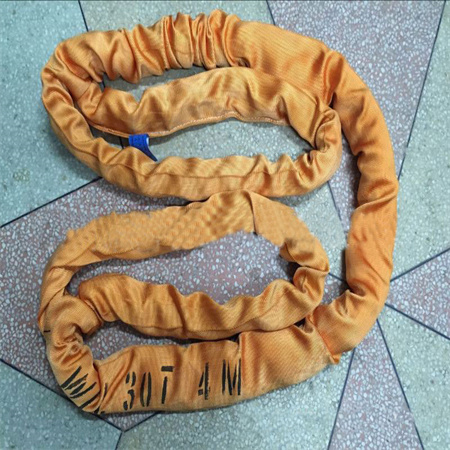
At thirty tonnes the sleeve stops being a colour chart and becomes the working surface: it takes the contact with the load, and it is the only external evidence of a load path that cannot be examined (§8).
| The sleeve's job | On a small sling | At thirty tonnes |
|---|---|---|
| Carries the identification | Colour states the capacity step directly | Colour says only that the article is ten tonnes or more; the label carries the actual figure (§10) |
| Takes the contact with the load | Useful; the accidental edge protection of a normal lift | The working surface; on heavy loads the contact pressure is the design case, and thicker protection raises the effective radius |
| Witnesses the core's condition | Rarely decisive | The only external evidence of a load path that cannot be examined; it is why the cover and core materials should match in chemical service |
| Can be renewed independently | A minor saving | A significant one, and the reason sleeve wear should be tracked rather than tolerated indefinitely |
9. Inspection and Retirement at This Size: the Same Rules, Higher Stakes
The inspection regime for this family does not loosen with capacity; the article is checked each day before use, and a further periodic inspection is made at intervals no greater than 12 months — yearly for normal service, monthly to quarterly where service is severe, and at a qualified person's recommendation for special or infrequent use. What changes at thirty tonnes is what a failure costs, and therefore how carefully the two lists in this section are read.
The first list is what to look for. It opens with missing or illegible sling identification, which at this size is the item that quietly takes the largest belts out of service, because the capacity cannot be established and the article cannot be used whatever its physical condition. It continues with acid or caustic burns, evidence of heat damage, holes, tears, cuts, abrasive wear or snags that expose the core yarn, broken or damaged core yarns, welding splatter that exposes core yarns, knots in the round sling body — except for core yarn knots inside the cover — discolouration and brittle or stiff areas on any part of the sling, and pitted, corroded, cracked, bent, twisted, gouged or broken fittings. Where any such damage is present, the article is removed from service immediately.
The second list is what may not be done to a damaged one. Temporary repairs of round slings and fittings are prohibited; melted or damaged internal yarns may not be repaired; cracked, broken, melted or damaged fittings may not be repaired; and any repair that is carried out must be made by the manufacturer or a qualified person and marked to identify who did it. At thirty tonnes that prohibition is worth more than it looks, because the commercial temptation to repair rather than replace scales with the price of the article — and the rule does not.
| Finding | What it means | Action |
|---|---|---|
| Identification missing or illegible | The capacity cannot be established, so the article cannot be used | Withdraw from service; check the duplicate label under the cover before writing the article off (§3) |
| Wear, cuts or snags that expose core yarn | The outside world has reached the load path | Remove from service immediately; this is the criterion the sleeve is designed to prevent |
| Broken or damaged core yarns; welding splatter | Direct loss of load path, from either a mechanical or a heat event | Remove from service; no temporary repair is permitted |
| Knot in the body; brittleness; discolouration | Load path interrupted, or the visible signature of heat or chemical damage | Remove from service; investigate what the article was exposed to, because the cause is probably still present |
| Damaged fittings or attachments | The rating of the assembly is only as good as its weakest component | Remove from service; cracked, broken, melted or damaged fittings may not be repaired |
10. What the Label Has to Carry, Since the Colour Cannot
Because the colour has stopped separating sizes by the time an article reaches thirty tonnes, the identification is the specification. Textile slings in this family carry a sewn label with the statutory marking, and for this family the label is specified in blue and is expected to carry the manufacturer's identification, the year of manufacture, the material, the effective working length, a serial number, the number of the European standard, and the working load limit. The duplicate of that information, stitched under the cover overlap as a reference copy, is what keeps an article identifiable after the visible label has been abraded — a routine event on a belt that is heavy enough to be dragged (§7).
Where an article is also used under United States practice, the identification requirement is stated from the other direction: new slings are marked to show the rated load for the types of hitches and the angle upon which it is based, the core material, and the cover material if it differs from the core. That third item is the one buyers rarely ask about and the one that matters most in chemical service (§8): if the label records that the cover and the core are different yarns, the sleeve is no longer a witness for the core, and the environment has to be checked against both materials rather than one.
The practical consequence for a thirty tonne order is that the label is a deliverable, not an accessory. When the article arrives, the figure on it should be the figure that was ordered, in the configuration that was agreed, at the angle that was agreed — and if the label does not say all of that, the article cannot be used for the lift it was bought for, however sound it is.
| Item on the identification | What it settles | Why it is decisive above ten tonnes |
|---|---|---|
| Working load limit | The figure the colour can no longer express | It is the only statement of capacity that survives the colour code running out (§2) |
| Rated load for the types of hitches and the angle it is based on | Which column of the tables the figure came from (§4) | A single figure without its hitch and angle is not a rating, it is a number |
| Core material, and cover material if different | Whether the sleeve is a witness for the core | Decides whether a chemical environment has to be checked against one material or two (§8) |
| Manufacturer identification and year of manufacture | Who made it, and how old it is | Age and provenance are what the periodic inspection reasons from (§9) |
| Serial number and effective working length | Traceability, and the geometry of the set | A set of legs has to match; a heavy article is rarely bought alone and rarely a single length |
| Number of the European standard | Which standard the article was made to | Separates this family, EN 1492-2, from the flat woven family, EN 1492-1 (§8) |
11. Writing the Enquiry: Six Things Besides the Tonnage
A thirty tonne enquiry that consists of the words in the product title will produce an article that may or may not suit the lift. The following is the short list that turns the figure into a specification, and each line exists because it changes either what is supplied or whether the article can be used at all.
| What to state | Why it changes the answer |
|---|---|
| The configuration: single leg, basket, choker, or a multi-leg set | The rated load depends on the type of hitch, and each family has its own column (§4) |
| The horizontal angle the legs will make | It decides which of the tabulated angles applies, and it is the factor most often omitted (§5) |
| Whether the belt will be used alone or as one of a matched set | A set has to be supplied together, with matching lengths and traceable serial numbers (§10) |
| The environment: temperature, chemicals, sunlight, and how long the article will live there | It settles the material, and in chemical service whether the cover must be the same yarn as the core (§8) |
| Edge and contact conditions, and whether the sleeve has to be fitted for them | Protection that belongs to the sling travels with it; the test for when an edge needs protecting is set out on the circular lifting straps page |
| The documents your site has to hold | A declaration of conformity to EN 1492-2, a test certificate for the batch, and the factor the article was made to determine whether the paperwork matches what you will be asked for |
On the factor: articles in this family are commonly built to a 7:1 ratio between the break and the working load, which is the value buyers most often want to see stated rather than assumed. Ask for it in writing, together with the standard and the marking, and the article's own capacity claim stops resting on the nameless confidence that the word flexible tends to produce.
Where a duty sits above the published tables — the case handled in full on the 300 ton page — the same six lines still apply, and the factor, the test and the marking have to be written into the contract rather than read off a table.
12. Frequently Asked Questions
Q1: What exactly does 30 ton mean on this article?
Q2: Why is a thirty tonne belt the same colour as a ten tonne one?
Q3: I have seen belts with black stripes counting the tonnes. Why does mine have none?
Q4: If I use two of them, do I get sixty tonnes?
Q5: What is the horizontal angle, and why is it not the angle I am picturing?
Q6: How do I confirm the capacity on site if the colour does not tell me?
Q7: What does the sleeve on a heavy-duty belt do, beyond carrying the colour?
Q8: Is it a round sling or a flat webbing sling?
Q9: Can a damaged thirty tonne belt be repaired?
Q10: What should I send you for a quotation?
Telephone and WeChat — 18066002268
E-mail — 702461526@qq.com
Address — Lifute Industrial Park, Taizhou City, Jiangsu Province, China
- Previous:Splicing, threading, wrapping sling, splicing, threading, wrapping, lifting belt
- Next:Circular lifting straps, flexible lifting straps, protective
-
Drone Anti-collision Net
-
Extra Large Capacity Cargo Net
-
Cargo Webbing Net
-

Color changing nylon double buckle loop nylon braided rope
-

Two end buckle lifting rope, double buckle round lifting rope, double fork nylon lifting rope, non jointed nylon lifting rope
-

Emergency escape lifeline, fire escape rope, fire safety escape emergency rope, steel wire core fire rope

