Language
 简体中文

- On the 2018 National Day holiday, Lifet completed six 100 ton large tonnage lifting belts as a gift
- The role of suspension net in the transportation of goods turnover
- Cargo soft lifting net, lifting net, lifting net, lifting net, bag, climbing net
- Precautions for using Lifutiden elevator
- How to make circular lifting straps
Contact: Wang Lili
E-mail:18066002268
Phone:702461526@qq.com
Address: Lifute Industrial Park, Taizhou City, Jiangsu Province
Lift Sling Rigging Co., Ltd manufactures heavy‑duty One Way Endless Lifting Slings with single eyes, purpose‑built for steel pipe, tube and timber industries for single‑trip export lifting and bundle handling. Made of high‑strength polyester webbing, these single‑use slings deliver stable load support for bundled steel pipes, tubular goods and timber logs, avoiding surface scratches to valuable cargo.The single‑eye endless design enables quick rigging for container loading, yard hoisting and overseas shipment, removing sling recovery work after unloading. Available in multiple working load capacities and custom lengths, our one‑way lifting slings comply with international rigging standards, offering cost‑saving disposable lifting solutions. Lightweight and easy to deploy onsite, they are widely trusted by steel mills, timber processors and export logistics partners worldwide. Source factory‑direct one‑way single‑eye endless lifting slings from Lift Sling Rigging Co., Ltd for your industrial hoisting needs.
Hits: ℃
Release time:2026-09-27 09:46
Lift Sling Rigging Co., Ltd manufacture One Way Endless Lifting Slings Single Eyes for Lifting Steel Pipe and Tube and timber industries,One Eye Endless Webbing Sling,
One Way Endless Lifting Slings, Single Eyes — for Steel Pipe, Tube and the Timber Industries
An order for one way endless lifting slings single eyes for lifting steel pipe and tube is an order for a flat woven band formed into a loop that carries one reinforced eye, bought for one journey with a load of pipe, tube or timber. The name describes three separate decisions, and this page is about the one that the trade argues about least and thinks about least: not the jour ney and not the loop, but the end. A single eye, two eyes and no eyes at all are three different articles, they attach to three different things, and on pipe, tube and timber duties t he choice between them is what decides whether the band can be attached at all.
A buyer who is searching rather than describing will meet the phrase in its longer trade form, one way endless lifting slings single eyes for lifting steel pipe and tube, and it is worth seeing what that run of words is doing: it names a journey, a form, an end and two cargoes in one line, without naming a length, a width, a fibre or a figure. Those four omissions are filled in by the order, and they are the reason two buyers can use the identical phrase and finish with two articles that cannot be swapped.
The two cargoes in the name are also not decoration. Steel pipe and tube are long, heavy and round, and the trade rigs them with the band wrapped or drawn closed rather than hung from a fitting. Ti mber is long, heavy and soft, and it is handled out of doors in yards where the ground, the weather and the machine that does the lifting are all part of the lift. Those two duties share a set of cond itions that almost no other lifting job shares, and they are the reason an article with one eye is a sensible thing to own. The sections below take the end configuration first, then pipe and tube, the n timber — which is the one part of this page that no other page on this site has ever covered, and about which the site has, until now, said nothing at all.
Three of the subjects that the name touches are already treated at length elsewhere on this site, and this page links to them rather than repeating them. The journey and the label on a one-trip ban d are on the one way sling page. The continuous loop as a form, with the arrangements it can make, is on the endless sling page. The eye-and-eye article, the two-eye form and the way a length is measured between two bearing points are on the eye and eye page and on the eye and eye type page. And the cargo side of a steel consignm ent — what steel and steel tube are as a unit load, how a bundle is closed and packed for a voyage, and what documents travel with it — is on the export steel and steel tube page. What is left for this page is the end configuration itself, and the two duties the name puts it to.
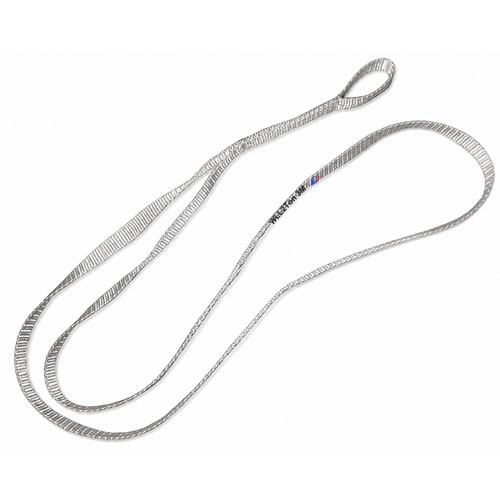
The article, on concrete. One flat woven band, printed with a working load limit and a length, with the loop formed by the band turning back on itself. This is the photograph to keep in mind while reading the next two sections, because everything the article can be attached to follows from that shape: there is a formed part, a nd there is a band, and the two behave differently at the load. Which of them goes on the hook, and which goes round the pipe, is the whole of the end-configuration question.
1. What the Name Says: the Journey, the Loop, the Ends, and the Two Cargoes
The name of this article is a list of five decisions, and a buyer who reads it as one product name will order the wrong one of them. One way is the commercial arrangement: the band travels with the consignment and is not recovered, which is why the article is built light and carries no register. Endless describes the form: the band is closed into a loop, so the article has no tail and no loose end anywhere on it. Single eyes describes the end, and it is the only word in the name that is about the article's construction rather than about its journey: this loop carries one reinforced eye. And steel pipe and tube and timber industries name the two families of load the article is bought for.
The word that needs a warning is single eyes, because it is used loosely in catalogues. This site uses double ear and eye and eye for the article with a reinforced end at each end, and it uses endless for the plain closed loop with no formed end at all; a single eye sits between them, and in different catalogues the same phrase can mean an eye at one end only, a loop with a single sewn reinforcement, or an eye formed in a band that is otherwise plain. That is a naming problem rather than an engineering one, and it has a practical answer which the rest of this page keeps coming back to: order from the two figures and a sketch rather than from the name. If the order states the loop measurement and the eye measurement, and the m aker's drawing comes back with one formed end on it, both sides are describing the same object whatever each of them calls it. A buyer who orders a name gets whatever that name means at the other end of the transaction.
| Word in the name | The decision it records | Where it is answered on this site |
|---|---|---|
| One way | The article goes with the load and does not come back, so it is built light and needs no rack, no interval and no register. | The one way sling page, which deals with the label and the reg ime behind it. |
| Endless | The band is closed, so there is no tail and no loose end; the article behaves like a rope loop rather than like a strap with t wo ends. | The endless sling page, which owns the form and the arrangemen ts it can make. |
| Single eye | There is one reinforced eye on the article. Whether it is at an end, on a closed loop, or formed by a fold is the naming varia tion that §1 warns about. | This page, §2 and §3. |
| Steel pipe and tube | A long, heavy, round load that the band cannot hold by shape alone, and that will move in the band if the band lets it. | This page, §4, for the rigging; the export steel page, for the consignment. |
| Timber industries | A long, heavy, soft load, handled out of doors, where the ground, the weather and the loader are part of the lift. | This page, §5 and §6. Nothing else on this site covers it. |
2. Single Eye, Two Eyes, No Eyes: What Each Configuration Can Be Attached To
An end is not a cosmetic feature. It is the part of the article that a fitting or a hook can pass through, and its presence or absence decides whether the band can be attached to something other th an the load. The three configurations are therefore best compared not by how they look but by the list of things each one can be connected to, because that list is what the buyer is really choosing be tween.
A plain loop — an endless band with no formed end — connects to the load and to nothing else. It goes under the load, round the load, or through something on the load, and it hangs on the hook as a doubled band. It cannot be pinned, cannot be bolted, cannot be passed through the eye of a shackle and pulled tight, and cannot be used with any accessory that needs an opening to threa d. What it has instead is symmetry: there is no end to be loaded wrongly and no end to wear out, which is the argument the endless form is bought for and which the endless sling page sets out properly. On a pipe or a log, that symmetry is worth a great deal, because the load is round and the band has to conform to it everywhere.
A single eye adds one thing to that list: an opening. With one eye on the article, the band can be hung from a hook by the eye, passed through a shackle or a ring, or used so that the eye is the part that is loaded by a fitting while the plain part of the band goes round the load. It also gives the article a defined end to inspect and a defined place for the identification to sit. What it costs is symmetry — one end of the article now takes the load in a different way from the rest of it, so one part of the band works harder than the others. That is not a defect; it is a trade , and it is the trade a pipe and timber buyer makes when he chooses the eye.
Two eyes turn the article into a connection between two points: eye to hook and eye to load, or eye to eye on a two-point pick. That is the most versatile arrangement of the three and the most heavily covered elsewhere on this site, including the ways a length is measured between the two eyes and the way the two ends share a load. What it costs on a pipe or a log is conformability : an article with two formed ends is stiff at both of them, and on a round load the two stiff ends are the places that will not lie flat against the surface.
| The article | What it can be attached to | What it cannot do, and what that costs on pipe, tube or timber |
|---|---|---|
| Plain loop, no formed end | The load, and the hook as a doubled band. Nothing else. | Cannot be pinned, bolted or threaded through a fitting. Costs a fitting-based pick: if the lift needs a shackle, this is the w rong article. |
| One eye and a plain band | A hook by the eye, a shackle or ring through the eye, and the plain band under, round or through the load. | Loses symmetry: one end works differently from the rest of the band, so it needs its own look before the lift. |
| Two eyes | Two points: hook to eye and load to eye, or eye to eye across two pick points. | Stiff at both ends. On a round load the stiff ends will not conform, so the band bears on the load at two short lengths instea d of lying along it. |
| One eye, used as the closing end | A round load to itself: the band goes round the pipe or the log and the eye is what the band is drawn through or onto. | Puts the whole load into one formed end, and puts that end in the place where the band crosses itself. It is the arrangement t hat needs the most careful look of the four. |
| One eye, used as the hook end | A hook, and the load by the plain part: the simplest way to use an eye on a round load. | Nothing, provided the hook's own bearing surface suits a woven eye and the plain part is long enough to go round the pipe or t he log. |
| Two eyes and a beam or a spreader | Two or four points on a rigid member, which keeps the legs apart and the load in one plane. | Needs the beam, and the beam has its own rules; on a long pipe the two-point pick is often better made with two loops than wit h one two-eye article. |

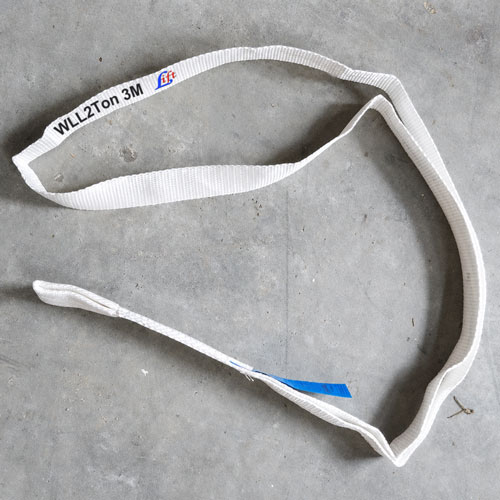
A formed article, laid out folded. The band carries fine transverse lines running across the weave, and the two formed ends are what the lines mark against. The photograph is here because it shows the part of the article the name in the title is about — the formed end — rather than because the lines are a subject of this page: what a band has to carry, and where that material is required to sit, is the business of the page that owns the standard, not of this one.
3. What a Single Eye Lets You Do That a Plain Loop Cannot
Three things, and each of them is worth having on a pipe or a log rather than on a box. The first is that the eye gives the article a hinge. A plain loop hanging on a hook is a dou bled band lying in the hook; a loop with an eye on the hook can rotate about the eye, so the band finds its own line to the load instead of being held in the plane the hook happens to be in. On a long round load that wants to swing and settle as it comes off the ground, a hinge at the hook is worth more than a slightly higher figure on the label.
The second is that the eye gives the article a defined end for the identification. On a plain closed loop the printed block is somewhere on the band, and if the band is wrapped rou nd a pipe twice, the block may finish up underneath the load. On an article with a formed end, the eye is the one part that stays in the same relationship to the hook every time the article is used, s o the identification can be placed where it will be read. That matters more on a one-trip article than on a returnable one, because there is no second chance to read it.
The third is that the eye is a serviceable place to attach an accessory — a shackle, a ring, a short strop — without putting the accessory through the band itself. On a pipe duty t his is the difference between a pick that can be adapted at the load and a pick that has to be planned at the office. The price of all three is the same price, and it is the one named above: an articl e with one formed end is not symmetrical, and on a round load the asymmetric end is the part that will be looked at twice before every lift.
| What the eye gives | Why it matters on pipe, tube and timber | What it does not do |
|---|---|---|
| A hinge at the hook | A long round load swings and settles on the way up, and the band has to be free to follow it. | Nothing about capacity. A hinge changes the geometry, not the figure on the label. |
| A fixed place for the identification | A one-trip article has no second chance to be read, and a band wrapped round a pipe can bury its own marking. | Nothing about what has to be printed; that list belongs to the standard, not to this page. |
| A place to attach an accessory | A shackle or a short strop can be added at the load without passing anything through the band's own weave. | It does not rate the accessory. A shackle has its own figure and its own paperwork. |
| An asymmetric article | One end works differently from the rest, so the pre-lift look has a definite place to start. | It cannot be made symmetrical again, and it should not be used as if it were. |
| A shorter band for the same reach | The eye is a formed length that the plain loop has to make up with more band, which on a long pipe means less material to wrap . | It makes length conventions matter more, not less: the eye is included in some ways of measuring and excluded from others. |
The article laid out flat, and the length of it. A closed band of even width, with nothing on it but its marking. Read against t he two sections above, this is the shape that has no opening on it anywhere: it can go under a pipe or round a log, and it can hang on a hook as a doubled band, and that is the complete list. Everythi ng the two sections above add is bought by putting a formed eye on the article, and the price of that purchase is visible in this photograph too, because the shape is then no longer the same at every point.
4. Cargo One: Steel Pipe and Tube, on the Rigging Side
The consignment side of steel pipe and tube — the unit load, the bundle, the steel strapping that holds it, the packing for a sea voyage and the documents that travel with it — is set out on this s ite's export steel and steel tube page, and it is not repeated here. What belongs to this page is the other half of the same job: once the pipe is on the ground in the yard and a crane or a loader is standing over it, what the band does, where it goes, and what the pipe does to it.
Pipe and tube behave differently from every other steel form because they are round in section and long in the third dimension, and those two facts produce three rigging consequences. First, everyt hing rolls. A single large pipe on a rack, a bundle of tubes on a truck bed, a coil of line pipe on a cradle: the article will move in the band if the band is not arranged so that it cannot. Second, e verything is heavy along a length the rigger cannot see at once, so the pick positions matter more than the total mass — a two-point pick that is placed for convenience rather than at the load's own b alance points will tilt the pipe when it comes off the ground, and the tilt is what hurts people.
Third, and least often written down, the band that goes round a pipe is usually doing the work of both a sling and a hold. The band is not merely carrying the pipe; it is also the thing that stops the pipe from sliding out of the band on the way up. On a flat load the sling's job is to carry downwards; on a round load it is to carry downwards and to hold inwards at the same time, and the hold i s produced by the wrap. That is why the length of the band, and not only its rating, decides whether a pipe lift is safe: a band that is too long for the pipe it is wrapped round makes a loose wrap, a nd a loose wrap on a round load is a load that can shift inside its own sling.
| Pipe or tube duty | How a band is normally arranged | Why an eye is or is not wanted |
|---|---|---|
| A single large pipe, from a rack | Two positions along the pipe, each band under or round the pipe and both legs to the hook. | A plain loop is usually enough and keeps the band conformable; an eye is wanted when the hook is the awkward part of the pick. |
| A bundle of tubes, closed and strapped | Under the bundle at two positions, never under the strapping, with the load taken by the bundle as a unit. | The bundle gives the band a flat underside to lie against, so the eye is less necessary — unless the receiver will have to re- sling it after unloading. |
| Coated line pipe | The same as above, with the band kept clear of the coated surface wherever the consignee expects to find it unmarked. | An eye can be used to keep the band's contact point away from the coating, by making the pick off the coated face rather than across it. |
| Pipe with bevelled, threaded or capped ends | Never across the end: the band is positioned inboard of the end preparation or of the cap. | An eye makes it easier to keep the band inboard, because the eye is a fixed part of the article that can be measured away from the end. |
| Tube in a stack, several layers deep | Under the whole stack at two positions, with the stack's own packing holding the layers so they cannot open. | Same as a bundle: the eye is a convenience for the receiver, not a necessity for the lift. |
| Pipe that has to be drawn closed on itself | The band is passed round the pipe and closed on itself, which is the arrangement the trade calls a choke and which a plain loo p can only make by passing the loop through itself. | This is where an eye earns its keep: a formed eye is a definite thing to pass through, and the closing action then happens at a designed part of the article instead of at an arbitrary fold of band. |
| Pipe pile and piling sections, lifted lengthwise | Two or more positions along a very long unit, often by two machines or by a machine and a tailing line. | The eye gives each end of the pick a defined attachment, which is worth having when two operators are working to the same load . |
| Tube lifted where the band cannot pass under | A wrap round the tube, or the band fitted before the tube is placed — the route this site's pre-slung page describes for a load that will never again have a gap under it. | An eye is what makes a pre-fitted band usable later: the receiver has something to hook rather than a plain loop to thread. |
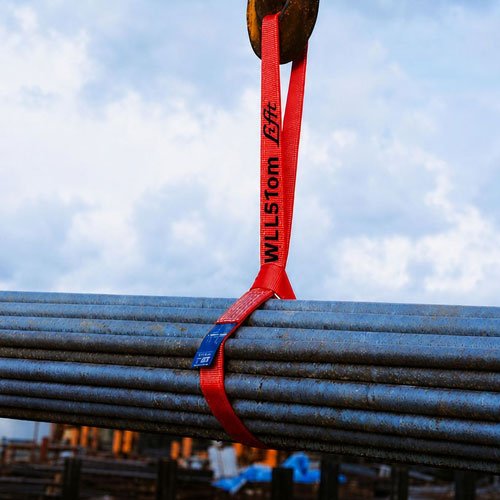
The pipe and tube duty in service. A red band leaves the hook as one run, opens into two under the stack, and carries the whole unit load on those two runs. Two of the three properties the section above describes are visible at once: the stack is round, so there is no flat face anywhere on the contact and the band is bearing o n tangents; and the load is long, so the two runs are separated along a length rather than gathered at a point. The third — that the band is holding the stack in as well as holding it up — is what the tension in the two runs is doing.
5. Cargo Two: Timber — the Industry This Site Has Not Written About
Timber is the second half of the name and the larger half of the opportunity, because this site has never published a page about it. Everything the website says about fibre so far is about either s teel or general industry; the log yard, the sawmill and the board mill are a different world with a different vocabulary, and the vocabulary is the first thing a buyer from that world notices is missi ng. Roundwood, softwood and hardwood, saw logs and mill logs, the butt end and the top end, debarked and bark-free, sawn packs and square-edged stock, kiln-dried and green, poles, piling, railway slee pers, veneer, plywood, chipboard and MDF: these are the words the timber trade uses to describe its loads, and a supplier who does not use them is a supplier who has not thought about the job.
The reason the vocabulary matters commercially is that the timber load has one property that no other load on this site shares, and it changes how the band behaves. Timber is compressible. A woven band bearing on a log or on a pack of sawn timber is not meeting an adversary: the wood gives a little, the contact spreads, and the band is not cut by the load as it would be by a st eel edge. That is a real advantage, and it is why a flat woven band is so often the right instrument in a log yard — but it also means the failure mode on timber is not the failure mode on steel. Noth ing cuts the band; instead the load moves, the band works loose, the wrap opens, and the danger comes from the load rather than from the edge.
The second property is phytosanitary rather than mechanical, and it belongs in a page about timber because it is the one requirement that can stop a timber consignment that is perfectly well slung. Published forestry guidance on the implementation of phytosanitary standards treats roundwood with bark as higher risk than roundwood that is debarked or bark-free, and says plainly that both commodities can carry pests, with debarked wood being less likely to. That is a statement about the cargo rather than about the band, and its practical consequence is worth being clear about : the timber itself is not wood packaging, and the packaging regime that applies to crates, pallets and dunnage — the treatment and the mark described on this site's export steel and steel tube page and its own dunnage section — is a different question from the one the cargo's own condition rai ses. A yard that has understood only one of those two questions will still have a shipment stopped.
| Timber trade | What the load is, and how it travels | What it asks of a flat woven band |
|---|---|---|
| Forestry and the log yard | Roundwood arrives as loose logs or as loose bundles, moved by a log grapple or by a loader with a fork, stacked in long rows t hat are handled again and again. | A load that is handled many times and slung between machines, where a band that is already on the log saves a rigger walking t he stack. §6. |
| The sawmill | Logs in, sawn timber out; the load changes from round to square-edged between the two ends of the same yard. | Two different contact problems in one site, and one band specification cannot be assumed to suit both. |
| Sawn and square-edged packs | Timber banded into packs, kiln-dried or green, stacked on bearers or on a lorry bed, with the pack's corners square and its to p courses loose until the banding is tight. | A pack presents a corner, which a flat band meets on its flank rather than its face — the one place where a soft load behaves like a hard one. |
| Poles, piling and long sections | Utility poles, piling and long dressed lengths, transported and unloaded at two or more positions, usually with the pick posit ions marked. | A long unit that two machines may handle: the band's length and the marked positions matter more than the figure on it. |
| Railway sleepers and heavy sawn sections | Dense, heavy, short pieces, stacked and bundled for transport, with the load concentrated in a small footprint. | A short unit of high mass: the band's rating is the binding constraint, and there are no balance points to help. |
| Veneer, plywood, chipboard and MDF | Sheet material in packs, usually crated or palletised, with the pack's edges exposed along all four sides. | The pack's own crate or pallet is part of the contact, so the band often meets packaging rather than timber. |
| Pallet and packing makers | Small timber components, cut and bundled, moved in boxes and on pallets inside a workshop rather than in a yard. | An indoor duty with short lifts, where the sharp corner of a cut component is the main risk to the band. |
| A timber importer or merchant's yard | Mixed loads, unloaded once and stacked for sale, with the slings often left on the packs because the next move is somebody els e's. | A one-way article left in place on the pack, which is exactly the situation the single eye makes workable for the next handler . |
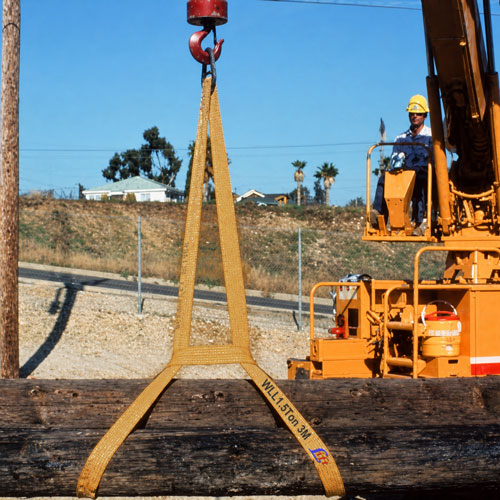
The timber duty in service, and the only photograph on this site that shows it. Two legs from the hook down and under a log, wit h the load lying on the ground rather than on a rack. Three things are worth reading off it. The band goes under the log, in two places, which is the arrangement a round load needs. The machine doing the lifting has a hydraulic boom and an operator, so the pick is being made at the load rather than from a prepared plan. And the log is unbanded, so the band is holding the round shape as well as car rying the mass — the doubling of the band's job that §4 describes on pipe.
6. Where a Band Meets Timber: the Butt End, the Bark, the Grapple and the Sawn Corner
A log is not a uniform cylinder. It is heavier at the butt end than at the top, it is not straight, and its surface is whatever the felling and the extraction left on it. All three of those matter to the band, and they are the reason a timber buyer reads a sling specification differently from a steel buyer. The butt end is the first: a log is denser and larger at the end that g rew first, so the load's own balance point is not the middle of its length, and a pick placed on the mid-point of the length will lift the log off its axis. That is not a sling fault, but it is a slin g consequence, because an unbalanced pick puts more of the load into one leg of a two-leg arrangement.
The second is bark, and what is in it. Bark on a log that has been extracted through mud and along a forest track carries grit, and grit inside the contact between a band and the l oad is the working definition of abrasion. On a soft load this is the dominant wear mechanism, taking over from the cutting that dominates on steel. The third is the machine. In a log yard the lifting is often done by a grapple or a fork rather than by a hook, which means the band is not the only thing touching the load: the machine's own grabbing equipment, the ends of the logs, and the stack behind all contribute. The fourth is the sawn corner, which only appears when the log stops being a log: a square-edged pack of sawn timber presents four hard corners, a nd a band that has been carried over from the log yard to the pack is now in a duty it was not thought about for.
| What the band meets | Why it is hard on the article | What the buyer can arrange |
|---|---|---|
| The butt end, and the off-centre balance | The load's mass sits towards one end, so an evenly spaced two-leg pick loads one leg harder than the other. | Mark the pick positions rather than using the mid-length, and state them on the order so the band's length suits the marked po sitions. |
| Bark carrying grit and mud | Grit inside the contact abrades the weave from both sides at the point where the band turns under the load. | A wider band spreads the same force over a longer contact, and a band replaced as a consumable rather than reused after a mudd y job. |
| A branch stub, a knot or a damaged flank | A local hard point under a band that is already loaded, which is the one thing that can cut a woven band on timber. | Choose the pick position with the load in front of you; a band that lands on a stub should be moved rather than trusted. |
| The loader's own grapple or fork | The machine may lift the same log by a method that has nothing to do with the article, and the two methods are not always used one at a time. | Decide who lifts what, and keep the band out of the machine's own contact area rather than leaving it to be caught in the grab . |
| The sawn corner of a pack | A square corner turns the band over a short radius, so a small area of weave takes the whole leg force. | Decide which face the band crosses, and say so; on a crated pack the band often meets the crate rather than the timber. |
| The pack's own banding or wire | Metal banding left proud of the pack is a hard edge sitting exactly where the lifting band wants to lie. | Slung under the pack, in the same rule that governs a steel bundle; the banding closes the pack and does not carry the lift. |
| Frozen, wet or icy timber | A wet or icy log is a low-friction log, and a low-friction round load is the case where the wrap has to be doing its second jo b properly. | Keep the wrap tight to the load's diameter, and treat a lift in freezing conditions as a pick that has to be watched rather th an a pick that can be rushed. |
| Mud, grit and standing water in the yard | The band is dragged, stood on and run over before it ever takes a load, which is damage done before the job starts. | A consumable loop kept with the machine rather than laid on the ground, which is the practical case for a one-way article in a yard. |
7. Five Things Pipe, Tube and Timber Have in Common
The two cargoes in the name are not usually mentioned in the same sentence, and the reason they are on the same page is that they behave alike in five respects that matter more to a sling specifica tion than the material does. Each of the five transfers between the two duties, and each of them is a reason a buyer from one industry will recognise the other's problems immediately.
The first is length. Both cargoes are long relative to their section, so the load's mass is spread along a distance that has to be walked to be judged, and the pick positions have to be decided rather than assumed. The second is roundness, or the absence of a flat bearing face. A pipe is round by definition; a log is round until it is sawn; and a sawn pack is a set of square corners rather than a face. None of the three gives a band the broad flat surface that a box or a plate stack gives. The third is that both are handled again and again before th e final lift — from the mill to the yard, from the yard to the lorry, from the lorry to the stack — so the article on the load is often the article that has to survive several handlings, not one.
The fourth is that both are lifted out of doors, on ground that is not a factory floor, by machines that are not overhead cranes. And the fifth follows from the fourth: on both car goes the person choosing where the band goes is very often the person on the machine, working alone, with the load in front of him and no plan on paper. That last point is the commerc ial argument for the whole article on these two duties. Where the rigging decision is made by the operator, the article has to be the kind of thing an operator can use correctly without being told, an d an article with one eye and a plain band is exactly that: it has one obvious place to hang and one obvious part to wrap.
| What the two cargoes share | How it shows up on pipe and tube | How it shows up on timber |
|---|---|---|
| Length | Single pipes and tube bundles are long, and the pick positions are a decision. | Logs, poles and piling are long, and the butt end moves the balance point away from the middle. |
| No flat bearing face | Round in section, so the band contacts on tangents and cannot rely on a face. | Round as a log, soft as a face; a sawn pack gives corners instead of faces. |
| Several handlings before the final lift | Mill, yard, quay, receiver: each step may re-sling the same unit. | Standing timber, forest road, log yard, mill, merchant's yard: more steps than the pipe usually sees. |
| Outdoor lifting plant | Mobile cranes, side loaders and loaders rather than an overhead crane on rails. | Hydraulic loaders, log grapples and fork machines working within reach of the stack. |
| The operator makes the rigging decision | The band is chosen and placed at the load, minutes before the lift. | The same, and often alone, with the machine running. |
| Consumable economics | The article goes with the consignment and is written off against the job. | The article is left on the pack or on the log, and is written off the same way. |
8. The Outdoor Yard: What the Ground, the Weather and the Machine Do to a Band Used Once
An article bought for one journey is still an article that has to survive the journey, and on pipe, tube and timber the journey begins in a yard. That is a different environment from a factory floo r, and it damages a woven band in ways that a buyer who is used to indoor lifting does not expect. The relevant conditions are all ordinary: mud and grit, standing water, ice and salt in winter, sunli ght in summer, and the fact that in a yard the band is often put down on the ground between lifts because there is nowhere else to put it.
Three of those are worth separating because they act at different times. Damage before the lift is what the ground and the machine do: a band walked on, run over, or left lying in a puddle, and a band that has been dragged across a concrete apron with grit under it. Damage during the lift is what the load does, and on pipe and timber that is abrasion from grit and from the load's own movement rather than cutting. Damage after the lift is what the yard does to a band that has been left on the load for days or weeks: sunlight on a band lying on a pipe stack, weather, and the next machine that arrives to move the stack without noticing that there is a sling on it.
The practical consequences are three and they are all cheap. Keep the article with the machine or in the cab rather than on the ground, because a band that is not on the ground cannot be walked on. Choose the pick position from the load rather than from habit, so that the band is not asked to bear on grit or on a stub. And treat the article as what it is — a consumable — so that a band that has had a hard week is replaced rather than kept because it still looks whole. On a one-trip article the temptation to keep a used band in service is the most expensive economy in the trade, and it is th e one that a yard, with no register and no rack, is most likely to fall into.
| Condition in the yard | What it does to the article | The habit that removes most of it |
|---|---|---|
| Mud, grit and standing water | Grit becomes an abrasive inside the contact; water alone is survivable, water carrying yard chemistry may not be. | Keep the article off the ground, and rinse a band that has been in mud rather than putting it straight back on a load. |
| Traffic over a band lying on the apron | Crushing and abrasion at once, and usually at the part of the band that will later be the loaded turn. | Store the article with the machine; a band in a cab or a toolbox is not in the traffic lane. |
| Sunlight on a band left on a stack | Ultraviolet exposure ages the fibre, and a band left on a pipe or a log stack for weeks is being aged for no benefit. | If the band is not going to be used at once, take it off the load; if it is to stay, accept that it is being spent. |
| Ice, frost and salt | A frozen band is stiff and a wet band is slippery; the slip is at the contact with a round load, exactly where the wrap is doi ng its second job. | Let a frozen band thaw and dry, and treat a winter lift on a wet log or a wet pipe as a lift that needs a second look. |
| The next machine to move the stack | A band left in place can be caught by a grapple or a fork that was not expecting it, which damages both the band and the habit of leaving it there. | Agree whether the article stays on the load; if it does, it should be the vendor's deliberate arrangement, not an accident. |
| Mixing used and unused bands in one place | Nothing to the article, everything to the next lift: nobody can tell a hard week from a new band by looking. | Keep the unissued quantity identifiable, as the site's single use endless webbing sling page sets out for a consumable store. |
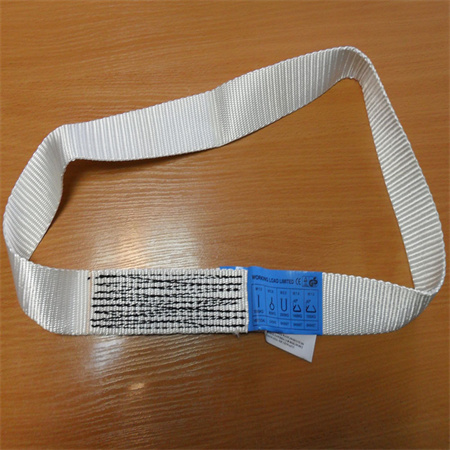
A one-trip article with its identification, out of the pack and on the floor. The blue label and the printed block are the whole of what travels with this article, and on a yard duty they are also the only thing that ties a piece in a machine cab back to a batch. That is the argument for keeping the article with the machine ra ther than on the ground, and it is the argument the two sections above make in physical terms: an article whose marking has worn off is an article that has been separated from its own specification.
9. The Words the Trade Uses, and Which of Them This Site Has Already Defined
Pipe, tube and timber are three trades with three vocabularies, and the same physical arrangement can be called three things in the same quotation round. That is not a small problem, because a buye r reading two quotes that use different words for one arrangement cannot tell whether he is comparing like with like. The table below is a translation list for the arrangements this article is used in , with a note on where each term is properly defined on this site, so that a buyer can put the two quotes side by side without either supplier having to restate somebody else's page.
Two entries in that list need a sentence of their own. The first is choke and girth hitch: the trade uses both for the arrangement in which a band is passed round the load and clo sed on itself, and this site's own pages use choked for the same idea. What the arrangement does to a rating is a real and consequential question, and it is answered where the form is defined rather than here, because the answer depends on the article. The second is the difference between a single eye and a double ear, which is the naming variation §1 warned about: on th is site a double ear is the two-reinforced-end article, and a single eye is the one-reinforced-end article, and a buyer who wants one of the two should say which by describing the ends rather than by trusting either phrase.
| The term | The arrangement it describes | Where it is properly defined here |
|---|---|---|
| Endless, continuous loop | A band closed on itself with no formed end anywhere on it. | The endless sling page. |
| Loop circumference | The distance all the way round a closed band, which is one of the two ways a closed article's length is stated. | The endless sling page, which owns the two conventions. |
| Single eye, one eye | One reinforced eye on the article; on this page the configuration is described in §2 and §3. | This page; the eye-and-eye forms are on the eye and eye page.< /td> |
| Double ear | The article with a reinforced end at each end, and the names the trade gives the two ends. | The double ear sling page. |
| Choke, girth hitch | The band passed round the load and closed on itself, which is how pipe and logs are most often held. | The rating consequence belongs to the eye and eye typ e page, which sets out the arrangements and their figures. |
| Basket | The band under the load with both runs up to the hook, which is the standard pipe and log pick. | The same page, which owns the arrangement table. |
| Spreader, lifting beam | A rigid member between the hook and the legs, used to keep two or four legs apart on a long load. | The lifting beam page. |
| Round sling, sleeved sling | The covered loop with an enclosed yarn core, which is the alternative when a bare woven band is not wanted on a particular sur face. | The endless round sling page. |
| Pre-slung | The band fitted at the packing point, before the load is placed, so that the receiver never has to rig it. | The disposable pre-slung cargo sling page.< /td> |
| One way, single trip | The commercial arrangement in which the article travels with the load and is not recovered. | The one way sling page. |
10. When This Article Is the Wrong One, and What to Buy Instead
An article with one eye is a compromise, and a compromise has a boundary. The boundary on pipe, tube and timber is drawn in four places, and a buyer who can see them will avoid most of the expensiv e mistakes in this cluster. The first is when the lift needs two defined attachment points: a two-point pick on a pipe where each point has to be a definite, measured attachment wants an article with two ends, and using a single-eye article for it means one end is a fold of band rather than a designed part. The second is when the load needs a connection to a fitting at bot h ends, because a band with one eye can only be pinned at one of them.
The third is when the duty is not a one-trip duty at all. If the same pipe or the same pack will be lifted next week by the same people, the economics that justify a consumable dis appear, and the article to buy is the returnable one with a register — however attractive the unit price of the one-trip article looks on the first quotation. The fourth is when the surface ru les out a bare woven band: a coated line pipe a consignee will inspect, a planed or machined timber product, a surface where any witness mark is a claim. In those cases the answer is not a di fferent eye configuration but a different article, and the sleeved loop is the one to look at.
| The duty | Why the single-eye article is the wrong answer | What to buy instead |
|---|---|---|
| A two-point pick where both points are measured | One end is a formed eye and the other is a fold, so the article is not symmetrical and the second point cannot be defined the same way as the first. | A two-eye article, or two plain loops, which on a long pipe is often the cleaner arrangement. |
| A pick that has to be pinned at both ends | There is only one opening on the article, so only one end can be connected to a fitting. | The two-eye form, and the fittings rated for the lift rather than assumed. |
| The same load lifted repeatedly for weeks | Nothing about the configuration; the article's commercial basis is wrong for the duty, and the control the duty needs is an ex amination history. | A returnable article with a register and an interval, in the same form if the form is right. |
| A coated, planed or inspection-grade surface | A bare woven band leaves its own witness on a soft or finished surface, and on a coated pipe that witness is a claim. | A sleeved loop, or the same band with the protection the packing has to carry for the receiver. |
| A hot load straight from a process | The fibre question overrides the configuration question, and a band chosen by habit may be the wrong fibre for the temperature . | The same form in the fibre the temperature calls for, chosen with the maker. |
| A load that has to be held rather than lifted | A lifting article used to tie a load down is outside its rating, and the eye does not change that. | Lashing equipment, such as the site's cargo lashing b elt page. |
11. Which Page to Read for Which Question
This cluster of pages is deliberately dense, because pipe, tube, timber, endless slings and eyes are topics that a buyer arrives at from five different directions. This section is the map: each ent ry states the question that page answers, so that a reader who has landed here with a different question can leave in a minute rather than reading the wrong page carefully.
| Page | The question it answers | Go there when |
|---|---|---|
| This page | The end configuration, and how pipe, tube and timber duties choose between one eye, two eyes and none. | The form of the band is open and the load is a pipe, a tube or timber. |
| Export steel and steel tube | The consignment as a unit load: what steel and steel tube are as cargo, how a bundle is closed and packed, and what documents travel. | The load is already a packed unit and the question is the unit, not the band. |
| Disposable pre-slung cargo sling | Fitting the band at the packing point, and what the receiver may assume as a result. | The receiver will have to lift the load without a rigger or a plan. |
| Single use lifting sling | The category itself: what one-trip means, why the trade buys it, and which rules still apply. | The question is whether a one-trip article is legitimate on your duty. |
| One way sling | The paper on the band: the items the label carries and the test regime behind the figure. | The question is what has to be printed rather than what has to be attached. |
| Endless sling | The closed loop as a form, the arrangements it can make, and the two ways its length is stated. | The question is the geometry of a loop rather than the configuration of an end. |
| Eye and eye sling and eye and eye type | The two-eye article: the sewing that forms the eyes, the arrangements and their figures, and how the length is measured betwee n two bearing points. | The article has two ends and the questions are about them. |
| Double ear sling | The double-ear form and the names the trade gives its two ends. | The question is which end of a two-ended article is which. |
| Single use endless webbing sling | The closed loop as a consumable: how a quantity of them is stored, counted, issued and checked on arrival. | The question is the store and the count rather than the load. |
| Steel plant sling for ribbed steel bar | A one-trip article on a steel works duty, traced from the bundle to the far end. | The load is bar rather than pipe, and the disposal question matters too. |
12. Frequently Asked Questions
Q1: What is a one way endless lifting sling with single eyes?
Q2: Why would a pipe or timber buyer want an eye at all, rather than a plai n loop?
Q3: What is different about slinging pipe and tube compared with other stee l?
Q4: How does timber behave differently from steel in a sling?
Q5: Is a log or a pack of timber wood packaging, for phytosanitary purposes ?
Q6: What wears a band out fastest in a log yard?
Q7: How is the length of this article stated?
Q8: Can it be fitted before the load is placed, so the receiver has nothing to rig?
Q9: When should this article not be used?
Q10: Which page in this cluster should I be reading?
Contact
Lift Sling Rigging Co., Ltd weaves and closes flat woven slings in the endless form, with eyes, in the fibre and the width the duty needs, with the working load limit and the length on the article. For a pipe, tube or timber duty, tell us the load and how it is picked, the two dimensions you need — the loop and the eye — and the quantity, and we will confirm the configuration, the width, the le ngth convention and the marking before anything is cut.
Telephone and WeChat: 18066002268
E-mail: 702461526@qq.com
Address: Lifute Industrial Park, Taizhou City, Jiangsu Province, China
HS code: 630790
- Previous:One Way Lifting Sling for Export Steel and Steel Tube
- Next:Single Use Endless Webbing Sling