 Language
 简体中文

- On the 2018 National Day holiday, Lifet completed six 100 ton large tonnage lifting belts as a gift
- The role of suspension net in the transportation of goods turnover
- Cargo soft lifting net, lifting net, lifting net, lifting net, bag, climbing net
- Precautions for using Lifutiden elevator
- How to make circular lifting straps
Contact: Wang Lili
E-mail:18066002268
Phone:702461526@qq.com
Address: Lifute Industrial Park, Taizhou City, Jiangsu Province

A 300 ton lifting belt is an agreed article rather than a catalogue one: the Chinese standards that govern textile slings tabulate round slings to 100 tonnes in a vertical lift and flat woven belts from 25 mm to 600 mm of band width, and the European colour code ends at its last entry, orange, which reads ten tonnes and above - so at 300 tonnes the form, the safety factor the sling is built to, the proof test it carries and the marking that identifies it are settled with the buyer and recorded on the certificate. HS 630790. Phone 18066002268.
Hits: ℃
Release time:2026-09-23 09:07
Lift Sling Rigging Co., Ltd manufacture 300 ton lifting belt, 300 ton sling, 300 ton lifting sling, 300 ton flexible lifting belt, 300 ton circular lifting rope.
300 Ton Lifting Belt — What the Standards Tabulate, and What Has To Be Agreed at 300 Tonnes
A 300 ton lifting belt is where textile lifting stops being a catalogue purchase and becomes an engi neering agreement. Everything below is written around that o ne fact, because it changes what a buyer has to do: the stan dards that govern textile slings are bounded documents, and the highest rating they tabulate for a round sling in a vert ical lift is 100 tonnes. Above that limit there is no entry to look up — no row in a table, no colour code that identifi es the rating, no published capacity to compare quotations a gainst. What exists instead is an article whose form, factor , test and marking are settled with the buyer and recorded o n its certificate.
So this page does the opposite of a normal product page. It does not promise a figure and leave you to trust it. It s ets out what is standardised and what is agreed(§2), the two forms a sling of this class is built in ( §3), the arithmetic that connects the rated load to the brea king force and why the factor has to be named on the certifi cate rather than assumed (§4), how such a sling is identifie d when the colour code has run out (§5), the temperature and chemistry limits and the uses the standard expressly exclud es (§6), how the load is shared between hitches and between the legs of an assembly (§7), how the article is actually bu ilt at this size (§8), what it weighs and how it has to be h andled (§9), and the paperwork that should arrive with it (§ 10). Two photographs of the article are read as evidence in §11 — including the one thing a buyer should notice about th em.

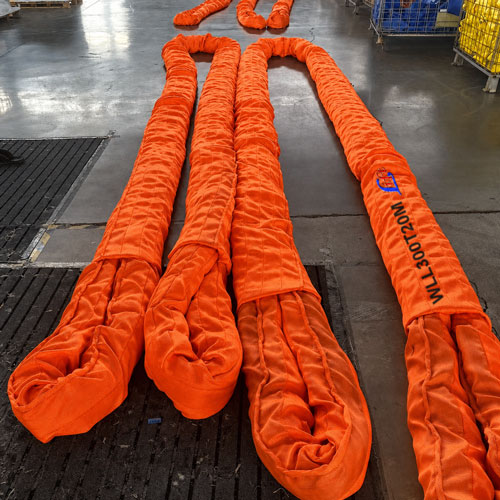
This page's own photograph of the article: a sle eved round sling in orange, carrying its working load limit and its length printed along the sleeve, with a blue identif ication label sewn to the cover. §5 explains why that printe d marking, and not the colour, is what identifies a sling at this rating.
1. What a 300 Ton Lifting Belt Is, and Why the Name List s Four Things
The product's own name names the same article four times
over: 300 ton lifting belt, 300 ton
lifting sling, 300 ton circular lifting ro
pe, and — in the fuller name used on this page — th
e 300 ton flexible lifting belt and the 300 ton sling. That
is not four products. It is the trade's vocabulary for one o
bject, and the four words come from four different ways of d
escribing it: the belt is what the flat for
m looks like, the sling is what it does, th
e circular lifting rope is what the round f
orm is sometimes called because it is a closed loop, and
Physically, the article is a textile sling with a working load limit of 300 tonnes, made in one of two forms. In the round form a load-bearing core of high-tena city synthetic yarn runs as a continuous loop inside a woven protective sleeve; in the flat form a wide woven band, built up in several plies, carries the load and is formed into eyes at the ends. Both forms are described i n §3. What they share is the material: the load is carried i n synthetic fibre — polyester, polyamide, polypropylene or a high-modulus polyethylene — and the fibre is what gives the article its advantages over steel (it does not scratch, it is a fraction of the weight, and it absorbs shock) and its v ulnerabilities (it can be cut, and it has a temperature limi t).
The reason this page leads with the standards rather than with the tonnage is that 300 tonnes is beyond the range the published standards tabulate, and a buyer who does not know that will compare quotations that are not comparable. The f amily of pages on this site shows how the ordinary range is sold: the white polypropylene lifting belt and the acid- alkali flat double-ear lifting belt are made to order fr om 1 t upward, and their capacity, colour and length can all be read off a table. At 100 tonnes and above — this article , and the site's other large-tonnage pages such as the two end buckle large tonnage sling and the large tonnage sling — the same words describe an article that is agreed rather th an selected. §2 sets out exactly where that line falls.
| The name | Where the word comes from | The form i t usually describes |
|---|---|---|
| Lifting belt | The appearance of the flat article: a bro ad band rather than a rope or a chain. | The flat woven belt, multi-ply, with an eye at each end. |
| Lifting slin g | The function: the article that goes betw een the hook and the load. | Either form, an d the word used in the standards for both. |
| Circular lif ting rope | The shape of the round form: a c losed loop with no ends and no fittings. | T he sleeved round sling, which the trade also calls the endle ss or circular sling. |
| Flexible | The property that decides where the article i s chosen at all: it bends to the load. | Bot h forms, as against chain and wire rope, which are the alter natives at this rating (§9). |
2. The Table Stops Before 300: What the Standards Actual ly Cover
The standards that a textile sling is judged against are
not vague about their own limits, and the limits are the mos
t useful thing a buyer of a 300 tonne sling can know. The Ch
inese standard series that governs manufacture states its sc
ope in the document: JB/T 8521.2-2025, for
round slings, applies to slings whose rated working
load in a vertical lift is not greater than 100 t,
made from polyamide, polyester, polypropylene, ultra-high-mo
lecular-weight polyethylene or aramid fibre, and it covers s
ingle-leg, two-leg, three-leg and four-leg assemblies with o
r without end fittings; it took effect on 1 February 2026 an
d replaced the 2007 edition. Its companion, JB/T 852
1.1-2025, covers flat woven webbing belts, and tabu
lates bands from 25 mm to 600 mm wide in th
e same fibres. The European standards that the industry quot
es alongside them are bounded in the same way: EN 1492-1 cov
ers flat woven webbing slings from 25 mm to 450 mm in width, and EN 1492-2 covers round slings made fro
m the same family of fibres, including multi-leg assemblies,
with the commonly specified minimum safety factor of
Read those figures together and the position of a 300 ton ne sling becomes plain. It is three times the round- sling standard's ceiling. It sits above the colour code, which stops at its last entry — orange, the entry for ten tonnes and above — so that the cover of a 300 t sling an d the cover of a 10 t sling may be the same colour. And it s its above the width range that the flat-belt standard tabula tes, which means the flat form of this article is not a stan dard stock size but a built-to-order band. None of that make s the article unsafe or unregulated; it changes what has to be done. Above the tabulated range the factor, the proof tes t, the marking and the inspection interval are matte rs of agreement, and the agreement is what the buye r should insist on seeing in writing. §4 deals with the fact or, §5 with the marking, §10 with the paperwork.
| The document | What it tabulates | Where a 300 to nne article falls |
|---|---|---|
| JB/T 8521.2- 2025, round slings | Round slings with a ver tical-lift rated load up to 100 t; five fibre types; one to four legs, with or without end fittings. | A bove the ceiling. The article is made outside the tabulated range, so its factor and test regime have to be agreed and s tated rather than read off. |
| JB/T 8521.1- 2025, flat woven webbing belts | Bands from 25 mm to 600 mm wide, single and multi-ply, in the same fibr e list. | The flat form of this article is b uilt by widening and multiplying plies to leave the stock ra nge; the band is made to order and its width is a specificat ion line of its own. |
| EN 1492-1, f lat woven webbing slings | Widths of 25 mm t o 450 mm; single and multi-ply; a safety factor typically 7: 1; the colour code that reads the working load limit straigh t off the band. | The factor and the colour system are the reference this site builds to; the width rang e, again, is left behind. |
| EN 1492-2, r ound slings | Round slings of polyester, pol yamide and polypropylene, including multi-leg assemblies, wi th a minimum factor commonly specified as 7:1 and a colour c ode whose last entry is orange, ten tonnes and above. | |
| ASME B30.9, the American route | A design factor commonl y 5:1 rather than 7:1, no mandatory colour code, and detaile d marking and removal criteria; it works alongside the OSHA 1910.184 regulations. | A 300 t sling sold i nto the American market is built to a 5:1 understanding, whi ch is a different breaking force for the same rated load (§4 ). The factor has to be on the certificate. |
The same reading applies to the exclusions, because they are as much a part of the standard as the limits are. The ro und-sling standard expressly does not cover slings used to secure or bundle cargo on a platform or in a vehicle, tubular slings without a filler, or lifts of peopl e and of hazardous items — molten metal, acid, glass plate, fragile loads, nuclear reactor components — or lifting in sp ecial environments. Those are not contract loopholes; they a re the cases in which the fibre is known to behave outside i ts design basis. If a lift is one of them, the answer is a d ifferent article, not a larger one.
3. The Two Forms Built at 300 Tonnes
At this rating the article is made in two shapes, and the choice between them is made by the load rather than by the tonnage. The round form is the sleeved roun d sling: a load-bearing core of high-tenacity synthetic yarn , formed as a continuous loop, inside a woven protective sle eve. It has no ends and no fittings, so nothing has to be ma tched to a shackle; it can be rotated between lifts so that the wear moves round the loop rather than concentrating in o ne place; and it is the form most easily wrapped around the irregular and the enormous — a vessel, a rotor, a fabricated steel section. The flat form is the wide w oven belt: a band built up in plies, with an eye formed and sewn at each end, offering a broad bearing surface that spre ads the contact pressure across the whole width of the band instead of concentrating it. That is why the flat form is ch osen for finished and painted surfaces and for anything with a thin wall, and why it is the form that appears on this si te's pages for white polypropylene belts and acid-alkali flat double-ear belts — except that at 300 tonnes the b and is built far wider than those pages describe.
The consequences of that difference are worth stating, be cause they decide which form a lift can use. The round sling 's load path is inside the sleeve: the slee ve does not carry the load, it protects the core, and it is therefore both the contact surface and the wear indicator. T he flat belt's load path is the band itself, visible along its whole length, with the two eyes and thei r stitched areas as the places where the entire load enters and leaves the article. A buyer inspecting a round sling is inspecting a cover; a buyer inspecting a belt is inspecting the load-bearing material. Both forms are made in this works at ratings this high, and the round form in particular is p roduced here well beyond 300 tonnes — the large-tonnage page s of this site are the place to see the range. Where the two forms overlap, the choice usually comes down to the contact surface (round for a soft sleeve against a finished load, f lat for the widest possible bearing area) and to the fitting s: a round sling needs no eye size, a belt does.
< /tbody>| The form | How it is built at this rating | What it is chosen for | What has to be watched |
|---|---|---|---|
| Round sling, sleeved | A continuous loop of high-tenacit y yarn as the core, inside a woven protective sleeve; the sl eeve may be printed along its length with the working load l imit and the length, and carries the identification label. | Large and irregular loads, soft or finished contact faces, assemblies where a leg has to wrap rather th an hook. See this site's endless round sling page for the form in general. | The sleeve is not the load path: a damaged cover hides the part that matters, so the inspection is a search for places where the core has been exposed or damaged (§8). |
| Flat woven b elt | A woven band of several plies, widened and thickened to reach the rating, with an eye at each end and a long stitched area carrying the load into that eye. | Wide bearing faces, thin-walled and finished loads, bridles where two eyes have to land on one hook. The site's two end buckle large tonnage sling and large tonnage sl ing pages cover the neighbouring forms. | The eye has to accept the hardware: at this rating the fit ting is large, and an eye that is right for the load can sti ll be wrong for the shackle, the pin or the master link (§7) . |
| The eye form of the round sling | The same sleeved core, arranged so that the loop closes into an eye at each end, w hich lets the sling be used as a two-leg article with define d ends. | Assemblies that need ends — bridle s, two-point lifts, slings that must not be able to slide th rough themselves. See the eye type round sling pa ge. | The eyes are the wear points and are f ixed, where a plain endless sling can be rotated; at this ra ting the difference in service life is not small. |
Whichever form is chosen, the article at 300 tonnes is a very large object rather than a large version of a small one : the sleeve that contains a core able to hold 300 tonnes is thick, the belt that reaches the same rating is wide and st iff, and the weight of the sling itself becomes a handling q uestion that does not exist at ten tonnes (§9). That is the practical meaning of the tonnage, and it is the reason the n ext question is not which form but which factor.
4. What 300 Tonnes Means: the Factor, and the Breaking F orce Behind It
A rated load is not a strength. It is a strength divided by an agreed number, and at this rating the number is the mo st important line of the certificate. The relationship is sh ort: the working load limit multiplied by the safety factor gives the minimum breaking force the article has to reach. A pplied to 300 tonnes it produces three different articles de pending on which factor the buyer's market uses. Under the E uropean factors, where 7:1 is the common specification for b oth flat woven webbing slings and round slings, a 300 tonne sling has to break at 2,100 tonnes. Under t he American design factor of 5:1 it has to break at 1,500 tonnes. Under the Australian margin of 8:1 it has to reach 2,400 tonnes — and that 8:1 f igure, because it is a real number from a real standard, is the one most often quoted into markets that do not use it.

This is not a technicality. If a page or a quotation says "safety factor 8:1, breaking strength 2,400 tonnes" and the sling is then supplied into a European project whose specif ication is EN 1492-2 at 7:1, the buyer has been given a numb er he cannot use and a factor he cannot verify against the s tandard he is working to; if the same claim is made under th e Chinese series, the same mismatch appears. The fix is a se ntence on the order and a line on the certificate: n ame the factor and the standard the test follows. A supplier who cannot state them is not able to demonstrate t he rating either, because the rating is the quotient of the two.
There is a second consequence at this scale, which is tha t the factor is a commercial as well as a safety figure. The higher the factor, the more yarn a sling of the same rated load has to contain, and at 300 tonnes that is measured in t onnes of fibre, in the width of the band or the diameter of the sleeve, in the weight that has to be handled, and in the size of the test bed the article has to be proved on. A buy er comparing two quotations for "a 300 ton sling" without kn owing which factors each is built to is comparing two differ ent objects — and the cheaper one is usually the lower numbe r. §10 sets out what to require in writing; §5 explains why the band itself will not tell you.
| Safety factor | Where it comes from | Breaking fo rce for a 300 t rated load | When it is the right one |
|---|---|---|---|
| 7:1 | The European textile sling standards: the commonly specified minimum factor for round slings, and the factor t ypically applied to flat woven webbing slings. | 2,100 tonnes | European and most export specifications, and the factor this site's articles are bui lt to by reference to EN 1492-1 and EN 1492-2. |
| 5:1 | The American design factor for synthetic webbing s lings, applied alongside the OSHA sling regulations. | 1,500 tonnes | North American spe cifications that name the American standard as the basis of the rating. |
| 8:1 | The higher margin used in the Australian sling sta ndard, which is a real factor in a real market — and not the factor of the European or the Chinese document. | 2,400 tonnes | Only where the buyer's own specification calls for it. Quoted into a European or C hinese project it is an unverifiable claim, not a bigger mar gin. |
One more line belongs here, because it is the question a buyer at this rating actually asks: what is the breaking for ce of the article in front of me? The answer is a test figur e, not an arithmetic one. The rated load is the figure the s ling may be used at; the breaking force is a property of the batch of yarn, the way the core or the band was made, and t he stitched area that terminates it; and the only defensible way to state it is to have the article or its type proved a nd to record the result. That is §10's subject.
5. Above Ten Tonnes the Colour Stops Identifying: How a 300 Ton Sling Is Marked
Textile slings are the easiest lifting equipment in the w orld to read at a glance, because the European colour code p rints the capacity on the outside of the article: violet for one tonne, green for two, yellow for three, grey for four, red for five, brown for six, blue for eight, and ora nge for ten tonnes and above. The last entry is whe re the code stops being useful. A code whose top entry reads "ten tonnes and above" does not distinguish a 10 tonne slin g from a 30 tonne sling, and it certainly does not identify 300. On an article this size the cover may well be orange — the colour of the top of the range — and the buyer who reads the colour has learned only that the sling is a heavy one. The practice that goes with the code, black yarns woven into the cover at one stripe per tonne, has the same fate at thi s rating: no one weaves three hundred stripes.
What identifies a sling of this class is therefore
The practical instruction for a 300 tonne purchase follow s from all this in one line: make the printed markin g, the label and the certificate carry the same three facts< /strong> — the working load limit, the factor, and the trace ability code — and check that they match on delivery. A larg e sling is expensive enough to travel across the world and b e used in a project where nobody can afford to guess what it is. Where a sling is being bought against a European specif ication, the same body of requirements is the checklist; the site's pages on the smaller articles, such as the one way s ling and the single use lifting sling, sh ow how much of that marking is carried by the label on a sli ng whose whole service life is one lift.
6. Temperature, Chemistry and the Uses the Standard Excl udes
The fibre sets two kinds of limit, and at 300 tonnes both
are worth checking before the sling is ordered rather than
after it arrives. The temperature limits of
the European framework are specific: for polyester and poly
amide the range given for use and storage is −40 °C
to +100 °C, and for polypropylene it is −40
°C to +80 °C. These are working limits rather than
survival figures, and they apply to the fibre — a sling lef
t lying against a hot fabricated section, or stored in a pla
nt where the radiant heat is high, is outside its basis even
if the air temperature around it looks acceptable. The
The exclusions in the round-sling standard then take the argument a step further, because they name cases in which a textile sling is not the right article whatever its rating. The standard does not cover slings used for securing or bundling cargo on a platform or in a vehicle; i t does not cover tubular slings without a filler; and it does not cover lifting people, or hazardous items — the list names molte n metal, acid, glass plate, fragile loads and nuclear reacto r components — or lifting in special environments. A lift th at falls into one of those categories is not answered by buy ing more tonnes. Molten metal is a chain or a wire rope problem, cargo res traint is a lashing problem, and acid immersion is a materia ls problem — and at 300 tonnes the cost of getting that wron g is not the price of the sling.
One more requirement belongs in this section because it i s a condition of use rather than of purchase. Where the load has a sharp edge, protection is required: the guidance that goes with the standard is that an edge with a radius smalle r than the sling's own width needs corner protection, and at this rating the load faces are large and often freshly cut or welded. Protection is ordered with the sling, not improvi sed on site — the sleeves and pads are part of this site's p roduct range, and the wear protection lifting sling page covers them.
| What you can see | What it tells you at this rating< /th> | What to rely on instead |
|---|---|---|
| The colour o f the cover | That the sling belongs to the top of the range, if the cover is orange. It cannot separate 10 tonnes from 300, and it says nothing at all about the fa ctor. | The identification label, and the wo rking load limit printed on the sleeve, which are the two ma rkings that carry the number. |
| Black stripe s in the cover | One stripe per tonne on a s ling of ordinary rating. At 300 tonnes the convention is not used and cannot be counted. | The printed s leeve marking, which states the figure directly rather than by counting. |
| The working load limit printed on the sleeve | The rated load, read from the article itself — the fastest and most r eliable check on a sling of this size, and the marking the r igger will use. | Cross-check it against the label and the certificate. Three markings that disagree mea n one of them is wrong and the article has to be held until it is resolved. |
| The identifi cation label | The formal identity: maker, w orking load limit, standard, material, effective working len gth, traceability code, date, and the factor where required. | Nothing — it is the authority. A label th at is missing or unreadable takes the sling out of service r ather than prompting a judgement call. |
7. Hitches and Multi-Leg Assemblies at This Scale
A single sling has three ratings, and an assembly of slin gs has more than three, because the load can be shared betwe en legs in ways that the article itself does not define. The three figures on the sling are the familiar ones: a vertical lift uses the rated load as printed; a choker reduces it to approximately eighty per cent, because the sling both pulls and bends at the choke p oint; and a basket hitch with the legs at n inety degrees doubles it, because two legs share the weight equally. Every one of those figures assumes a geometry, and the geometry is the part that a 300 tonne lift cannot take f or granted: as soon as the legs leave the load at an angle t he basket figure falls, and the arithmetic of that reduction is the same at 300 tonnes as at three. This site works that arithmetic on the endless sling page rather than repeat ing it here.
What is specific to this rating is the assembly. The round-sling standard covers single-leg, two-leg , three-leg and four-leg assemblies, with or without end fit tings, so a 300 tonne lift is normally specified as an assem bly rather than as a sling: a master link at the top, two, t hree or four legs beneath it, and a fitting at each leg end. Three consequences follow. First, the assembly's rating is not the sum of its legs — the legs share the load according to the geometry, and the angle between them is what decides how much of it each leg sees. Second, every component in the load path has to be rated for its share, including the mast er link, the shackles and the leg ends, so that the weakest element is not the one nobody specified. Third, the fittings have to fit: at this rating a master link is a large object , the eyes or the sleeved ends have to seat in it without be ing constricted or bunched, and the place the load enters th e sling is exactly where a textile article is least tolerant of being squeezed.
The practical instruction is to treat the lift, not the s ling, as the thing being specified. A buyer who knows only t hat the load is 300 tonnes has specified a sling; a buyer wh o knows that the load is 300 tonnes and will be lifted on fo ur legs from a single hook at a stated angle, with edges at the contact points and a shackle of a stated size at each en d, has specified an assembly that can be quoted without assu mptions — and the assumptions are where the risk in a lift o f this size actually lives.
| The condition | The limit or the rule | What it m eans on the order |
|---|---|---|
| Heat and col d | −40 °C to +100 °C for polyester and poly amide; −40 °C to +80 °C for polypropylene, for use and stora ge. | State the service temperature. A lift near a heat source needs the distance from it, not just the air temperature. |
| Acid and alk ali | Polyester is the general-purpose fibre ; polypropylene is the one specified for acid and alkali exp osure. The standard also excludes lifting acid as a hazardou s item. | Say what the sling will be exposed to, not only what it will carry. A pickling line and a pain ted fabrication are different orders in the same tonnage. |
| Sharp edges and abrasive faces | An edge with a radius s maller than the sling's width requires corner protection; ab rasion is what shortens a textile sling's life fastest. | Order sleeves or pads with the sling. At 300 t onnes a replacement is a project event, not a store-cupboard item. |
| The excluded uses | Cargo securing and bundling, tubular slings without a filler, lifting people, and lifting molten metal, acid, glass plate, fragile loads or nuclear componen ts, or lifting in special environments. | If the lift is one of these, the order is for a different arti cle. Choosing a larger textile sling instead is the one mist ake this page most wants to prevent. |
| The arrangement | How the rating works | What to state or verify at this rating |
|---|---|---|
| Vertical lif t | The printed rated load, with the whole o f it passing through the article and, on a belt, through bot h stitched eyes. | That the sling's own mark ings carry the figure, and that the hook or fitting accepts the eye or the sleeved end without squeezing it. |
| Choker hitch | Approximately eighty per cent of the prin ted figure, with a further reduction where the choke angle i s steep. | That the choke closes on the body of the sling and never on an eye, a seam or a label, which at this diameter means a much longer article than a vertical lift of the same height. |
| Basket hitch | Double the printed figure while the two l egs stand at ninety degrees to the load, falling as the angl e closes. | The angle, in writing. A basket figure quoted without its angle is a number that may be doub le the vertical rating or barely above it. |
| Two, three o r four legs | The stated load is shared betw een the legs according to the geometry; the assembly is cove red as an assembly by the round-sling standard. | Each leg's share, the angle between the legs, and the rating of the master link and every fitting in the path — th e assembly is only as strong as its weakest item. |
| Contact with the load | Not a rating at all, but the con dition the rating depends on: protection where the edge radi us is smaller than the sling's width. | The shape of the contact faces, and the sleeves or pads to be su pplied with the sling rather than found on site. |
8. How the Article Is Built at This Size
Both forms are textiles, and both reach 300 tonnes the sa me way: with more fibre and more of the structure that holds it. In the round form the core is a contin uous loop of high-tenacity yarn — a loop, not a length joine d at the ends, because a joint inside a load-bearing core is a defect rather than a feature — and the count of yarns in that loop is what produces the rating. Around it goes the wo ven sleeve, closed along its length, whose two jobs are to k eep the core in place and to take the abrasion that would ot herwise reach the yarn; at this size the sleeve also becomes the surface that carries the printed working load limit and the length, and the place where the identification label is sewn. In the flat form the same logic runs through a different geometry: the band is woven from high-t enacity yarn in several plies, its width is grown towards th e top of the range the flat-belt standard tabulates, and eac h end is turned back and stitched over a long area so that t he load can pass out of the band and into the eye without co ncentrating in one course of stitching.
Three things about the construction are worth a buyer's a ttention, because they are the ones that cannot be checked b y looking at a photograph and are the ones that separate a 3 00 tonne sling from a 30 tonne sling with a large label. The first is the quantity of load-bearing material: the yarn count in the core, or the width and ply count of the band. The second is the termination: on a belt, the length and quality of the stitched area, wh ich is where the entire rating enters the article; on a slee ved sling, the continuity of the core through the whole loop . The third is the traceability of the material— which mill the yarn came from and which batch — becau se the certificate that §10 asks for is only as good as the identity of the fibre it describes. A quotation that names a ll three is a quotation from a works that expects to be held to them.
The family of pages on this site shows the same construct ion at lower ratings, where every dimension is smaller and t he tables apply directly: the extra large tonnage lifting straps page describes the widened and thickened band used for large flat belts, and the large tonnage sling page covers the round f orm. Reading them together with this page gives the whole pr ogression from a stock-size band to a built-to-order article .
| The element | How it is made at this rating | Wha t the buyer should ask for in writing |
|---|---|---|
| The core of the round form | High-tenacity yarn formed i nto a continuous loop, so that the load path has no joint in it. | The fibre type, the yarn count or the construction, and the traceability of the batch the certifi cate will name. |
| The sleeve o f the round form | Woven, closed along its l ength, carrying the identification label and usually the pri nted working load limit and length. | The ma rking to be printed, and confirmation that label and sleeve carry the same working load limit — the check a rigger will make on site. |
| The band of the flat form | Woven in several plies, wide ned towards the top of the standard's band range, with the p lies sewn together through the body and the eyes. | The band width and the ply count as two separate spe cification lines, and the fibre of which they are made. |
| The stitched termination | A long stitched area carrying the whole rating out of the band and into the eye; the poin t at which the article is most concentrated. | The stitched length and the thread used, and — on deliver y — a look at the seams for pulled or broken stitching befor e the sling is ever loaded. |
| The fibre | Polyester, polyamide, polypropylene or a hig h-modulus polyethylene, chosen for the environment as much a s for the load. | The material certificate, and a statement of the temperature and chemical conditions i t is being bought for (§6). |
9. Weight, Handling and Storage: the Consequences of the Size
A 300 tonne sling is a heavy object in its own right, and that is the part of owning one that no specification sheet conveys. The sleeve that contains a 300 tonne core, or the b and that reaches the same rating, is measured in tens of cen timetres across and weighs enough that it cannot be carried, only moved — by crane, by pallet, or on a pallet trolley of its own. Two consequences follow. The first is that rigging the sling is a lift in itself: it has to b e picked up, laid out and positioned by equipment that is ra ted for it, and the people doing it need to be able to work without dragging the article over the floor or over the load 's edges, both of which damage the article faster than any l oad will. The second is that inspection stops being a two-minute job: the hand-over-hand check that a 3 tonne sling receives before every lift has to be planned on an article whose cover is metres long, and it has to includ e the places that cannot be seen without handling the sling — the full length of the cover on the round form, and both s titched areas on the belt.
Storage follows from the same facts. Textile slings belon g flat, clean, dry and off the ground, out of direct sunligh t and away from heat sources and chemicals, because ultravio let light and chemical attack degrade synthetic fibre withou t any visible change to the outside of the article; a large sling stored coiled on a concrete floor in a workshop corner will not fail because of its load, it will fail because of its storage. The site's other pages cover the inspection reg ime for textile slings in detail — the endless round s ling page for the sleeved form, whose cover is the only thing standing between the core and the world. What is speci fic here is the scale: on an article this size the storage d ecision and the inspection plan are made when the sling is b ought, not when it is first used, and a works that cannot de scribe how the sling will be inspected has not finished spec ifying it.
10. Proof Testing and the Certificate Pack
Above the tabulated range of the standards, the test regi me is one of the things that has to be agreed — which makes the paperwork part of the product rather than an attachment to it. Two requirements are general and come from the ordina ry frameworks: the supplier should provide a manufacturer's certificate that confirms the safety factor the article was built to, and a test report and declaration should accompany every order. On a 300 tonne article those two sentences bec ome the buyer's checklist, because there is no table to appe al to afterwards.
A practical set of requirements for an order of this size
can be written in four lines. Name the factor and t
he standard the test follows, so that the rated loa
d and the breaking force are connected by a stated number ra
ther than an implied one (§4). Ask for the test reco
rd, whether it is a type test of the design or a pr
oof test of the item, and ask which it will be before the or
der is placed. Ask for the material certificate, naming the fibre and the batch, since that is what the
traceability code on the label has to lead back to. And
| The document | What it should show | Why it matte rs at 300 tonnes |
|---|---|---|
| The manufact urer's certificate | The maker, the working load limit, the material, the safety factor the article is b uilt to, and the standard framework it was made to. | It is the only place the factor appears. The band and the label carry the rating; the certificate carries the number the rating was derived with. |
| The test rec ord | Which test was carried out, on what, w hen and with what result — a type test of the design, or a p roof test of the item supplied. | Above the tabulated range there is no published capacity to check the article against. The record is what replaces the table. |
| The material certificate | The fibre type, the supplier of the yarn and the batch identity. | It is what the traceability code on the label has to lead back to. Without it the code is a number rather than a trail. |
| The marking agreement | The text printed on the sleeve, the contents of the label, and the traceability code, agreed before manufacture. | At this rating the ma rking is the identification (§5). Agreeing it in advance is what makes the delivery check possible. |
| The declarat ion of conformity | Where the market require s it, the declaration and the conformity marking that go wit h the European framework, and the customs identity of the ar ticle. | A 300 tonne sling crossing a border is an imported item as well as a lifting accessory; the pap erwork has to satisfy both. |
11. The Two Photographs on This Page, Read as Evidence
Both photographs on this page are the product's own, and both are worth reading carefully, because between them they show what identifies a sling at this rating and one honest i nconsistency that a buyer should notice. The first photograp h, printed above §1, is a sleeved round sling in ora nge — the top entry of the colour code, ten tonnes and above — laid in a coil, with its working load li mit and its length printed along the sleeve and a < strong>blue identification label sewn to the cover. It is the article of this page, and it demonstrates §5's po int better than the text can: the colour says only that the sling is a heavy one, and the number that actually matters i s printed beside it.
The second photograph shows the same form again — a sleev ed round sling in orange, laid out in loops on a tiled floor — but its sleeve is marked with a much smaller rating and a five metre length. It is a product photograph of the form r ather than of a 300 tonne item, and there is no reason to pr etend otherwise: the two pictures are of one family of produ cts, taken in the same works, and the second one is a smalle r sling. A buyer who wants the photograph and the specificat ion to agree should ask for the photograph to be taken on th e article being bought. What the family does make clear is t he range this works actually covers: among the related produ cts at the foot of this page is a large-tonnage round sling photographed on the factory floor with its own rating printe d along the sleeve, an order of magnitude above this article . None of the three photographs shows a factor, a test or a core — those are the parts of a 300 tonne sling that a pictu re cannot evidence, which is why §10 asks for them in writin g.
| The photograph | What it shows | What a buyer can read from it |
|---|---|---|
| The first, a bove §1 | A sleeved round sling in orange, c oiled, with its working load limit and its length printed al ong the sleeve and a blue label sewn to the cover. | The form (round, sleeved, no ends and no fittings), the fact that the marking is printed rather than implied by the colour, and that the article carries a label as well as a printed sleeve. |
| The second, in the gallery | The same form in the same c olour, laid out in loops on a workshop floor, with a much sm aller rating and a five metre length marked on the sleeve. | That the same printed-sleeve convention is used across the range, and that this particular photograph i s of a smaller sling — a point worth noticing rather than gl ossing over. |
| The related tile photograph | A large sleeved round slin g laid out on a factory floor with its rating printed along the sleeve, in the same works. | The range t his works covers — the same construction, an order of magnit ude above this article — and the same identification convent ion. |
| What no phot ograph can show | The safety factor, the bre aking force, the test the article was proved by, the yarn co unt or the ply count. | That a picture is no t a specification. Those four figures are the ones to ask fo r in writing, and §10 sets out what to ask. |
12. Frequently Asked Questions
Q1: What is a 300 ton lifting belt?
Q2: Why is 300 tonnes different from a 30 tonne sling?<
/summary>Because it is above the range the standards tabula
te rather than at a larger point inside it. The round-sling
standard applies to slings with a vertical-lift rated load o
f not more than 100 tonnes, and the colour code stops at its
last entry, orange, which is the entry for ten tonnes and a
bove. A 30 tonne sling can be looked up and compared; a 300
tonne sling has to be agreed, tested and marked, and those t
hree things are what the buyer specifies (§2, §4, §10).
Q3: What safety factor should a 300 ton sling be built to?
Q4: What breaking force does a 300 ton sling have?It depends on the factor the article is built to:
2,100 tonnes at 7:1, 1,500 tonnes at 5:1, and 2,400 tonnes a
t 8:1. Those are arithmetic, not test results. The breaking
force actually achieved is a property of the yarn batch, the
construction and the terminations, which is why it belongs
on a test record rather than in a claim on a web page (§4, §
10).
Q5: How is a 300 ton sling identified, if the colour co de stops at ten tonnes?
Q6: What temperature range applies?
Q7: Can a 300 ton sling be used in a choker or a basket hitch?
Q8: Round sling or flat belt at 300 tonnes?
Q9: What documentation should arrive with a 300 ton sli ng?
Q10: What can a 300 ton lifting belt not be used for?The round-sling standard excludes securing or bund
ling cargo on platforms and vehicles, tubular slings without
a filler, and lifting people or hazardous items — the list
names molten metal, acid, glass plate, fragile loads and nuc
lear reactor components — as well as lifting in special envi
ronments. Those exclusions do not scale away with size: a bi
gger textile sling is still the wrong article for molten met
al or for cargo restraint (§6).
Contact
Lift Sling Rigging Co., Ltd makes 300 ton lifting belts a nd lifting slings in both forms — the sleeved round sling an d the wide multi-ply flat woven belt — together with the ass emblies, sleeves and end fittings that go with them, in rati ngs from 100 tonnes upward and in the forms and lengths the lift requires. The articles are made to the JB/T 8521.1 and JB/T 8521.2 framework for flat woven webbing belts and round slings, and produced with reference to the safety factor an d colour code system of EN 1492-1 and EN 1492-2, with each a rticle marked with the working load limit for the hitches it is rated for. Tell us the rated load, the form, the fibre, the length, the hitch or the assembly, the fittings the ends must accept and the conditions the sling will work in, and we will confirm the factor, the test, the marking and the do cumentation that will travel with it.
Telephone and WeChat — 18066002268
E-mail — 702461526@qq.com
Address — Lifute Industrial Park, Taizh ou City, Jiangsu Province, China
HS code — 630790
- Previous:Circular lifting straps, flexible lifting straps, protective sleeves, circular lifting straps
- Next:High strength circular sling, high-strength sling rigging, h
-
Drone Anti-collision Net
-
Extra Large Capacity Cargo Net
-
Cargo Webbing Net
-

Color changing nylon double buckle loop nylon braided rope
-

Two end buckle lifting rope, double buckle round lifting rope, double fork nylon lifting rope, non jointed nylon lifting rope
-

Emergency escape lifeline, fire escape rope, fire safety escape emergency rope, steel wire core fire rope

